6 Criteria for Evaluating SAP Custom Code Transformation Platforms
November 2nd, 2026
6 min read

TL;DR:
Evaluate SAP custom code transformation platforms on repository-wide analysis, governed automation, evidence-based disposition guidance, quality and commercial accountability, clean core and ABAP Cloud readiness, and business continuity criteria. Platform choice affects transformation speed, cost, risk, and internal workload. Buyers should compare measurable outcomes, traceability, lifecycle support, and the customer effort that remains after automation.
Introduction
At SAP Sapphire 2026, SAP introduced its Autonomous Enterprise vision, with more than 50 Joule Assistants orchestrating a subset of over 200 specialized agents. SAP also announced agent-led transformation tooling to analyze systems, remediate code, configure, and test at scale. For enterprises carrying decades of legacy ABAP, the announcements increase the urgency to modernize custom code as mainstream maintenance for core SAP Business Suite 7 applications ends in 2027.
AI is now common across SAP custom code transformation platform messaging, but the underlying approaches serve different purposes. Developer tools can accelerate new-code generation and object-level work. Enterprise transformation requires automation that can address existing SAP custom code consistently, comprehensively, and at scale.
Buyers should ask whether a platform can govern changes, audit results, and maintain control across the full custom code lifecycle.
How Does the Platform You Choose Shape Your S/4HANA Outcome?
The SAP custom code transformation platform you select for an S/4HANA program can materially shape the program’s timeline, budget, and delivery risk. Platforms that automate analysis, remediation, optimization, and synchronization across the full codebase can compress work that would otherwise depend on scarce internal ABAP resources and lengthy manual effort.
A Forrester Consulting Total Economic Impact™ study commissioned by smartShift modeled a composite organization. It calculated a 253% ROI over three years, payback in less than six months, and nearly $9.3 million in avoided manual code transformation costs. The study also projected 191,000 labor hours saved through automation.
Buyers should evaluate SAP custom code transformation platforms by the outcomes they can document. Relevant measures include manual effort removed, time to value, delivery predictability, cost reduction, and risk mitigation. The best SAP custom code transformation platforms provide evidence that connects their automation capabilities to measurable enterprise value.
6 Criteria for Evaluating SAP Custom Code Transformation Platforms
The SAP custom code transformation market includes analysis tools, developer assistants, remediation utilities, and enterprise transformation platforms, each designed for a different scope of work. To evaluate SAP custom code transformation platforms effectively, buyers need a structured framework for assessing scale, governance, and accountability across a complex SAP program.
Criterion 1: Depth and accuracy of custom code analysis
Reliable transformation begins with an accurate view of the entire custom code repository. A platform should analyze main objects and their underlying sub-objects, account for shared dependencies, and identify issues across compatibility, performance, security, stability, modernization, and maintainability. When customer usage data is available, the analysis should also support decommissioning, testing, and lifecycle decisions before, during, and after conversion.
Ask vendors how their analysis handles dynamic calls, cross-object dependencies, and SAP application context. For recommendations involving SAP standard or clean core patterns, ask what structured SAP knowledge supports the recommendation, how current that knowledge is, and how the result is validated. Comprehensive SAP custom code analysis should establish scope and support evidence-based decisions before execution begins.
Criterion 2: Proven automation capabilities beyond AI marketing claims
When evaluating SAP custom code transformation tools, start with the problem each tool was designed to solve. AI developer tools were built for generating new code and improving developer productivity. Transforming existing SAP custom code is a different class of problem. Enterprise transformation requires repeatable automation across an existing code repository, traceable changes, and consistent outcomes at scale.
Buyers searching for the best AI platform for SAP transformation should first define the workstream they need to automate. For SAP custom code transformation, ask vendors to demonstrate:
- The issues the platform identifies and resolves automatically
- The scale and speed achieved in comparable enterprise environments
- The validation process applied to transformed code
- The customer effort that remains across remediation, validation, testing, and exception handling
- The evidence supporting quality, timeline, and cost commitments
- Which use cases rely on deterministic automation, generative AI, or human judgment
AI developer-assist tools and enterprise lifecycle automation serve different purposes. Buyers should evaluate whether the approach can deliver the required transformation outcome across existing SAP custom code at enterprise scale.
Criterion 3: Evidence-based support for every custom code disposition path
A credible platform should help teams evaluate related customizations and their dependencies in business context. Treating every technical object as an isolated decision can overlook the relationships that determine whether teams can safely retire, re-platform, redesign, or retain and adapt functionality. smartShift organizes repository simplification around four strategic paths:
- Retire. Safely decommission unused or obsolete custom code.
- Re-platform. Move suitable capabilities to a different development or extensibility environment.
- Redesign. Rework the business process or extension using a more appropriate architecture.
- Retain and Adapt. Preserve required functionality while remediating and modernizing the code for the target environment.
Platform support will vary by path. Decommissioning can be automated when usage and dependencies support retirement. Re-platforming and redesign require architectural and business decisions, while retain and adapt may combine automated remediation with targeted modernization. Buyers should ask where the platform provides analysis, recommendations, automation, and expert review for each path.
Criterion 4: Built-in quality assurance, governance, and accountability
Enterprise transformation requires controls that make every automated change reviewable and auditable. Evaluate whether the platform provides before-and-after comparisons, documented rule application, traceability to the original finding, validation reports, exception handling, and integration with established development and testing processes.
Governance also includes commercial accountability. Buyers should determine who owns remediation quality, how exceptions and defects are handled, and whether the provider commits to scope, price, timeline, service levels, and quality. Tool-only subscriptions typically leave more validation and delivery accountability with the customer. The best SAP custom code transformation platforms connect technical traceability with contracted outcomes.
Criterion 5: Alignment with clean core principles and ABAP Cloud requirements
A platform should support a pragmatic clean core journey based on the organization’s current repository, target architecture, and business requirements. Evaluation criteria should include the ability to identify unused code, security and stability concerns, unreleased SAP APIs, outdated development patterns, and the evidence needed to determine whether customizations should be retired, re-platformed, redesigned, or retained and adapted.
ABAP Cloud readiness requires more than a syntax check. Buyers should evaluate whether the platform can identify direct SAP table access, unreleased APIs, restricted ABAP technologies, and other patterns that limit clean core and ABAP Cloud readiness, then support transformation toward released APIs, CDS views, and SAP-supported extensibility patterns. Clean core modernization is an ongoing journey, so the platform should also support future S/4HANA upgrades and continued custom code development after the initial transformation.
Criterion 6: Minimizing business disruption throughout the transformation
Large S/4HANA programs often run alongside continuing enhancements, fixes, and regulatory changes in the production ECC landscape. SAP custom code transformation platforms should support parallel development without assuming a long code freeze is practical.
Evaluate whether the platform can compare, merge, transform, and synchronize relevant custom code and ABAP Dictionary changes between the ECC production landscape and the S/4HANA project landscape. Automated Dual Maintenance can reduce manual retrofit work, limit code divergence, and help preserve business velocity through go-live.
The best SAP custom code transformation tools should support the complete program lifecycle, including initial analysis, transformation, parallel development, cutover, and future upgrades. Buyers should assess how each platform reduces disruption while maintaining traceability, control, and compatibility throughout the journey.
What Types of SAP Custom Code Transformation Platforms Should Buyers Consider?
Not every option in this category serves the same purpose. Buyers often compare SAP-native tools, AI assistants, SI-led services, and enterprise automation platforms, even though each addresses a different part of the transformation.
|
Approach |
Primary role |
Automation scope |
Governance and accountability |
Clean core / ABAP Cloud |
Business continuity |
|---|---|---|---|---|---|
|
SAP-native tools: ATC and Custom Code Migration app |
Analysis, scoping, and checks |
Native checks and selected manual fixes |
Customer- owned |
Baseline checks |
Customer- managed |
|
AI developer tools |
New-code generation and developer productivity |
Object-level assistance |
Developer validation |
Development support |
Customer- managed |
|
Developer- led manual remediation |
Legacy-code remediation |
Object-by- object |
Team- dependent |
Expertise- dependent |
Manual retrofit effort |
|
Enterprise automation: smartShift |
Enterprise custom code lifecycle outcomes |
Repository- scale transformation |
Fixed price, timeline, and quality commitments |
Readiness and transformation support |
Ongoing development with minimal code freezes |
smartShift: A Proven Leader Among SAP Custom Code Transformation Platforms
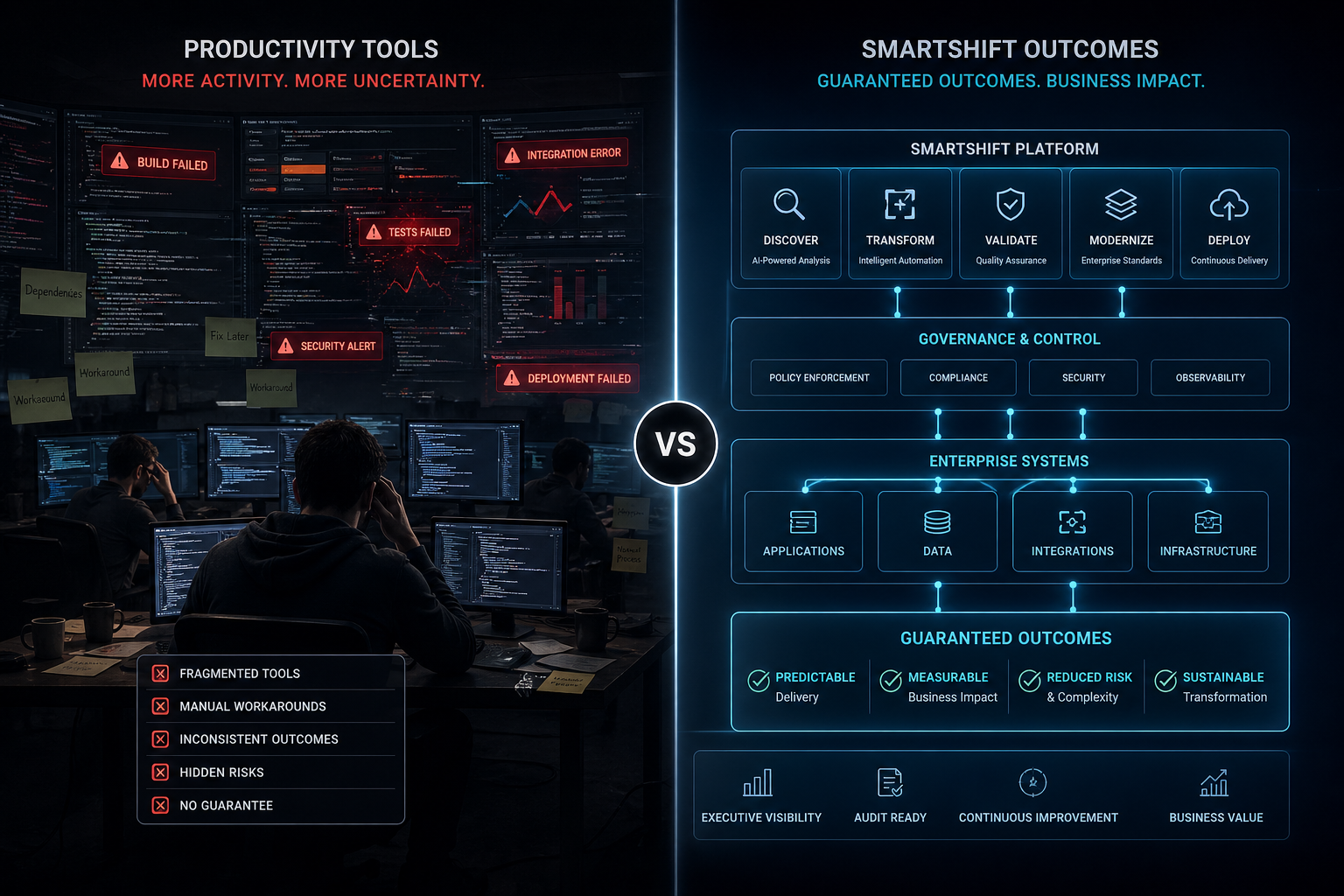
smartShift combines 20+ years of SAP custom code experience with repository-scale automation designed to deliver guaranteed business outcomes across the custom code lifecycle. Its outcome-based model includes fixed-price and fixed-timeline commitments, quality guarantees, and automation that addresses compatibility, performance, security, stability, modernization, and maintainability at scale. A Free Rapid Code Analysis gives teams repository-wide visibility into transformation requirements and potential scope before broader execution begins.
Conclusion
Choosing among SAP custom code transformation platforms requires more than comparing feature lists or AI claims. The strongest platform should provide repository-wide analysis, governed automation, evidence-based disposition guidance, built-in quality controls, alignment with clean core and ABAP Cloud standards, and a practical approach to business continuity.
These capabilities directly affect transformation speed, cost, delivery risk, and the manual effort required from internal teams. Buyers evaluating the best SAP custom code transformation platforms should ask each vendor to demonstrate measurable outcomes, explain how it governs automated changes, and show how the platform supports the full custom code lifecycle.
A disciplined evaluation process gives organizations greater confidence in their S/4HANA plans and a stronger foundation for future upgrades, modernization, and ongoing technical debt reduction.
Frequently Asked Questions
What role do SAP-native tools play in custom code transformation?
SAP-native tools such as the ABAP Test Cockpit and Custom Code Migration app provide essential scoping, usage, and compatibility checks within SAP’s recommended process. Enterprise-scale transformation adds repository-wide remediation, optimization, decommissioning, dependency management, governance, validation, and potentially dual maintenance. Buyers should evaluate how a platform complements SAP-native tooling and converts findings into governed transformation outcomes.
How long does automated custom code transformation take?
For smartShift, enterprise custom code transformations typically take four to six weeks, depending on scope and complexity. The broader S/4HANA program may run much longer. Buyers should ask every vendor to define repository scope, customer workload, timeline, validation responsibilities, and any conditions that can change the commitment before execution begins.
How should buyers compare fixed-price and time-and-materials transformation models?
Fixed-price delivery can be more economical when the provider identifies the full scope upfront and accepts accountability for delivery. Buyers should compare vendor fees, internal developer effort, testing requirements, potential change requests, timeline risk, and responsibility for defects.
What questions should I ask a prospective SAP custom code transformation partner?
Ask which issues are resolved automatically, what customer effort remains, how dependencies are analyzed, what SAP knowledge supports recommendations, how changes are traced and validated, and which outcomes are contractually guaranteed. Also request evidence for repository coverage, quality, timeline, price, clean core and ABAP Cloud readiness, dual maintenance, and comparable enterprise results.
As the Chief Technology Officer at smartShift, he brings over 25 years of experience in product strategy, SAP applications, and enterprise AI. Previously, he served as SAP's field CTO, where he worked with ISVs and channel partners to align complex technologies with market needs. He has earned multiple accolades, including the SAP Innovation Award (2005). His leadership roles across startups and large enterprises, along with recognition such as the Zinnov Start-up Beacon Award (2014), uniquely position him to drive innovation and growth at smartShift.
Topics: