AI-Powered SAP Modernization: Transforming Custom Code for S/4HANA
July 24th, 2026
7 min read

Anyone who has led an SAP modernization knows this: Complexity is the baseline. In today’s S/4HANA programs, decades of custom ABAP code, often spanning tens of thousands of objects and deeply embedded dependencies, have transformed a high-stakes enterprise challenge.
Yet many organizations still underestimate the scale. A human-first approach, even with strong internal teams, introduces delays, inconsistencies, and governance gaps that compound risk over time. The result is slower progress, more testing burden, and less confidence in the outcome.
This inflection point marks the shift to automation-first SAP modernization, changing the model and enabling organizations to transform entire custom codebases faster, with greater precision and control. Rather than treating code remediation as a labor-intensive workstream, leading organizations are adopting automation-first strategies that deliver predictable, governed transformation across the full codebase.
More importantly, with the right AI-enabled technology partner in place, modernization is becoming a continuous, lifecycle-driven capability guided by data, aligned with clean core principles, and built to support ongoing innovation.
In this article, we explore how AI-driven transformation is reshaping SAP modernization and what it means for risk, speed, and long-term business value.
What You’ll Learn
- Replace manual, developer-intensive remediation with automation-first transformation; modernizing entire ABAP landscapes with speed, precision, and guaranteed outcomes.
- AI adoption in SAP programs is accelerating as enterprises confront escalating code complexity, compressed S/4HANA timelines, and heightened pressure to reduce transformation risk.
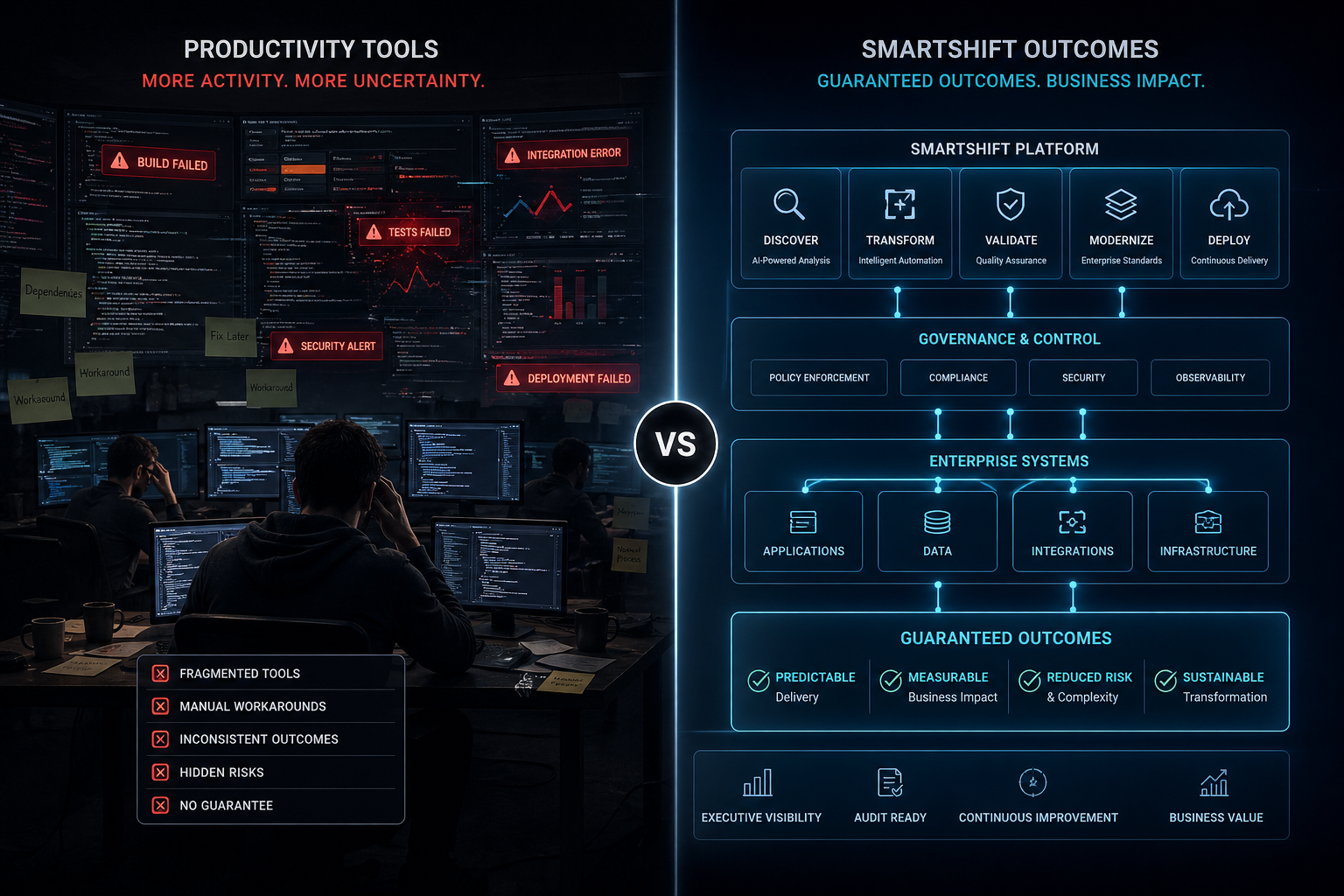
- Traditional tools surface issues but stop short of resolution, leaving organizations to manage dependencies, rework, and execution risk manually.
- Intelligent Automation analyzes dependencies across the SAP custom codebase to enable accurate, end-to-end transformation at enterprise scale.
- Why enterprise-grade AI requires governance, traceability, and domain-specific data foundations to reduce risk and support accountable execution.
- The measurable business impact of intelligent automation includes faster S/4HANA readiness, reduced remediation cycles, lower regression risk, and a clearer path to clean core and continuous modernization.
What Is AI-Powered SAP Modernization?
AI-powered SAP modernization is the use of intelligent automation to analyze, understand, and transform SAP custom code at scale. Instead of relying on manual effort or basic code-scanning tools, it applies domain-specific intelligence to interpret how custom ABAP code behaves, identify dependencies, and transform that code for modern SAP environments such as S/4HANA.
At its core, AI-powered SAP modernization combines deep code analysis with contextual decision-making across programs, data structures, interfaces, and business processes, enabling accurate transformation of the entire codebase.
This approach allows organizations to move beyond fragmented remediation efforts toward a structured, end-to-end modernization strategy. By automating both analysis and execution, it can consistently transform large volumes of custom code, reduce human variability, and support alignment with modern SAP standards such as clean core and ABAP Cloud.
The Rapid Rise of AI in SAP Modernization Programs
AI-powered SAP modernization is gaining traction as enterprises confront the realities of large-scale S/4HANA transformation programs. The volume of custom ABAP code, deeply interconnected dependencies, and compressed upgrade timelines has pushed traditional approaches to their limits. Organizations can no longer rely solely on manual remediation or static tools. They need scalable, governed automation that reduces risk while accelerating delivery.
This moment is the moment when AI for SAP custom code becomes meaningful. Its value is not just faster analysis. It is more consistent decision-making and more scalable execution across complex SAP landscapes. It addresses core enterprise pressures: managing massive codebases, minimizing business disruption, and meeting aggressive transformation deadlines with greater predictability.
At the same time, the broader SAP ecosystem is moving in this direction. From AI embedded in SAP’s own roadmap to emerging AI agents for SAP, the shift is industry-wide. AI for ABAP is becoming part of the modernization conversation, but enterprise buyers still need to distinguish between developer assistance and governed transformation outcomes.
As a result, AI-powered SAP modernization is quickly becoming the standard for organizations seeking faster, safer, and more predictable transformation outcomes.
From Manual Remediation to AI-Driven SAP Modernization
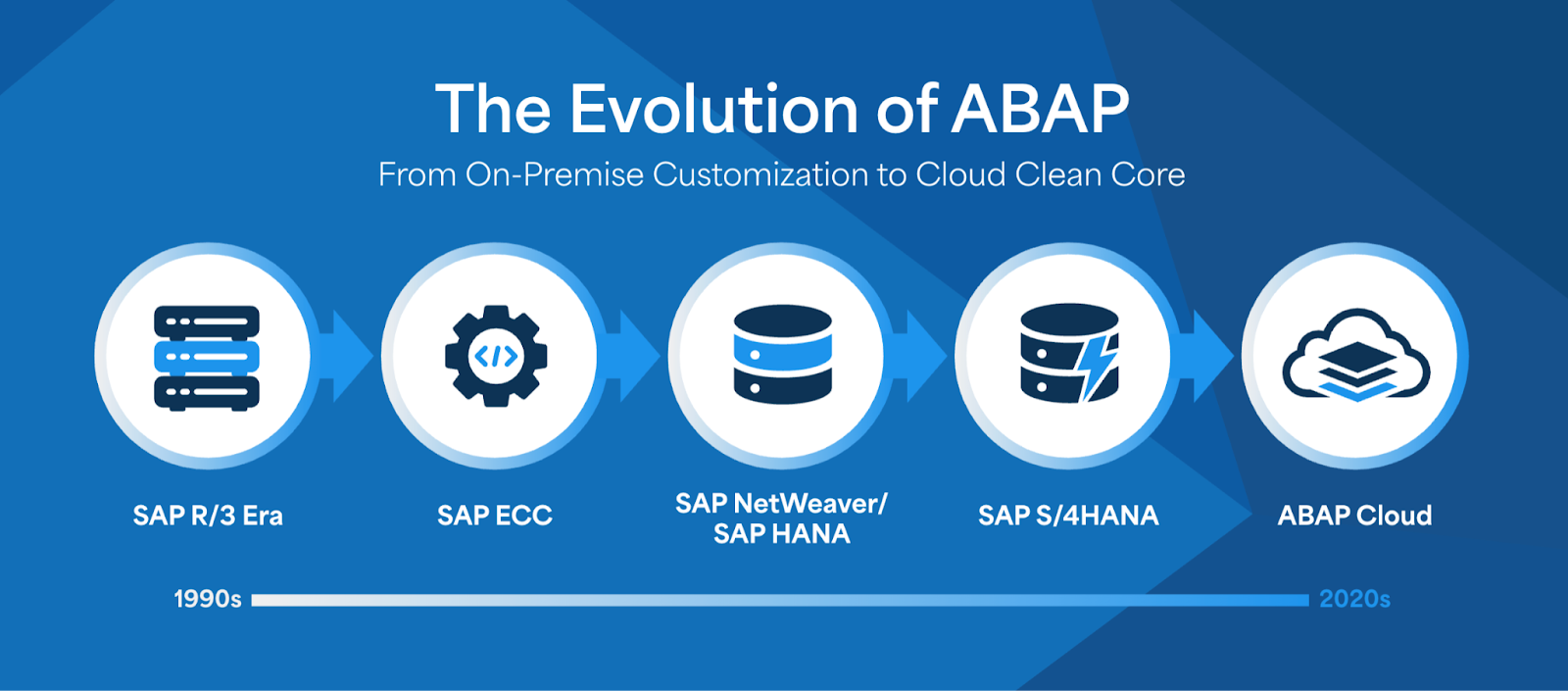
For years, SAP custom code remediation has been a manual, developer-intensive effort. Teams relied on large groups of ABAP developers to analyze code, interpret findings, and implement fixes across thousands of objects, often over months or years. Tools like ATC and code scans helped identify issues, but they remained diagnostic rather than outcome-driven. They flagged problems without understanding context, dependencies, or the correct path to resolution.
This approach creates clear limitations. Manual remediation is slow, difficult to scale, and highly dependent on individual expertise and available bandwidth. In large SAP environments with thousands of interconnected custom objects, maintaining consistency and avoiding errors becomes increasingly challenging. The result is longer timelines, higher costs, and elevated risk during S/4HANA upgrades.
AI-powered SAP modernization changes this model. By applying AI for SAP custom code and AI for ABAP within a governed automation framework, organizations can move from fragmented manual effort to end-to-end transformation at scale. AI agents for SAP bring dependency awareness, contextual reasoning, and repeatable execution across the entire codebase.
The Role of AI Agents in SAP Custom Code Modernization
AI agents for SAP are becoming central to modern, scalable transformation strategies. Unlike traditional tools, these agents go beyond surface-level analysis to evaluate custom ABAP code, its behavior, its dependencies, and its role within the broader SAP landscape.
Using AI for SAP custom code, these agents analyze the entire custom codebase rather than isolated objects. They map dependencies across programs, tables, interfaces, enhancements, and business processes, creating a comprehensive view of how custom logic operates across the environment. This dependency awareness is critical because even small changes in ABAP can create cascading impacts across the system.
AI for ABAP also enables more contextual decision-making. Instead of simply flagging issues, AI agents help determine whether an object should be remediated, optimized, decommissioned, retained, or adapted to align with S/4HANA and clean core principles.
The result is a more complete, end-to-end approach to AI-powered SAP modernization. By combining deep analysis with automated execution, AI agents for SAP support transformations that are more accurate, more consistent, and better aligned to both technical requirements and business outcomes at enterprise scale.
Understanding the Risks of AI in SAP Custom Code Modernization
While AI-powered SAP modernization offers clear advantages, it also introduces risks that enterprises cannot afford to ignore, especially in complex, business-critical SAP environments.
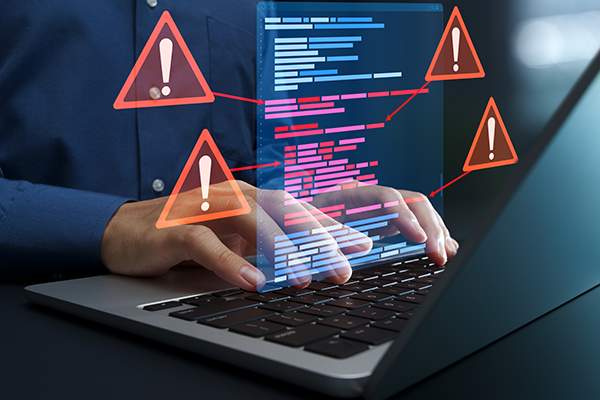
One of the biggest concerns is hallucination. Generic AI models can generate plausible but incorrect outputs, such as suggesting non-existent SAP objects, misreading ABAP logic, or recommending changes without a full system context. In the context of AI for SAP custom code, even small inaccuracies can cascade into larger system issues, regression risk, or failed S/4HANA outcomes.
Governance is another challenge. Without structured controls, transparency, and validation, AI-driven changes can lack auditability, making outcomes harder to trust, verify, and defend internally. This clarity is especially critical in regulated industries, where traceability and auditable documentation are mandatory.
There are also security implications. AI models that lack proper data boundaries or rely on incomplete context can expose sensitive logic, miss insecure legacy patterns, or introduce new vulnerabilities during transformation.
Effective AI for ABAP requires more than model intelligence. It requires deep SAP knowledge, curated transformation data, and governed execution. AI agents for SAP must be grounded in real transformation experience to support safe, reliable, enterprise-ready outcomes.
The Business Impact of AI-Powered SAP Modernization
The real value of AI-powered SAP modernization is not technical novelty. It is a measurable business impact. By applying AI for SAP custom code within an automation-first model, organizations can accelerate S/4HANA readiness, compress remediation timelines, and improve confidence in delivery.
For example, companies like Potters Industries transformed more than 20 years of ABAP custom code to S/4HANA in 4 weeks, saved an estimated 960 developer days, and required adjustments to only 2 of 4,783 transformed custom objects. AI for ABAP helps reduce remediation cycles by automating analysis and execution, while lowering regression risk through more consistent, dependency-aware transformations. At the same time, AI agents for SAP support clean core alignment by helping organizations retire unused code, modernize what remains, and reduce the custom footprint they carry into future upgrades.
Perhaps most importantly, this approach enables continuous modernization, not just a one-time upgrade. Instead of treating transformation as a single project milestone, enterprises gain an ongoing capability to manage upgrades, reduce technical debt, and evolve their SAP landscape with greater speed, precision, and confidence.
How smartShift Delivers 99.99% Automation Accuracy in SAP Modernization
smartShift’s approach is fundamentally different from generic AI developer assist tools. It is built on patented Intelligent Automation®, combining decades of SAP transformation expertise with proven execution at enterprise scale, rather than relying on probabilistic outputs or code suggestions.
At its core, smartShift applies a library of 250+ transformation rules and structured SAP knowledge to analyze and remediate custom ABAP code across the full codebase at scale. This deterministic approach is designed to systematically evaluate dependencies, objects, and interactions, closing the gaps left by traditional analysis tools and assistive AI workflows.
Rather than relying solely on pattern recognition, smartShift applies validated transformation logic refined through real-world SAP programs. This approach supports precise, end-to-end execution across highly customized SAP landscapes with far less dependence on manual intervention.
Equally important, every transformation operates within a controlled, outcome-driven framework. With traceability, built-in validation, and fixed-price, fixed-timeline delivery, organizations gain more predictability and accountability.
The result is consistent, repeatable modernization with 99.99% automation accuracy, delivering cleaner, more stable, S/4HANA-ready code aligned with clean core principles at enterprise scale.
Final Thoughts
SAP modernization is now a strategic business transformation, not just a technical upgrade. The shift from manual remediation to AI-powered SAP modernization marks a turning point for enterprises navigating complex S/4HANA programs. What once required months of developer effort can now be transformed with greater scale, consistency, and control using AI for SAP custom code and AI for ABAP.
As SAP landscapes continue to grow in complexity, relying on manual processes or limited tools is no longer sustainable. Organizations need precision, speed, and confidence, especially when business continuity, delivery timelines, and future upgrade readiness are at stake. This reality exemplifies where AI agents for SAP deliver real value, enabling a transformation that is not only faster but also better governed, more auditable, and more aligned with clean core principles.
AI-powered SAP modernization is quickly becoming a strategic necessity. Enterprises that adopt this approach gain a clear advantage: reduced risk, more predictable outcomes, and the ability to continuously modernize their systems.
Looking ahead, intelligent, automation-first SAP modernization will define the future standard. The question is not whether enterprises need this capability, but how quickly they can operationalize it to stay competitive.
FAQs
How does AI analyze dependencies across SAP custom objects?
smartShift uses patented Intelligent Automation® to analyze the full custom code landscape, not just isolated objects. By applying transformation rules and structured SAP knowledge, it identifies and resolves dependencies across programs, data structures, enhancements, and integrations. The result is a complete, system-wide understanding that enables accurate, end-to-end transformation without missed relationships or downstream issues.
How does AI improve decision-making during SAP transformation programs?
smartShift provides visibility into the codebase, quantifying scope, complexity, and risk before transformation begins. This data-driven insight allows CIOs and SAP leaders to plan with precision, align stakeholders, and avoid costly surprises. Instead of relying on assumptions, decisions are based on complete, actionable intelligence.
Can AI reduce S/4HANA upgrade timelines?
Yes. By automating the most labor-intensive aspects of code remediation, smartShift can significantly shorten remediation timelines, in some cases reducing them from months to weeks. Automation eliminates manual bottlenecks, reduces rework, and enables parallel execution, accelerating time to S/4HANA readiness without compromising quality.
Does AI-powered modernization require changes to the SAP system architecture?
Not necessarily. smartShift works within the existing SAP landscape to transform custom code for S/4HANA compatibility while supporting alignment with clean core principles and, where applicable, the ABAP Cloud development model. Broader modernization programs may involve architectural decisions around extensibility, released APIs, or SAP BTP. Still, smartShift’s custom code transformation does not require a wholesale redesign of the SAP architecture or disruption to core business processes.
Is AI replacing SAP developers in modernization projects?
No. smartShift augments your SAP team by automating repetitive, high-volume remediation work. This frees developers to focus on innovation, architecture, and business-critical enhancements rather than manual code fixes.
Can AI support compliance and audit requirements in SAP modernization?
Yes. smartShift delivers traceable, auditable transformations with deterministic logic and built-in validation, helping support enterprise governance, compliance, and audit readiness. Every change is documented and controlled, supporting compliance requirements and providing the transparency needed for enterprise governance and audit readiness.
As the Chief Technology Officer at smartShift, he brings over 25 years of experience in product strategy, SAP applications, and enterprise AI. Previously, he served as SAP's field CTO, where he worked with ISVs and channel partners to align complex technologies with market needs. He has earned multiple accolades, including the SAP Innovation Award (2005). His leadership roles across startups and large enterprises, along with recognition such as the Zinnov Start-up Beacon Award (2014), uniquely position him to drive innovation and growth at smartShift.
Topics: