TL;DR: AI developer assist tools can help developers create, analyze, document, and remediate ABAP code faster. But SAP custom code lifecycle management is an enterprise-scale challenge that requires full codebase visibility, consistent transformation, governance, and long-term compatibility across ECC to S/4HANA, S/4-to-S/4 upgrades, clean core initiatives, ABAP Cloud readiness, and technical debt reduction. smartShift applies automation-first SAP custom code transformation across the full custom codebase, with fixed pricing, fixed timelines, and guaranteed quality.
Introduction
Artificial intelligence is rapidly changing how software gets built, tested, and maintained. SAP environments are no exception. A growing number of AI developer assist tools now promise to help teams create, analyze, document, and remediate ABAP code faster.
That can be useful.
But for enterprise SAP teams, the bigger question is not whether AI can help a developer work faster.
The bigger question is whether it can support SAP custom code lifecycle management by helping an organization analyze, transform, govern, and continuously manage SAP custom code across ECC to S/4HANA transformations, S/4-to-S/4 upgrades, clean core initiatives, and long-term technical debt reduction.
That is where the difference between AI developer assist tools and smartShift becomes clear.
What is the Difference Between AI Developer Assist Tools and smartShift?
At a high level, AI developer assist tools and smartShift may appear to overlap in the broad category of modernizing ABAP more quickly. They serve different purposes.
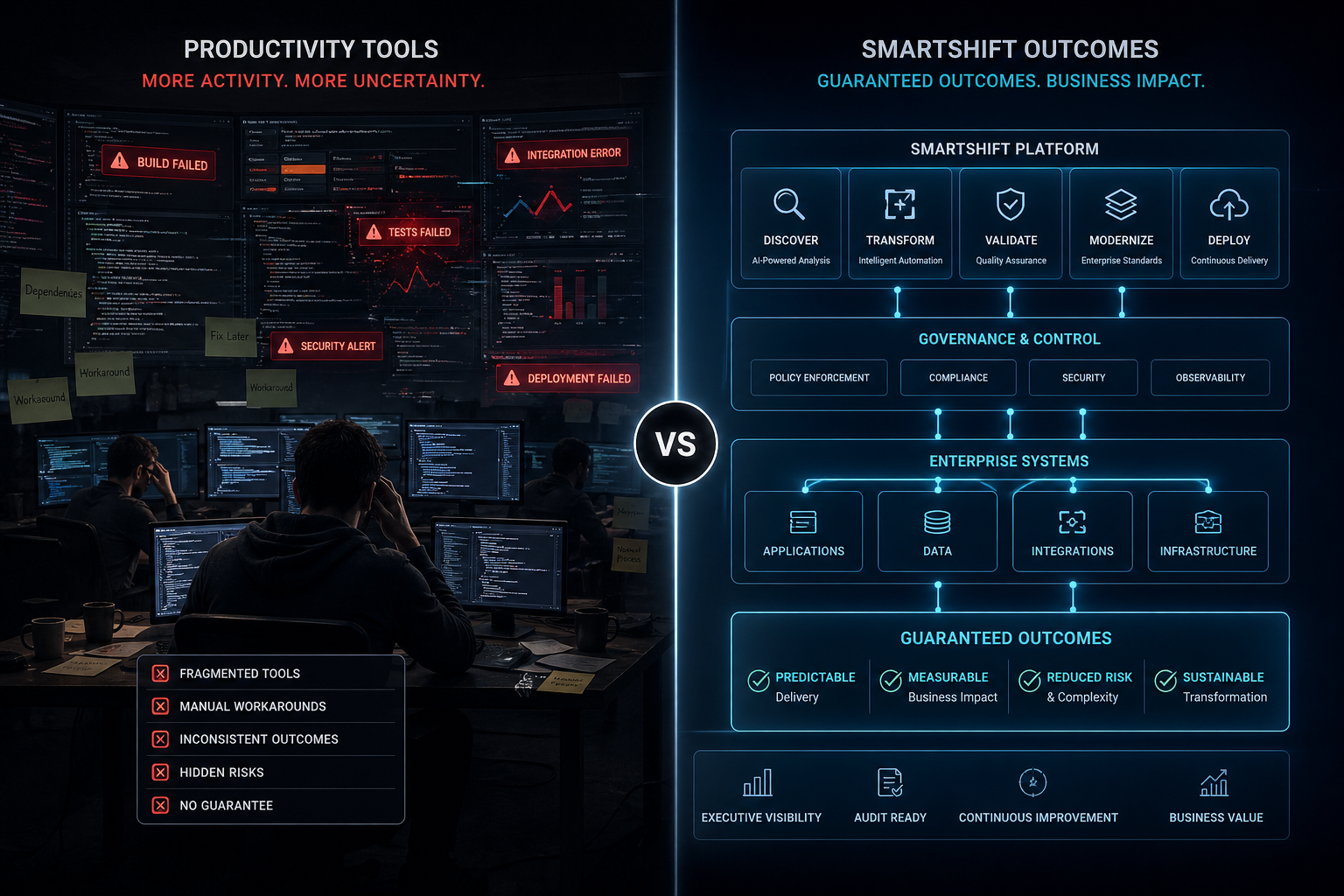
AI developer assist tools are built primarily to improve developer productivity. They help teams work faster on selective, user-driven, object-level tasks such as code generation, documentation, analysis, testing support, and remediation. With these tools, the judgment of what to transform and how to transform it ultimately sits with the developer. Outcomes vary based on individual interpretation, experience, and execution.
smartShift is built for SAP custom code lifecycle management at enterprise scale. With smartShift, transformation logic, SAP modernization experience, and quality controls are embedded within the automation itself, driving consistent, repeatable results across the full custom codebase without dependence on the caliber or availability of individual developers.
According to smartShift’s comparison framework, developer assist tools are centered on selective, user-driven, object-level work with manual review and no fixed commercial accountability. smartShift is positioned around full-codebase transformation, automated remediation, fixed price, fixed timeline, and guaranteed quality.
That difference matters a great deal in SAP.
|
Category |
AI Developer Assist Tools |
smartShift Intelligence Platform |
|---|---|---|
|
Primary focus |
Developer productivity |
Enterprise lifecycle outcomes |
|
Business model |
Tool subscription |
Outcome-based automation delivery |
|
Scope |
Top-priority issues only |
All identified in-scope issues addressed |
|
Scale |
One object at a time |
Entire SAP custom codebase |
|
Coverage |
Selective and user-driven |
All custom code issues are addressed by default |
|
Validation |
Manual review required |
Automated, comprehensive remediation |
|
Risk model |
Assistive and human-dependent |
Outcome-driven with guaranteed quality |
|
Upgrade readiness |
Depends on manual validation |
Continuous compatibility engineered |
|
Confidence in AI |
Confidence remains in the people delivering the outcome |
Agentic automation based on decades of gathered SAP context drives confidence, SLAs, and contractual guarantees |
|
Accountability |
Cannot be confirmed until all issues are identified |
Contracted, predictable outcomes |
|
Time guarantees |
None. Issues are identified manually over time. |
Fixed timeline, with all issues identified upfront |
|
Price guarantee |
None. Manual work is time- and materials-driven, and unforeseen issues can trigger change requests. |
Fixed price, with all issues identified upfront |
An AI developer assistant says, “We can help your developers fix code faster.”
smartShift says, “We can help you modernize and manage SAP custom code with automation-first transformation and guaranteed quality across the full lifecycle.”
That positioning aligns with smartShift’s broader promise to help enterprises keep SAP custom code compatible, secure, optimized, and ready for future change across ECC to S/4HANA transformations, S/4HANA version upgrades, and clean core enablement.
The Difference Between Assistance and Outcomes
AI developer assist tools are designed to support individual or team-based workflows. They can help developers with the generation of new code, testing support, documentation, issue review, and iterative remediation. Their center of gravity is productivity.
smartShift is designed differently.
smartShift is not a coding assistant or a developer copilot. It is an automation-first platform for enterprise-scale SAP custom code analysis, transformation, optimization, decommissioning, synchronization, and ongoing lifecycle management. Its focus is not simply helping a developer work faster. Its focus is on helping an enterprise modernize and continuously manage SAP custom code with predictable business outcomes.
That means the conversation shifts from code suggestions to codebase outcomes.
It shifts from selective remediation to broad coverage.
It shifts from manual validation and time-and-material uncertainty to guaranteed delivery with contractual accountability.
For SAP teams under pressure to modernize, upgrade, and reduce long-term technical debt, that is the difference between accelerating effort and delivering results.
Why Is SAP Custom Code a Lifecycle Management Challenge?
SAP custom code is a lifecycle management problem because transformation requirements repeat with every upgrade, security requirement, compliance need, and platform evolution. Without a continuous strategy for SAP custom code lifecycle management, organizations end up in a recurring cycle of manual rework across ECC to S/4HANA transformations, S/4-to-S/4 upgrades, clean core initiatives, ABAP Cloud readiness, carve-outs, consolidations, and security initiatives.
One of the biggest mistakes in SAP modernization is treating custom code as a one-time remediation event tied to a single milestone.
First, it is ECC to S/4HANA.
Then it is clean core readiness.
Then it is ABAP Cloud readiness.
Then it is the next S/4-to-S/4 upgrade.
Then it is a carve-out, a consolidation, a security initiative, or a compliance requirement.
Then it is another upgrade.
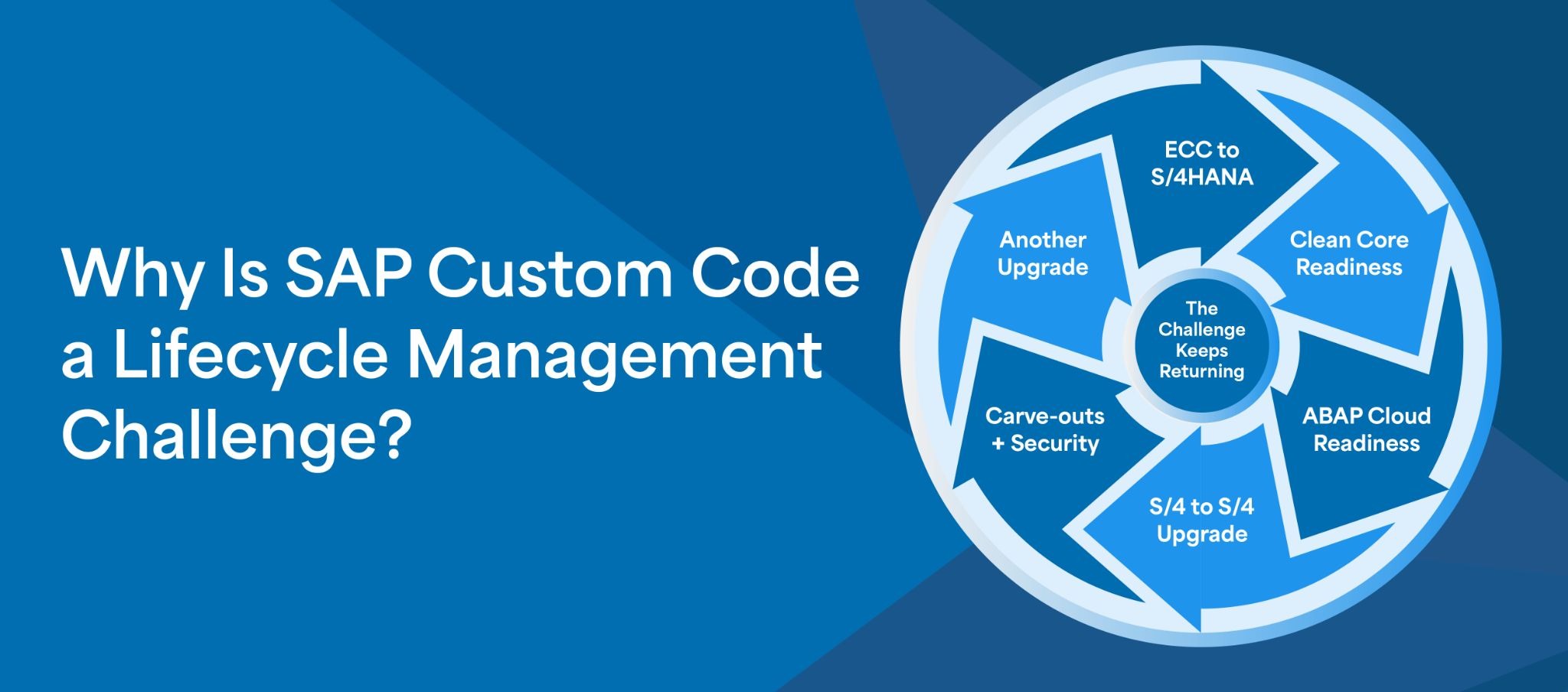
The problem keeps returning because custom code is not a single-event challenge. It is an ongoing lifecycle management challenge.
With decades of SAP custom code transformation experience, smartShift is built to manage the full custom code lifecycle.
It begins with visibility. smartShift Code Analysis provides a complete view of the SAP custom code landscape, including code inventory, issue identification across compatibility, performance, stability, security, and modernization readiness, and actionable readouts to support planning.
It continues with transformation. smartShift Code Transformation modernizes the full custom ABAP codebase with automation that addresses compatibility, security, performance, and stability issues across millions of lines of code.
It extends into decommissioning, where obsolete custom code can be identified and safely retired to reduce scope, risk, and cost. smartShift customers often find significant opportunities to retire unused custom code without disrupting business processes.
It also includes Dual Maintenance, which helps keep ECC and S/4HANA systems aligned during active transformation so organizations can continue business-as-usual development without extended freezes.
And it reaches forward into clean core and ABAP Cloud enablement, where legacy custom code must be modernized to align with SAP’s latest extensibility and development standards.
That is a fundamentally different value proposition than AI-assisted coding.
AI assistance can accelerate individual tasks. SAP custom code lifecycle management enables enterprises to control the future state of the SAP environment.
Why S/4-to-S/4 Upgrades Matter More Than Most Teams Expect
It is easy to assume that once an organization gets from ECC to S/4HANA, the hardest custom code work is behind it.
In reality, that is often where the next phase begins.
S/4-to-S/4 upgrades are one of the clearest examples of why SAP custom code lifecycle management matters. Every new release introduces updated standards, extensibility models, security expectations, and modernization requirements that can impact custom code. If teams treat every upgrade as a deadline-driven cleanup exercise, they end up in a cycle of recurring remediation, repeated testing, persistent technical debt, and growing operational drag.
smartShift’s approach to S/4HANA version upgrades is built around a broader opportunity. Rather than helping customers do the bare minimum to reach the next release, smartShift helps them use the same upgrade window to modernize custom code, improve stability, improve security, reduce obsolete code, and lay the foundation for future upgrades, clean core readiness, and SAP BTP adoption.
If a vendor only helps developers resolve isolated code issues, it may support the immediate upgrade task. But it does not necessarily improve upgrade readiness over time.
smartShift’s value in S/4-to-S/4 is bigger than remediation. It helps enterprises make upgrades more repeatable, predictable, and easier to manage year after year. That is where SAP custom code lifecycle management becomes a strategic advantage, not just a technical workstream.
Custom Code Lifecycle Management Helps Control SAP Technical Debt
Technical debt in SAP is not abstract.
It shows up as obsolete code that keeps getting carried forward. It shows up as undocumented logic teams are reluctant to change. It shows up as custom fields, reports, interfaces, and dependencies, all of which complicate modernization. It shows up as insecure code that creates risk during cloud and upgrade initiatives. It shows up as repetitive manual rework every time SAP evolves.
In many SAP environments, a significant share of technical debt is embedded in the custom code layer.
That is why SAP custom code lifecycle management should also be understood as a practical strategy for managing technical debt over time.
Without a systematic approach to analyzing, transforming, securing, and, where appropriate, safely retiring custom code, technical debt keeps compounding. It increases the upgrade project scope. It stretches testing cycles. It raises maintenance costs. It limits innovation. It makes clean core harder to achieve. It forces enterprises to keep paying for decades of accumulated custom code in every future transformation.
smartShift helps address that broader challenge across multiple dimensions.
Code Analysis gives teams visibility into where risk and complexity exist.
Code Transformation modernizes what must move forward.
Code Decommissioning removes obsolete code that no longer creates business value and only adds cost, risk, and drag.
Code Security helps eliminate vulnerabilities buried in legacy custom ABAP.
ABAP Cloud Enablement helps align custom code with SAP’s latest cloud-ready development standards.
Dual Maintenance helps organizations avoid creating more debt and disruption during major transformation programs.
S/4HANA Version Upgrade automation helps prevent unresolved technical debt from being carried forward into every future release.
Together, these capabilities create a lifecycle strategy to reduce, control, and prevent technical debt in SAP custom code over time.
The Real Limitation of AI Developer Assist Tools
AI developer assist tools can help developers work more efficiently. That is valuable, especially for teams under pressure to create, analyze, document, and remediate ABAP code faster.
For enterprise SAP teams, the risk is confusing developer productivity with enterprise modernization.
AI developer assist tools are often narrower than the SAP custom code lifecycle management challenge they are asked to solve. They may accelerate individual tasks, but the broader enterprise problem still requires full-codebase visibility, consistent transformation, governance, accountability, and long-term compatibility.
They are often human-dependent. A person still has to decide what to fix, validate outputs, resolve ambiguity, absorb risk, and manage the delivery burden. smartShift’s comparison framework makes this distinction explicit by contrasting manual review and assistive workflows with automated, comprehensive remediation and guaranteed quality.
They are often selective rather than comprehensive. Instead of addressing the whole custom code estate, they may focus on top-priority issues, specific objects, or developer-led remediation flows. smartShift’s platform story is different: full codebase transformation, mass remediation at scale, and continuous compatibility engineered throughout the lifecycle.
They do not solve accountability on their own. A tool can generate output, but it does not necessarily own the commercial model, the delivery timeline, or the quality guarantee. smartShift is explicitly positioned around fixed price, fixed timeline, predictable delivery, and guaranteed quality.
They also do not inherently solve technical debt lifecycle challenges. Even when developers work faster, obsolete code, hidden dependencies, security risks, and upgrade blockers may remain in the environment.
That is the risk.
An organization can feel like it is modernizing because developers are moving faster, while the actual SAP custom code estate remains complex, costly, and difficult to carry forward.
smartShift’s Approach: Automation First, AI Where It Improves the Outcome
smartShift takes a different approach because it starts with automation, governance, and enterprise outcomes.
Its foundation is an automation-first transformation built on decades of experience in SAP custom code modernization. AI is part of the value story, but it is applied inside a governed system built for enterprise-scale execution, compatibility, quality, and predictable delivery.
That matters because enterprise SAP modernization is about more than writing better code. It is about controlling risk, improving speed, reducing rework, and making future change easier.
It is also why smartShift fits naturally into the broader idea of continuous custom code management. SAP custom code management is not a single point-in-time challenge. It requires a continuous, strategic plan for visibility, transformation, decommissioning, security, compatibility, and ongoing modernization.
That is the difference between a developer productivity tool and an enterprise lifecycle approach.
A developer assist tool can help a person complete a task faster.
An automation-first lifecycle approach helps an organization manage the custom code layer with the scale, consistency, and accountability required for long-term SAP modernization.
The Bottom Line
AI developer assist tools can help developers work faster.
smartShift helps enterprises modernize, manage, and keep SAP custom code ready for future change across its full lifecycle.
That includes ECC to S/4HANA.
It includes S/4-to-S/4 upgrades.
It includes clean core readiness.
It includes ABAP Cloud readiness.
It includes decommissioning obsolete code.
It includes reducing, controlling, and preventing technical debt in SAP custom code over time.
For enterprise SAP teams, that is the real dividing line in the market.
For enterprise SAP teams, the market distinction comes down to who can help control the custom code layer with enough depth, scale, governance, and accountability to support long-term modernization.
smartShift was built for that.
Frequently Asked Questions
What is SAP custom code lifecycle management?
SAP custom code lifecycle management is the ongoing process of analyzing, transforming, securing, retiring, and modernizing SAP custom code as business needs, SAP standards, and platform requirements change.
How does SAP Dual Maintenance relate to custom code lifecycle management?
Dual Maintenance helps keep ECC and S/4HANA landscapes aligned during transformation. It supports custom code lifecycle management by reducing code freezes, preserving business-as-usual development, and helping ensure new ECC changes are reflected in the S/4HANA project system before go-live.
Can AI developer assist tools replace a dedicated SAP custom code management platform?
AI developer assist tools can help developers work faster on individual tasks. Enterprise SAP custom code management requires broader capabilities, including full-codebase visibility, automated transformation, governance, validation, accountability, and long-term compatibility across upgrades and modernization initiatives.
How does smartShift make S/4HANA upgrades easier over time?
smartShift helps enterprises move beyond one-time remediation by continuously improving custom code quality, reducing obsolete code, addressing security and performance issues, and engineering compatibility for future S/4HANA upgrades, clean core readiness, and ABAP Cloud enablement.
Topics: