How to Reduce S/4HANA Migration Risk in 2026
July 10th, 2026
15 min read

Your S/4HANA migration carries risk that lives in places you may not be watching closely enough. Pricing rules, approval workflows, fulfillment logic, and compliance checks often sit inside years of legacy custom ABAP code, user exits, and Z-developments. smartShift helps enterprise SAP leaders future-proof their SAP custom code. Our patented Intelligent Automation® platform transforms entire codebases at scale, delivering clean, stable, and upgrade-ready code with guaranteed target-version compatibility.
This guide walks you through the specific risks that derail S/4HANA migrations, how automated custom code analysis surfaces hidden issues, and what remediation strategies actually work at enterprise scale. You'll find practical steps for assessing your current codebase, operationalizing Clean Core principles, and building a foundation that supports both your immediate migration and frictionless future upgrades.
Key Takeaways: How to Reduce S/4HANA Migration Risk in 2026
- Custom code is your competitive edge, not just technical debt. It carries vital institutional knowledge and unique business logic that SAP's standard analysis tools miss, making full-codebase visibility essential before migration.
- Automated code analysis eliminates the "unknowns." By scanning 100% of your ABAP code—not just a manual sample—smartShift identifies every deep dependency, performance risk, and incompatibility to size your project with absolute precision.
- We guarantee the outcome, not just the effort. smartShift delivers code transformation under a fixed-price, fixed-timeline contract with 99.99% accuracy, reducing your post-migration testing burden by up to 75%.
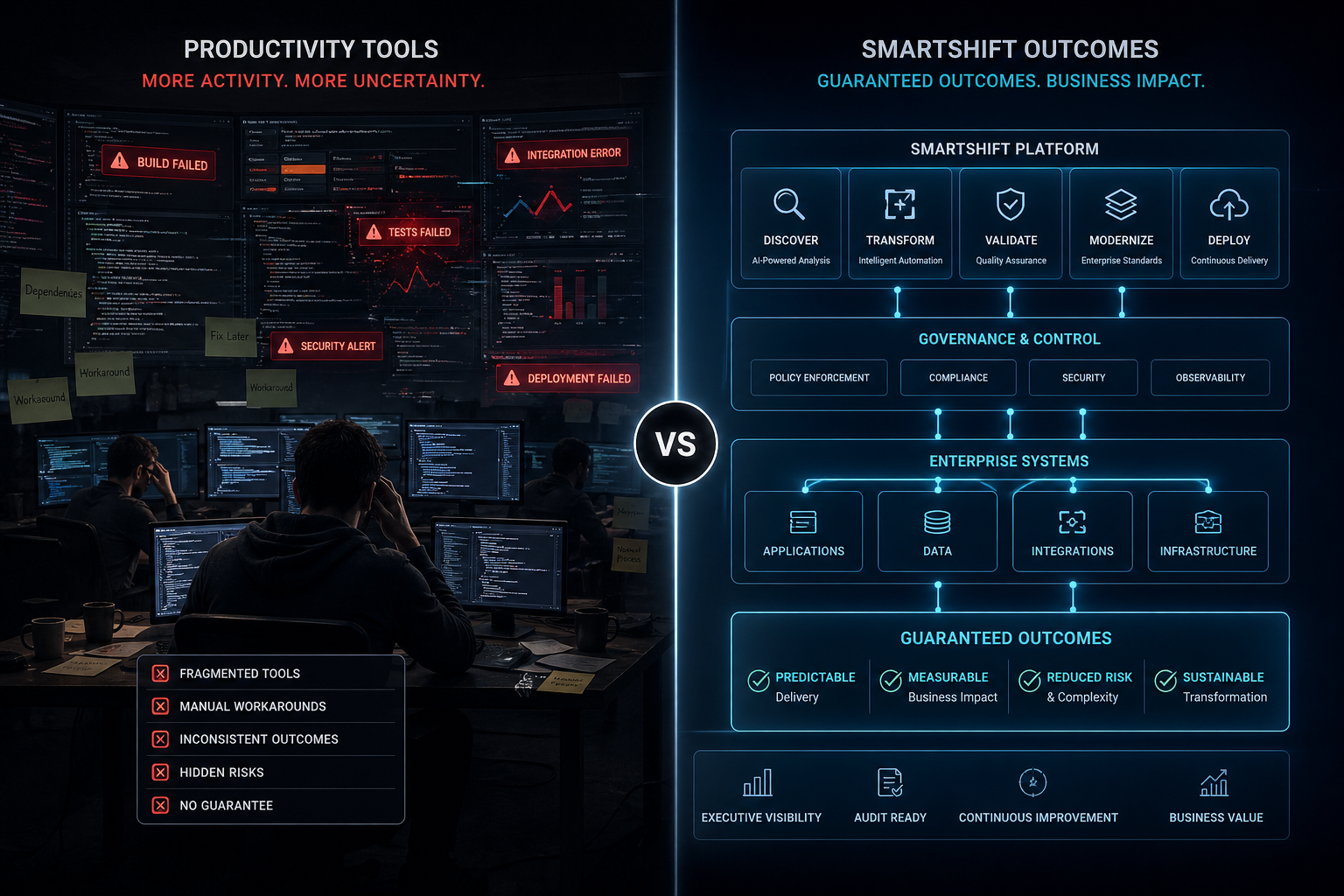
- Modernization requires execution, not recommendations. Lightweight tools and generic AI developer assistants require constant human oversight and introduce high error rates. Enterprise-scale SAP conversions demand a proven, deterministic platform that takes full accountability for delivering production-ready code.
What Makes S/4HANA Migration Risky in the First Place?
S/4HANA introduces fundamental changes to how SAP handles data, processes transactions, and structures business logic. The simplified data model eliminates aggregate tables that ECC custom code often relied upon.
Your custom programs may reference these deprecated structures directly. When they do, migration doesn't just require adaptation—it requires redesign. The risk isn't theoretical. Custom code that worked reliably in ECC can fail silently in S/4HANA, producing incorrect reports or processing errors that surface during financial close or customer-facing operations.
The Business Partner framework creates additional complexity.
Why Custom Code Creates the Biggest Migration Blind Spots
Many enterprise SAP environments contain more custom code than SAP delivers out of the box. Over years of operation, development teams have built pricing routines, approval workflows, compliance checks, and industry-specific processes directly into the ABAP layer. This code carries institutional knowledge that may not exist anywhere else.
Standard SAP migration analysis flags obvious incompatibilities. It does not evaluate whether your custom logic still delivers the business outcomes you need in S/4HANA's architecture. A Z-report built to aggregate data from COEP may continue to compile, but the data it retrieves through compatibility views may be incomplete or structured differently than expected.
The real risk isn't code that fails to run. The real risk is code that runs and produces outputs that look correct until downstream issues emerge. Those issues often surface at the worst possible time—during financial close, regulatory reporting, or customer fulfillment cycles.
How Does Automated Custom Code Analysis Reduce Risk?
Automated analysis scans your entire ABAP codebase against S/4HANA compatibility rules tailored to enterprise modernization. Unlike manual review, automation examines every program, function module, include, and enhancement systematically. Nothing gets skipped because of time pressure or resource constraints.
The smartShift approach analyzes 100% of your custom code and delivers clear reports showing what needs transformation, what is obsolete and can be safely removed, and what requires redesign.
Automated analysis also creates documentation that often doesn't exist for legacy code. When your team understands what each custom program does and how it interacts with SAP standard functionality, migration planning becomes more accurate, and remediation becomes more efficient.
What Specific Issues Does Automated Analysis Detect?
Automated scanning identifies several categories of compatibility issues that affect S/4HANA readiness. Deprecated table references rank among the most common findings. Programs that read from or write to tables eliminated or merged in S/4HANA require targeted rework before migration.
Field length changes create subtle but significant problems. For example, standard material numbers now support 40 characters instead of 18. Custom validations, interface mappings, and conversion routines built around legacy field lengths can truncate data, corrupt integrations, or fail system validation checks.
Function modules and transaction codes tied to classic ECC functionality may no longer exist in the target system. Custom processes built around these deprecated components require redesign using S/4HANA-approved APIs and methods. Automated analysis flags these deep dependencies before they become production-stopping issues.
What Is Clean Core and Why Does It Matter for Migration Risk?
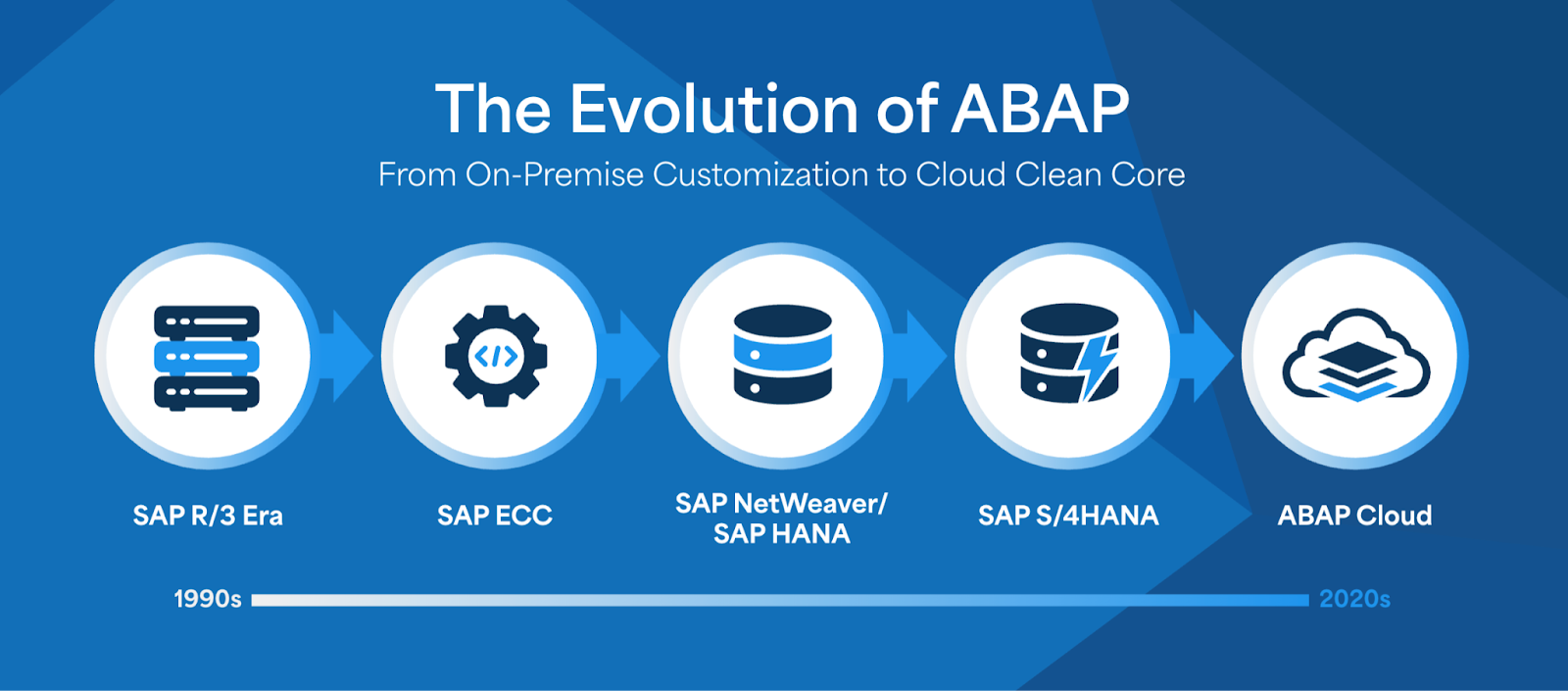
Clean Core represents SAP's modern design standard for keeping your central ERP system close to its standard, unmodified state. Instead of embedding customizations directly into standard code, Clean Core practices push enhancements to designated, upgrade-stable extension points—such as BADIs, CDS views, released APIs, or side-by-side applications on SAP Business Technology Platform (BTP).
This separation matters for migration risk because it determines how much costly rework future upgrades will require. Code embedded directly in standard SAP standard code creates friction with every system update. In contrast, custom code built through modern extension points remains stable and insulated across upgrades.
During your S/4HANA migration, you have a one-time opportunity to align your legacy custom code with Clean Core principles. This alignment adds structured analysis upfront but dramatically reduces the total cost of ownership (TCO) over your system's lifecycle. Each future SAP upgrade becomes faster, less risky, and less resource-intensive.
How Do Extensibility Models Affect Your S/4HANA Strategy?
SAP and smartShift classify custom developments based on how they couple to standard SAP functionality and whether they are upgrade-safe. During our Clean Core Analysis, custom code is mapped against a 4-Quadrant Cloud Readiness Matrix to help determine its future-state path:
- Side-by-Side Extensions: Built on SAP BTP, these custom applications and integrations sit completely outside the central ERP standard, making them fully loosely coupled and upgrade-stable.
- In-App / Key User Extensions: Upgrade-safe customizations created directly on the SAP stack using designated Fiori apps, custom fields, and released SAP APIs.
- Classic Custom Extensions: Traditional custom ABAP programs [slide matrix]. While necessary for highly specialized business processes, this code must be modernised to ABAP Cloud syntax or wrapped using released APIs to prevent future upgrade friction.
- Core Modifications: Heavy, direct modifications to standard SAP standard code or implicit enhancements that tightly couple custom logic to standard tables. These violate Clean Core standards and introduce severe upgrade and stability risks.
Your migration strategy should prioritize identifying and shifting tightly coupled legacy logic and direct table writes toward modern, loosely coupled extensibility models. During smartShift’s Clean Core Analysis, we inventory your entire custom repository to deliver a clear, data-driven blueprint for this transition—including an Entry Point List and detailed RICEFWD classifications.
What Does Enterprise-Scale Code Remediation Actually Require?
Enterprise SAP environments often contain thousands of custom objects. Manual remediation at this scale is simply not practical. Even with adequate ABAP resources, manual approaches cannot maintain consistency across a massive legacy codebase or keep pace with tight S/4HANA migration timelines.
Automation is essential for several reasons:
- Absolute Consistency: Automated remediation applies fixes systematically. The same pattern gets corrected the exact same way across every occurrence, eliminating the style-based variability and the average 15% error rate that human developers introduce.
- Industrial-Scale Speed: Automation easily handles the sheer volume of custom code. What would take an army of developers months or years of manual labor is safely completed in weeks.
- Proven Experience at Scale: smartShift's patented automation platform has modernized over 3,300 SAP systems and converted more than 3.5 billion lines of code. This unmatched scale of experience means our rules handle complex, non-obvious patterns that occur across diverse enterprise environments, far beyond the basic cases documented in SAP's standard simplification database.
Why Manual Remediation Creates Additional Risk
Manual code remediation introduces significant technical and project risk:
- Developer-by-Developer Variability: Without automated, rule-based governance, different developers will solve the same S/4HANA compatibility issues differently. This inconsistent custom logic makes testing and long-term maintenance an ongoing nightmare.
- The Scarce Talent Trap: Manual remediation consumes your most experienced, business-critical ABAP developers. Pulling these top experts away from production support and strategic enhancements to fix routine technical syntax errors creates major resource conflicts, slowing down both your migration project and your daily operations.
- The Documentation Debt: Under intense timeline pressure, manual developers inevitably cut corners on documentation. This creates massive knowledge gaps that surface as unexpected errors during system testing, go-live cutovers, or post-migration financial cycles.
How Should You Assess Your Current Custom Code Landscape?
An effective assessment begins with a comprehensive, data-driven inventory. You must look beyond simple object counts to understand exactly what categories your custom objects fall into, how they depend on one another, and how frequently they execute in a production environment. An ABAP program that runs daily during customer checkout carries an entirely different risk profile than a custom report that executes once a year during audit season.
This is where usage analysis becomes your primary scope-reduction tool. Legacy custom SAP environments are notoriously cluttered; typically, up to 50% of custom code is completely obsolete or unused. Carrying this dormant code into S/4HANA unnecessarily inflates your testing cycles, extends project timelines, and creates downstream security risks. By layering production statistical usage data over your codebase, you can confidently identify and safely retire 25% to 40% of your custom footprint before S/4HANA remediation even begins.
To establish this baseline, smartShift delivers a two-tier discovery process:
- smartShift Code Analysis: Uses a lightweight, non-disruptive Extractor to scan 100% of your custom repository in less than half a day. It uncovers S/4HANA compatibility, HANA performance, stability, and security risks, transforming guesswork into a fixed-price, fixed-timeline plan.
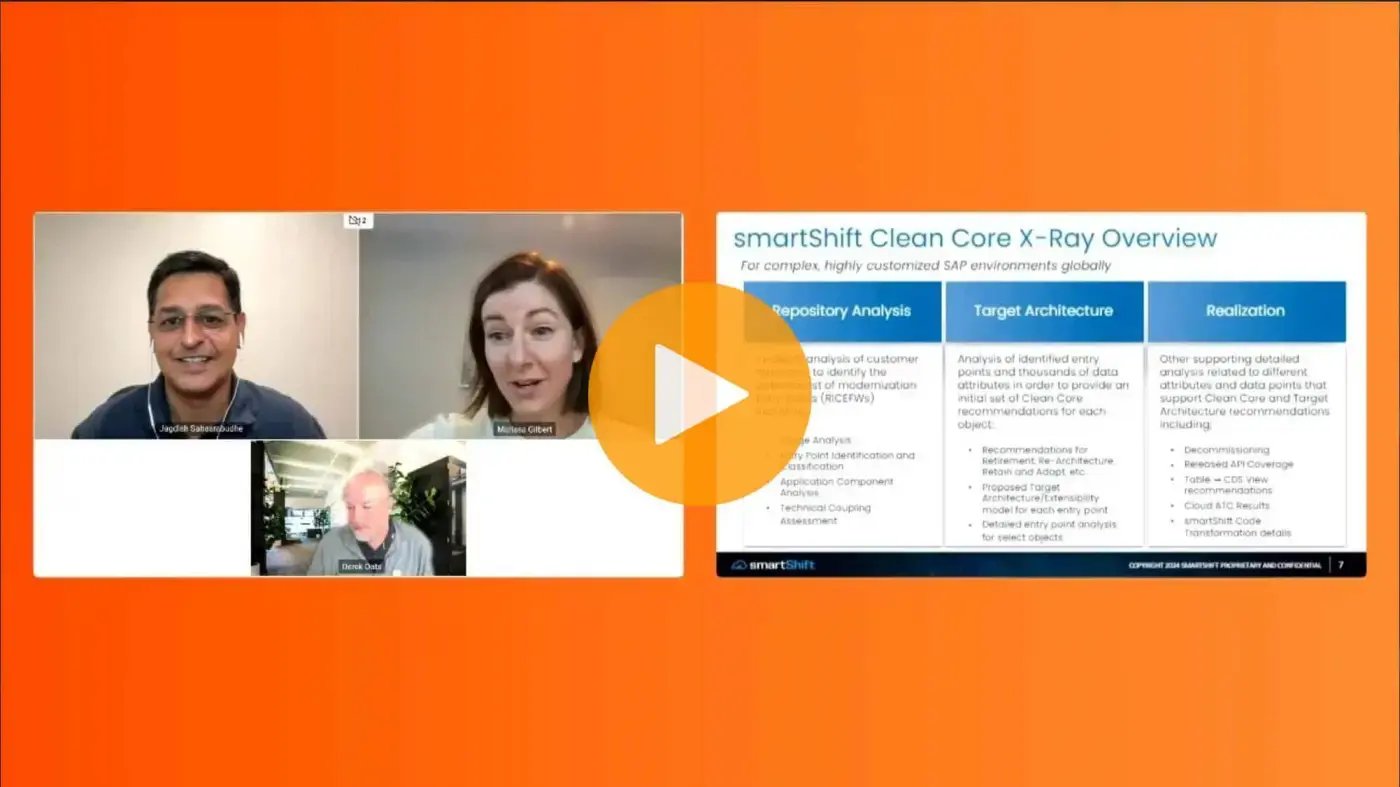
- smartShift Clean Core Analysis: Deeply evaluates your architectural alignment with SAP's modern extensibility standards. This analysis delivers a structured Entry Point List and maps your entire RICEFWD inventory against a 4-Quadrant Cloud Readiness Matrix. This gives you an actionable, objective blueprint showing exactly which custom processes should be retired, re-platformed to SAP BTP, redesigned, or retained and adapted with modern ABAP Cloud syntax.
What Questions Should You Answer During Assessment?
To eliminate execution uncertainty, your custom code assessment must answer several critical questions:
- Which custom programs reference deprecated SAP tables or obsolete function modules?
- Which tightly coupled legacy customizations require structural redesign rather than basic syntax remediation?
- What exact percentage of your custom codebase is active versus completely dormant?
- How will S/4HANA data model changes impact your downstream integrations, custom APIs, and BW extractors?
You must also evaluate and resolve your documentation debt. In many legacy systems, custom code has been running for decades, and the developers who wrote it are long gone. If your current team cannot explain what a custom program does, migrating it becomes an unacceptable risk. smartShift resolves this systematically. Our platform maps your codebase's entire semantic structure, generating automatic Before/After HTML comparison reports and utilizing Generative AI to produce plain-language documentation of legacy object behavior.
Finally, perform an honest evaluation of your team's capacity. Manual code remediation is a massive resource drain. ASUG research indicates that 37% of enterprise leaders face severe ABAP resource and skill shortages. Forcing your top internal experts to spend months manually fixing routine syntax errors and database joins is a poor use of talent—it delays your migration, stalls ongoing business-as-usual innovation, and introduces a 15% average human error rate. Replacing manual effort with deterministic automation preserves your core team's bandwidth, allowing them to focus on the high-value functional design and strategic innovation that actually drives business value.
How Do You Prioritize Testing Across a Large Codebase?
With thousands of custom ABAP objects in play, attempting to test everything with the same intensity is a recipe for project delays. An effective modernization strategy relies on risk-based testing prioritization:
- Process Criticality First: Code that governs financial postings, regulatory compliance, customer-facing transactions, and core supply chain operations should receive the most rigorous integration and User Acceptance Testing (UAT). Peripheral custom reports can be validated with light smoke tests.
- Focusing on True Architectural Changes: Standard technical modifications—such as material number field length extensions (from 18 to 40 characters) or basic syntax updates—are fully automated by smartShift with absolute precision. Testing resources should instead be concentrated on the small fraction of custom code (typically less than 10%) that required functional redesign or manual business-rule adjustments.
- De-risking with Simulation and Rehearsal: Rather than using testing cycles to fix broken code on the fly, smartShift’s speed allows you to treat testing as a dress rehearsal. For example, during their S/4HANA conversion, Jabil used the time saved by smartShift to run three complete load-verification cycles, rehearsing the cutover repeatedly to guarantee a flawless go-live with no operational disruption.
With automated code modernization, testing is no longer a prolonged exercise in reactive debugging; it becomes a controlled, predictable validation of your business’s future-ready ERP core.
What Does a Practical S/4HANA Migration Risk Reduction Roadmap Look Like?
An effective custom code transition is not a reactive clean-up job; it is a structured, sequence-driven process that replaces guesswork with factual certainty. A predictable, de-risked roadmap follows three clear steps:
- Analysis and Sizing (Weeks 1 to 4): You cannot remediate what you haven't inventoried. Utilizing smartShift Code Analysis and Clean Core Analysis, a lightweight extractor program scans 100% of your custom repository in a matter of hours. This process maps all object dependencies, identifies obsolete unmaintained code for safe decommissioning (typically 25% to 40% of the codebase), and delivers a firm, fixed-price proposal.
- Automated Code Transformation (Weeks 4 to 8): Retained custom objects are processed outside of your active SAP system in smartShift’s secure, patented transformation engine. It automatically resolves HANA and S/4HANA compatibility, SQL performance, and security issues across millions of lines of code in a matter of hours. To guarantee a seamless transition, smartShift Modernization Factory experts resolve any technical outliers and execute rigorous syntax and extended program checks before delivering a validated, ready-to-import transport.
- Validation and Integration Testing: Traditional manual migrations require a grueling unit-testing phase to find and fix human coding errors. Because smartShift's rule-based automation delivers code with a 99.99% accuracy rate (<0.1% defect rate), traditional unit testing is eliminated. Your project team can completely bypass this phase and proceed directly to end-to-end integration and business process validation, reducing your overall testing timeline by up to 75%.
How Do You Maintain Momentum Without Losing Control?
Tight S/4HANA migration timelines create intense pressure to move quickly, which often leads to dangerous technical shortcuts. To maintain project velocity without sacrificing system stability, enterprise leaders should adopt two proven strategies:
- Adopt an MVP (Minimum Viable Product) Migration Methodology: Attempting to remediate, secure, and fully redesign thousands of custom ABAP objects in a single "big bang" upgrade introduces extreme risk. Instead, smartShift advocates for an MVP approach: focus your initial migration window strictly on the technical compatibility changes required to run safely on S/4HANA. Once you achieve a successful, fast-tracked go-live, you can transition to a Continuous Modernization lifecycle—iteratively refactoring, optimizing performance, and decoupling legacy logic into side-by-side extensions at a predictable, controlled pace.
- Deploy Dual Maintenance: A multi-month or multi-year migration project cannot halt daily business enhancements. To keep your legacy ECC production environment and your target S/4HANA environment synchronized, smartShift automates change replication. For lower-volume projects, Delta Runs provide ad-hoc, milestone-based code transformations. For high-frequency, complex global landscapes, smartShift Dual Maintenance automatically analyzes, merges, and remediates ongoing production transports in real time, eliminating the need for business-crippling code freezes.
- Demand Fixed-Timeline, Fixed-Price SLA Guarantees: Traditional System Integrators benefit from project delays by operating under variable Time & Materials (T&M) models. By partnering with smartShift, you gain contract-backed predictability. We deliver fully transformed, upgrade-ready custom code on a firm, fixed schedule and fixed price—backed by a 100% target-version compatibility and quality guarantee.
What Should Enterprise SAP Leaders Evaluate in Remediation Partners?
Not all SAP transformation approaches deliver the same outcomes. When evaluating modernization partners, it is critical to distinguish between generic, developer-centric tools and enterprise-scale transformation platforms.
Lightweight, suggestive AI developer assistants may help individual programmers write code faster, but they offer no programmatic consistency and zero accountability for end-state outcomes. True enterprise modernization requires a governed, deterministic platform that can transform millions of lines of custom code simultaneously under strict architectural standards and SLA-backed outcome guarantees.
To make an informed decision, enterprise IT leaders should evaluate potential partners across three core criteria:
- Track Record and Scale: Experience is the ultimate de-risker. Ask potential partners: How many SAP systems have you successfully modernized? How many lines of custom ABAP have you actually transformed? Experience with highly customized, global landscapes means your partner has already encountered and written automation rules for the complex, non-obvious code patterns that newer entrants must debug manually.
- Outcome Accountability: Partners operating under a variable Time and Materials (T&M) model place all project, budget, and schedule risks back onto the customer. Demand contract-backed, SLA-driven predictability with a 100% target-version compatibility guarantee.
- Value-Added Code Hygiene: Simple "find-and-fix" tools only address mandatory syntax errors, leaving your system cluttered with performance bottlenecks, security vulnerabilities, and obsolete, unmaintained code. A true modernization partner optimizes and cleans your codebase during the transformation window so you go live with a secure, highly performant, Clean Core-aligned landscape.
What Makes smartShift's Approach Different?
smartShift is the global leader in SAP custom code transformation and Clean Core enablement. We deliver patented, AI-powered automation that transforms entire codebases at scale with a 100% compatibility guarantee and a proven 99.99% accuracy rate:
- Factual Planning via a Transformation Metamodel: Traditional System Integrators guess S/4HANA remediation timelines using basic manual samples, leading to inevitable scope creep. smartShift eliminates this guesswork. We parse 100% of your ABAP repository, translating it into a language-independent metamodel to analyze deep cross-object dependencies and dry-run our transformation rules. When we deliver our final Code Analysis, we already know exactly how your code will transform.
- Unrivaled Scale of Experience: smartShift is trusted by the world's most complex SAP organizations, including BMW, Procter & Gamble, and John Deere. Our platform has successfully modernized over 3,500 SAP systems and transformed more than 3.5 billion lines of custom ABAP code.
- Absolute Cost and Timeline Certainty: Every smartShift engagement is delivered under a fixed-price, fixed-timeline contract. Because our transformation engine operates with six-sigma precision, we completely eliminate traditional manual coding variability and reduce post-migration testing efforts by up to 75%.
- Zero Business Disruption: We address the entire transition lifecycle. Our Automated Dual Maintenance solution continuously retrofits and synchronizes ECC production changes into your parallel S/4HANA project environment in real time, enabling your business to maintain full development velocity without business-crippling code freezes.
- Post-Go-Live Hypercare: Our commitment does not end at transport hand-off. smartShift remains fully engaged through your integration testing, go-live cutover, and provides one month of dedicated Post-Go-Live Hypercare Support to guarantee an issue-free transition.
How Does Dual Maintenance Fit Into Migration Risk Reduction?
Your active SAP ECC production landscape does not freeze when you kick off an S/4HANA migration. Daily business operations demand constant support—emergency bug fixes, critical security patches, regulatory updates, and ongoing enhancements must still be deployed into your live legacy environment while your future S/4HANA target system is being built.
Without programmatic synchronization, this parallel development creates an unstable "go-live gap". Production modifications made in ECC do not automatically appear in your target system. At go-live, you risk deploying S/4HANA code that completely lacks recent, business-critical corrections, introducing severe operational and compliance risks at the exact moment your business can least afford it.
This is where smartShift’s Dual Maintenance completely de-risks the transition:
- Continuous, Zero-Disruption Synchronization: Built on our patented Intelligent Automation® platform and a secure version-control repository, the solution automatically detects code modifications released from your ECC production environment, translates them to match S/4HANA structures, resolves DB conflicts, and injects them into your project track.
- Tailored to Your Testing Cadence: smartShift delivers synchronization via ad-hoc, milestone-based Delta Runs or through smartShift Retrofit—which operates under committed weekly, bi-weekly, or monthly SLAs to systematically process, merge, and promote custom ABAP and related Data Dictionary (DDIC) objects.
- Unmatched Speed and Precision: smartShift’s automated retrofit merges and transforms code 5x faster with an automated quality rate 1,000x better than manual retrofitting. It cuts dual-maintenance costs by 20%, reducing the manual time developers spend comparing and merging code from a burdensome 30% down to less than 5%.
The Real-World Proof of Zero Disruption:
Global enterprises rely on smartShift to keep their businesses moving while they transform:
- Procter & Gamble (P&G): Bruno Pont, Senior Director at P&G, noted: "We have not stopped a single project thanks to smartShift during our first year of transition. All the business transformation that is needed to keep the business running... continued as if the transition to S/4HANA was not happening."
- CONA Services (Coca-Cola): During a multi-year migration, smartShift synchronized 1,500 active ECC changes every month. Because of this real-time agility, CONA successfully upgraded to a newer version of S/4HANA mid-flight, ensuring they went live on the most current SAP platform available.
What Happens After Migration—And Why It Matters Now
Reaching S/4HANA go-live is a massive achievement, but it is not the end of your custom code lifecycle. S/4HANA upgrades are now a recurring operational reality. With SAP releasing continuous updates and enforcing strict end-of-maintenance timelines on early S/4HANA versions, your custom code layer must remain highly agile to prevent the re-accumulation of technical debt.
Aligning with Clean Core standards during your migration is your ultimate "upgrade insurance." By refactoring monolithic legacy code into loosely coupled extensibility layers, BTP side-by-side applications, and released APIs, future SAP releases become rapid, low-risk, and cost-effective.
To maintain this standard, the deep repository visibility, dependency maps, and semantic analysis established during your migration must persist. Rather than treating code quality as a one-time project, leading organizations transition to the smartShift Continuous Modernization Lifecycle. Through continuous, subscription-based code hygiene, smartShift's deterministic code robots dynamically scan and refine your repository in the background—securing your systems against emerging security risks, optimizing database performance, and ensuring your core remains clean, stable, and eternally upgrade-ready.
FAQs about How to Reduce S/4HANA Migration Risk in 2026
What is the biggest source of S/4HANA migration risk?
Custom ABAP code represents the single largest technical and operational risk during an S/4HANA transition. Decades of accumulated Z-programs and enhancements reference deprecated tables, merged data models, and old syntax that are entirely incompatible with modern S/4HANA architecture.
smartShift’s automated Code Analysis eliminates this blind spot by scanning 100% of your ABAP codebase to identify compatibility, security, and performance risks that manual review and standard scanners miss.
How long does custom code remediation take for enterprise SAP systems?
Manual custom code adaptation is notoriously unpredictable, often stretching from 6 to 18 months and pulling highly-skilled developers away from business innovation. By replacing manual labor with deterministic code robots, smartShift delivers fully remediated, production-ready code in weeks rather than months. Every transformation cycle is delivered under a firm, fixed-price and fixed-timeline contract.
What is a clean core and why does it matter for S/4HANA migration?
Clean Core is SAP's modern design standard aimed at keeping the central ERP standard unmodified, with custom logic decoupled through approved extension points and released APIs. Aligning your custom code with Clean Core during migration is essentially long-term upgrade insurance. It permanently strips away accumulated technical debt, shrinks your attack surface, and ensures future SAP upgrades are quick and frictionless.
Can automated remediation handle all custom code compatibility issues?
Yes, because the vast majority of S/4HANA modifications are technical rather than functional. 90%+ of required changes are purely technical and fully automatable. The smartShift Intelligent Automation platform resolves 100% of custom code compatibility issues with 99.99% accuracy. For the small fraction of exceptions that require specialized business rules or custom design decisions, our dedicated factory experts collaborate with your team to deliver fully validated results.
How do you prevent parallel production code changes from creating go-live gaps?
Typically, parallel development tracks result in manual retrofitting delays or business-crippling "code freezes". smartShift’s Dual Maintenance solves this by automatically detecting, transforming, and synchronizing ECC production changes with your S/4HANA project environment in real time. This ensures your target S/4HANA system is perfectly current at go-live without disrupting your ongoing business velocity.
What should enterprise SAP leaders look for in a custom code partner?
IT leaders must demand demonstrated automation depth, proven enterprise scale, and SLA-backed outcomes. Traditional System Integrators operate on a variable Time & Materials (T&M) model, placing all delivery and timeline risk on the customer. smartShift completely de-risks the process, having successfully modernized over 3,300 SAP systems and analyzed 4 billion+ lines of code with a 100% quality and compatibility guarantee.
As the Chief Technology Officer at smartShift, he brings over 25 years of experience in product strategy, SAP applications, and enterprise AI. Previously, he served as SAP's field CTO, where he worked with ISVs and channel partners to align complex technologies with market needs. He has earned multiple accolades, including the SAP Innovation Award (2005). His leadership roles across startups and large enterprises, along with recognition such as the Zinnov Start-up Beacon Award (2014), uniquely position him to drive innovation and growth at smartShift.