Enterprise SAP transformation is a business-critical mandate. As organizations adopt SAP S/4HANA, often through programs like RISE with SAP, they simplify their infrastructure and operating models, but one constraint remains: custom code.
Technical debt. Upgrade risk. Performance instability. Clean Core misalignment. In highly customized environments, these challenges define the pace, cost, and success of transformation.
This inflection point is where many programs lose momentum.
In this article, we discuss where misaligned transformation approaches stop short, why custom code complexity becomes the defining risk in S/4HANA programs, and how the right automation approach changes the equation.
Common Challenges in SAP S/4HANA Transformation Programs
Legacy Custom Code and Technical Debt
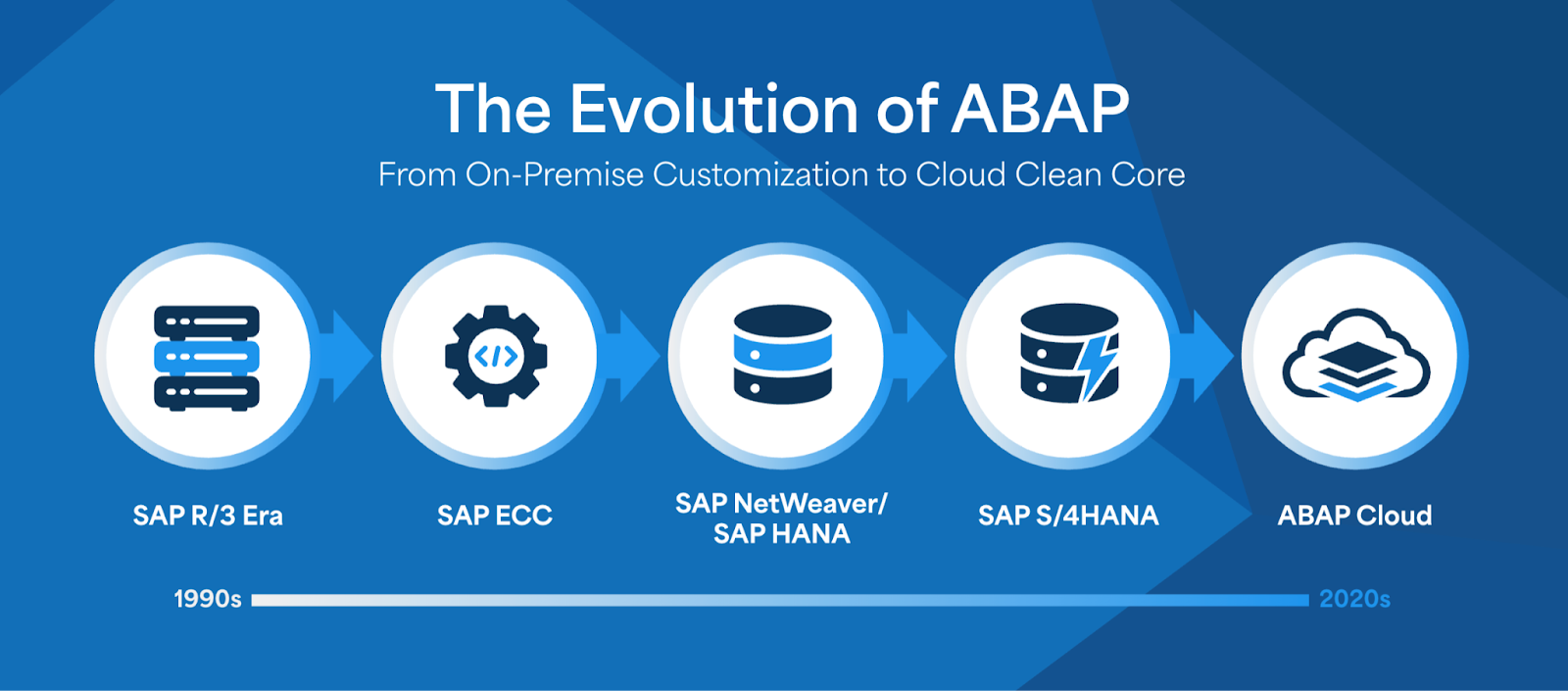
Most enterprises running ECC have accumulated years and often decades of ABAP custom code. Some of it is business-critical. Much of it is redundant, unused, or poorly understood.
Without deep, system-wide analysis, organizations lack visibility into:
- What code is actively used
- What can be decommissioned
- What violates modern ABAP and cloud-ready standards
- What introduces a performance or security risk
Moving to SAP S/4HANA without addressing this foundation introduces hidden costs, extended timelines, and long-term instability.
Manual Effort in Code Remediation
Many transformation approaches still rely on manual-first processes that require ATC lists, selective fixes, and developer-by-developer rewrites.
At enterprise scale, this leads to:
- Schedule volatility
- Resource constraints
- Expanding testing cycles
- Inconsistent outcomes
Sustainable modernization requires more than issue-by-issue remediation. It requires structural transformation across the full custom codebase.
Risk of Downtime and Business Disruption
SAP environments are mission-critical. Poorly controlled custom code transformation introduces:
- Regression defects
- Performance degradation
- Rework during upgrades
- Extended cutover windows
As operating models evolve, the complexity within custom code remains a defining factor in transformation success and a primary driver of risk, cost, and business disruption.
How smartShift’s Intelligent Automation Platform® Solves These Challenges
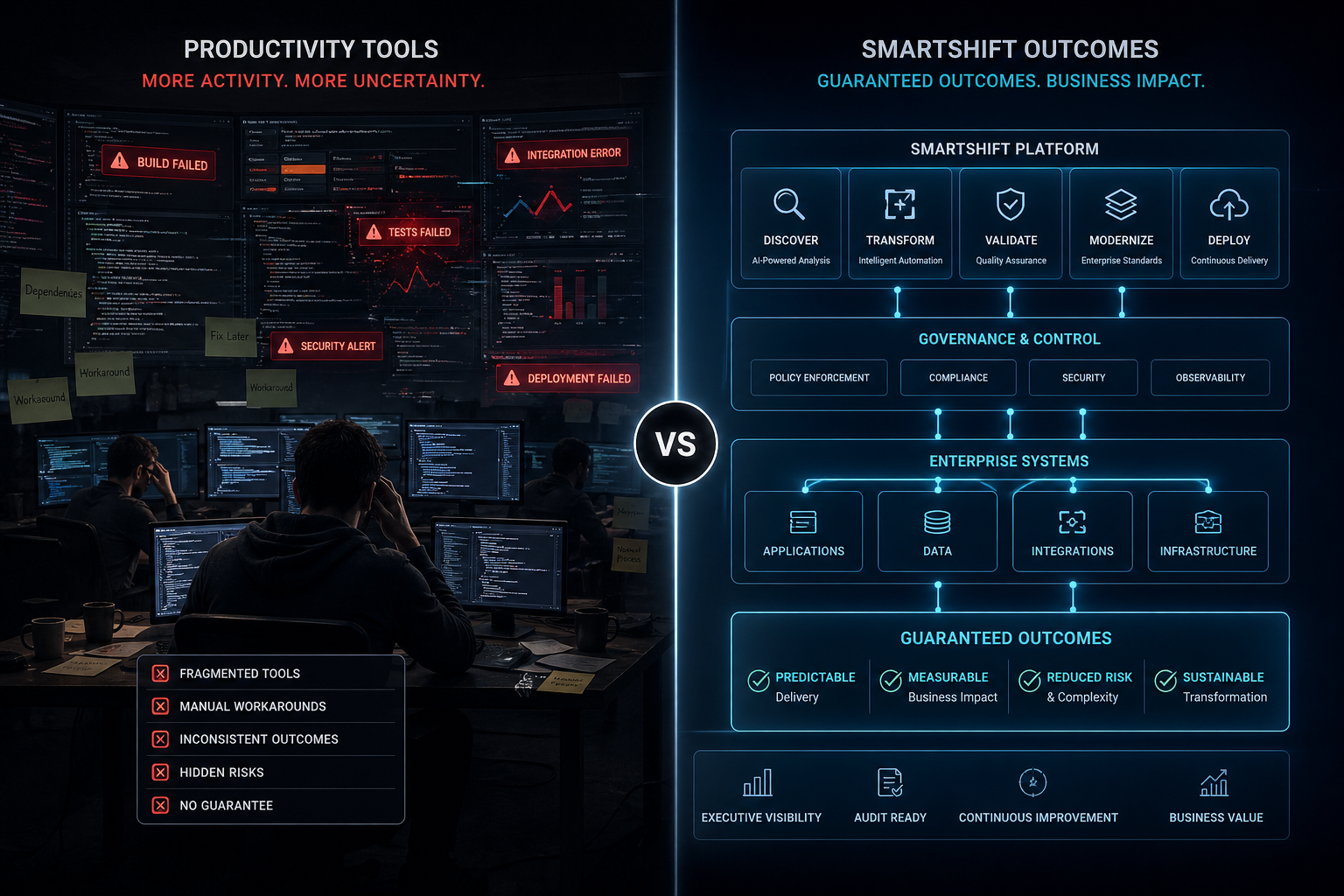
smartShift Intelligent Automation is purpose-built for enterprise-scale SAP transformation. For over two decades, it has automated the analysis and transformation of complex SAP custom code, replacing manual effort with precise, scalable execution.
Unlike developer-led approaches, smartShift operates across the entire codebase, delivering consistent, high-quality outcomes with predictable timelines and costs.
Automated Custom Code Transformation at Scale
smartShift applies patented automation across the full custom code landscape to:
- Eliminate unused and redundant code
- Resolve S/4HANA incompatibilities
- Optimize performance for SAP HANA
- Align code with modern ABAP, Clean Core, and cloud-ready standards
What traditionally takes months is completed in weeks with enterprise-proven accuracy:
- Speed: Weeks, not months
- Accuracy: 99.99% automation precision
- Efficiency: Minimal rework during testing
Automation stabilizes scope, timeline, and cost, removing uncertainty from transformation programs.
Built-In Quality, Security, and Compliance
smartShift delivers transformation outcomes that are secure, stable, and future-ready:
- Performance optimization for HANA
- Automated security remediation
- Unicode and SPAU/SPDD compliance
- Alignment with Clean Core and modern SAP standards
Predictable, Outcome-Driven Delivery
Using patented automation, dependency mapping, and comprehensive validation, smartShift ensures consistent, audit-ready results at scale, without the variability of manual execution.
The result: a transformation you can plan, trust, and deliver on time and on outcome.
How smartShift Supports a Clean Core Strategy in SAP Environments
Clean Core is not a slideware concept. It is a structural requirement for cloud-based SAP systems.
SAP defines the policy. smartShift enables enterprises to operationalize it through automation.
A Clean Core approach:
- Removes unused and redundant custom code
- Decouples extensions from the SAP standard
- Enables side-by-side extensibility via BTP
- Ensures upgrade agility
- Reduces long-term technical debt
Whether you are migrating from ECC or already on S/4HANA, unmanaged custom code increases TCO and restricts flexibility
smartShift enables enterprises to modernize without sacrificing past investments.
Code and data are complementary pillars of transformation. Clean Core governance ensures both are positioned for long-term stability and innovation.
Case Studies: Accelerating RISE with SAP Transformation with smartShift
System integrators and global enterprises rely on smartShift to accelerate transformation programs.
Kimberly-Clark: 5.8 Million Lines of Code, S/4HANA-Ready in 6 Weeks
When Kimberly-Clark paused its S/4HANA transformation, the issue wasn’t vision; it was scale. A greenfield approach left critical business capabilities behind, forcing a pivot to a brownfield strategy that required analyzing and converting 5.8 million lines of custom ABAP code across more than 24,000 objects.
Manual remediation at that volume would have introduced unacceptable risk, increased costs, and extended timelines.
smartShift automated the entire custom code workstream, resolving over 305,000 ABAP issues and delivering 100% S/4HANA compatibility in just six weeks
Dual Maintenance ensured ongoing ECC changes were synchronized through go-live, allowing operations to continue uninterrupted. The system went live one month ahead of schedule, with optimized, modern ABAP code that reduced long-term maintenance costs and strengthened performance and stability.
CONA: 45TB System, 23,000 Users, Zero Drama at Go-Live
CONA Services, supporting North America’s largest Coca-Cola bottlers, faced one of the largest ECC-to-S/4HANA conversions undertaken at the time: a 45TB system used by 23,000 SAP users.
What began as a projected 1,500-object remediation effort quickly revealed over 45,000 custom objects and more than six million lines of code requiring analysis and transformation. Manual approaches proved too slow and error-prone for a program of this magnitude.
smartShift’s Intelligent Automation analyzed the entire codebase in hours and transformed all custom code in eight weeks, addressing more than 300,000 ABAP impacts.
Automated Dual Maintenance allowed CONA to continue making approximately 1,500 monthly changes in ECC without slowing innovation.
The result was a seamless go-live, minimal post-production defects, and a support window reduced from four planned weeks to one. In a landscape where S/4HANA upgrades frequently destabilize operations, CONA achieved scale transformation without operational disruption.
Potters Industries: 20+ Years of Custom Code Transformed in Four Weeks and Under Budget
Potters Industries needed to modernize more than two decades of accumulated ABAP custom code while meeting a hard seasonal deadline. Production disruption was not an option. The environment included 4,783 custom objects and over 629,000 lines of code requiring remediation for S/4HANA compatibility.
Partnering with Syskoplan Reply, smartShift automated the transformation of all custom code in just four weeks, saving an estimated 960 developer days and completing the project under budget.
Only two of 4,783 transformed objects required minor adjustments during testing.
The system went live before peak season with no impact on production. Instead of diverting resources to manual remediation, Potters redirected investment toward innovation. Automation converted timeline risk into execution certainty.
RISE with SAP on Hyperscaler Environments
Regardless of infrastructure choice, application readiness depends on custom code modernization. However, infrastructure modernization alone does not guarantee application readiness.
smartShift ensures that your custom ABAP landscape is:
- Cloud compliant
- Performance optimized
- Clean Core aligned
- Upgrade ready
This alignment reduces operational drag and enables DevOps-driven innovation in the cloud.
Getting Started with smartShift for Your RISE with SAP Journey
Successful RISE with SAP methodology begins with visibility.
smartShift provides:
- Automated system analysis
- Risk and technical debt assessment
- Clean Core alignment strategy
- Deterministic modernization execution
- Fixed price, fixed duration delivery
Modernize your SAP landscape with control, predictability, and measurable ROI.
FAQs
How long does a typical smartShift project take?
smartShift projects are completed in **weeks—not months—**depending on system size and complexity. Our automation-first approach transforms the entire codebase with predictable timelines, fixed scope, and guaranteed outcomes, eliminating the uncertainty of manual remediation, especially in complex SAP S/4HANA and RISE with SAP environments.
Can I continue development in ECC during transformation?
Yes. smartShift’s automated Dual Maintenance capability enables ongoing development in ECC while synchronizing changes into the S/4HANA environment in real time. This approach ensures business continuity, avoids code freezes, and keeps innovation moving in parallel with transformation, supporting common RISE with SAP methodology approaches.
What types of issues does smartShift resolve that are difficult to fix manually?
smartShift resolves issues across compatibility, performance, security, and code quality at full-codebase scale. This process includes S/4HANA incompatibilities, unused or redundant code, HANA performance gaps, and misalignment with Clean Core standards.
Unlike manual approaches, which are limited by time, talent, and consistency, smartShift applies hundreds of automated transformation rules across millions of lines of code, delivering comprehensive, consistent, and audit-ready outcomes across SAP S/4HANA and RISE with SAP programs.
How does smartShift reduce risk in SAP transformations?
smartShift reduces risk by replacing manual, developer-dependent remediation with automated, rule-based transformation at scale. This process ensures consistent, high-quality outcomes across the entire codebase, while minimizing defects, rework, and timeline variability.
Automation also reduces the risk of business disruption, security vulnerabilities, and project overruns, enabling faster, more predictable transformations aligned with the goals of RISE with SAP offerings.
Does smartShift support Clean Core strategies?
Yes. smartShift enables Clean Core adoption by identifying and removing redundant custom code, modernizing remaining code to SAP standards, and decoupling extensions from the core.
This approach aligns your system with SAP’s modern extensibility model, improving upgradeability, reducing technical debt, and creating a foundation for continuous innovation, whether deployed in traditional environments or RISE with SAP on AWS and other hyperscalers.
Topics: