As SAP accelerates its cloud-first roadmap, ABAP development must evolve with it. SAP ABAP Cloud represents SAP’s modern, cloud-ready development model. It’s designed to enable clean core extensibility, protect upgrade paths, and support continuous innovation.
But what is ABAP Cloud in practical terms?
At its core, ABAP Cloud is a restricted, cloud-optimized ABAP language version that enforces the use of released APIs and upgrade-safe extension patterns. It is the foundation for development in SAP S/4HANA Cloud and the ABAP environment on SAP Cloud Platform (SAP BTP), providing a structured path for organizations modernizing their custom code base.
For enterprises running highly customized SAP landscapes, this shift has strategic implications. Legacy custom code built for traditional ABAP models may not be fully compatible with ABAP Cloud standards. Without a clear plan, organizations risk slowing their migration timelines, increasing remediation costs, and carrying forward technical debt that limits agility.
This guide explains:
- What SAP ABAP Cloud is and why it matters now
- Where the ABAP environment on SAP Cloud Platform (SAP BTP) fits in ABAP Cloud deployment options
- How to evaluate existing custom code for ABAP Cloud compatibility
- How to distinguish between “carry-forward” code and what requires redesign
Modernizing for ABAP Cloud is not just a technical adjustment. It is a critical step toward achieving Clean Core, accelerating S/4HANA transformation, and future-proofing your SAP investments.
What Is ABAP Cloud?
SAP ABAP Cloud is SAP’s cloud-ready development model designed to enforce clean core principles and protect long-term upgrade stability. At its simplest, ABAP Cloud is ABAP with guardrails. It introduces a restricted, cloud-optimized language version that limits how custom logic interacts with the SAP core, ensuring extensions remain compliant, stable, and future-ready.
In a clean-core architecture, SAP defines a structured extensibility hierarchy:
- Key user extensibility (configuration, custom fields, UI adaptation, low-code/no-code enhancements)
- Developer extensibility using ABAP Cloud
When business requirements cannot be met through key user tools, ABAP Cloud becomes the approved path for building custom logic within SAP-defined, upgrade-safe boundaries.
Where Does ABAP Cloud Run?
ABAP Cloud operates in SAP’s cloud-aligned environments, including:
- The ABAP environment on SAP Cloud Platform (SAP BTP)
- SAP S/4HANA Cloud (Public Edition and Private Edition)
It is important to distinguish this from simply running SAP on a hyperscaler. Hosting a traditional system in the cloud does not equal ABAP Cloud in the SAP-defined sense.
You can lift-and-shift an SAP system to infrastructure hosted by AWS, Azure, or GCP and still run classical ABAP. That is not SAP ABAP Cloud.
ABAP Cloud specifically refers to SAP’s cloud-compliant ABAP stack, including language restrictions, released APIs, and strict extension policies that enforce clean core development standards.
From Classical ABAP to SAP ABAP Cloud: Why the Model Had to Change
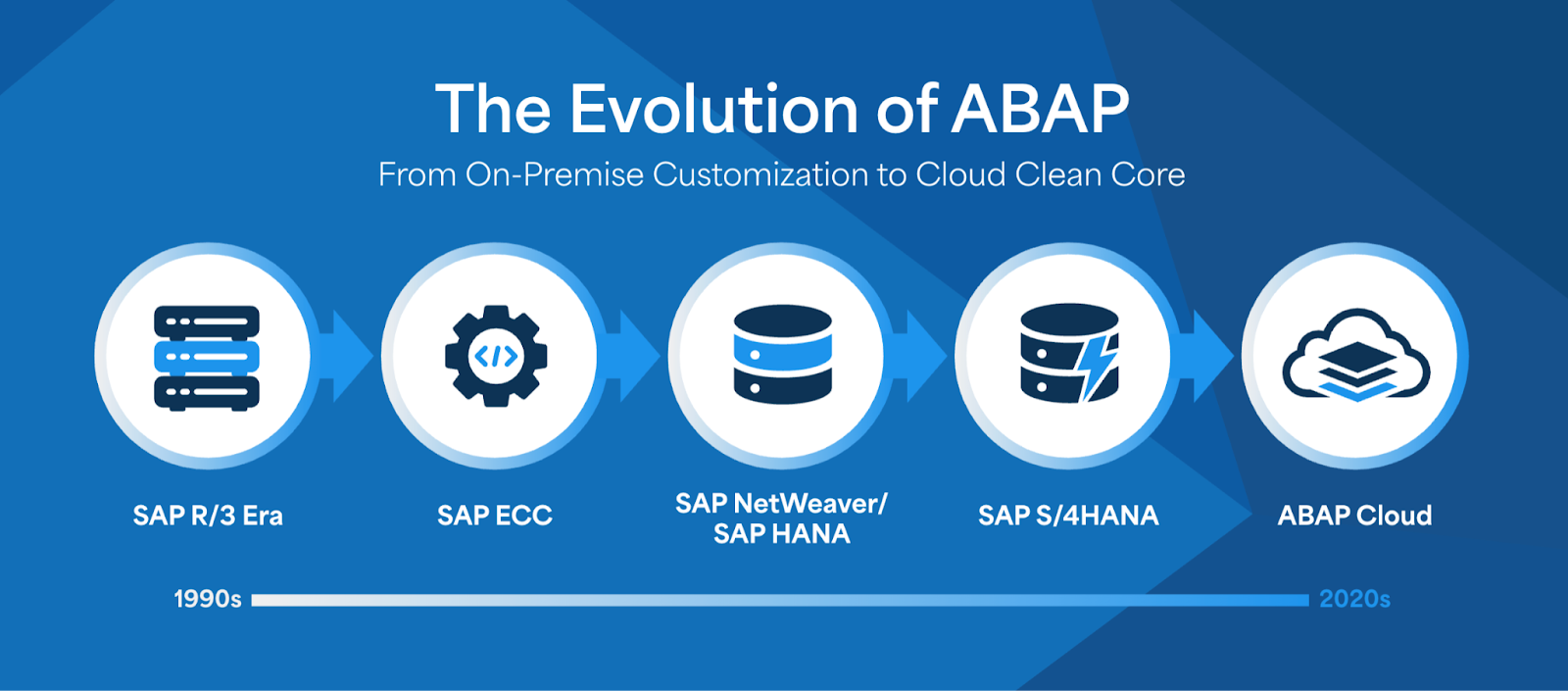
ABAP was originally designed for a different era of SAP, one built around monolithic, on-premise ERP systems. In the SAP R/3 and SAP ECC landscape, ABAP functioned as a tightly integrated, server-side programming language with broad system access.
Developers could directly access application tables, enhance SAP standard objects, use user exits, and even modify core programs. This level of flexibility enabled deep customization tailored to unique business processes.
But that flexibility came at a cost.
Over time, unrestricted access to the SAP core created tight coupling between custom SAP code and standard objects. Direct database reads, implicit enhancements, and modification-based approaches increased upgrade complexity, extended testing cycles, and amplified long-term technical debt. What delivered agility in the short term often slowed innovation in the long term.
The Shift Toward Modern, Upgrade-Safe Development
With the introduction of SAP NetWeaver and later SAP HANA, SAP began redefining the ABAP stack.
The move to an in-memory, columnar database shifted performance optimization toward “code-to-data” principles. Core Data Services (CDS) models and database pushdown became foundational. At the same time, SAP started formalizing extensibility and encouraging the use of enhancement frameworks and released APIs instead of direct modification of standard code.
The launch of SAP S/4HANA accelerated this transformation.
- Simplified data models reduced redundant tables
- Fiori-based user experiences reshaped the application layer
- Continuous delivery and cloud-based deployment models demanded lifecycle stability
In this new environment, unrestricted customization was no longer sustainable.
ABAP Cloud: The Formalization of Cloud-Ready Development
SAP ABAP Cloud represents the structured evolution of ABAP into a cloud-first, clean core compliant development model.
Rather than allowing open access to system internals, ABAP Cloud enforces:
- Restricted language usage
- Mandatory use of released, contract-based APIs
- Clear separation between custom extensions and the SAP digital core
- Strict compliance with upgrade-safe development standards
This shift was not cosmetic. It was necessary to support frequent upgrades, multi-tenant cloud environments, and SAP’s broader cloud-first roadmap.
For enterprises with significant custom SAP investments, this evolution raises a strategic imperative. Legacy development patterns that were once acceptable in SAP ECC may now introduce upgrade risk, compliance exposure, and delays in transformation. Aligning custom code with ABAP Cloud principles is no longer optional for organizations pursuing Clean Core, S/4HANA Cloud, or SAP BTP innovation.
In short, ABAP Cloud is not simply a new syntax model. It is SAP’s blueprint for lifecycle-stable, upgrade-safe, cloud-ready custom code.
Core Features of ABAP Cloud (ABAP Cloud Components)
The following components form the foundation of ABAP Cloud:
ABAP Cloud Language and Syntax Restrictions
ABAP Cloud uses a restricted ABAP syntax compared to classical ABAP. The intent is to keep development within clean core boundaries by limiting legacy constructs and unsupported patterns that SAP does not allow in the cloud-ready ABAP stack. These restrictions are validated through standard checks (for example, ABAP Test Cockpit) and the requirement to use released, supported interfaces. The practical outcome is straightforward: ABAP written for ABAP Cloud is more likely to remain upgrade-stable because it avoids patterns SAP does not support in cloud-aligned development.
ABAP RESTful Application Programming Model (RAP)
The ABAP RESTful Application Programming Model (RAP) is the default programming model for transactional applications in ABAP Cloud. RAP formalizes the separation between:
- Data model (defined in CDS entities).
- Behavior definition (business logic and transactional rules).
- Service exposure (OData services).
RAP supports draft handling, validations, determinations, and transactional consistency while remaining aligned with clean core principles.
Core Data Services (CDS)
Core Data Services (CDS) provide the semantic data modeling layer in ABAP Cloud. Rather than allowing unrestricted SQL access, CDS defines structured, reusable data models with annotations for:
- UI behavior (Fiori Elements).
- Authorization.
- Analytics.
- Service exposure.
CDS promotes the “code pushdown” principle introduced with SAP HANA, ensuring that calculations and aggregations execute at the database layer. In ABAP Cloud, CDS is mandatory for modeling business entities and replacing direct table access to SAP standard objects.
Eclipse-Based Development Tools (ABAP Development Tools – ADT)
ABAP Cloud development is performed using modern development environments rather than traditional SAP GUI-based tools. The primary environment today is ABAP Development Tools (ADT) in Eclipse, along with SAP Business Application Studio for cloud-based development workflows. SAP has also announced support for additional IDE options, including Visual Studio Code, reflecting the broader shift toward modern developer tooling.
Traditional SAP GUI development transactions (such as SE80 or SE38) are not used in ABAP Cloud environments.
Key characteristics include:
- Git-enabled transport mechanisms (gCTS)
- Integration with CI/CD pipelines
- Built-in static code analysis and cloud readiness checks
- Version-controlled development workflows
These modern development environments align ABAP development with contemporary DevOps practices while supporting SAP’s clean core and cloud-native architecture.
Published APIs and Extension Points
A core requirement of ABAP Cloud is the use of released APIs and defined extension points. SAP designates objects as “released” for cloud development, meaning they are covered by a stability contract and safe for consumption.
Custom SAP code must:
- Use only released classes, interfaces, CDS views, and APIs.
- Avoid implicit enhancements or modifications to SAP standard.
- Implement extensions through approved mechanisms (in-app extensibility or side-by-side extensions on SAP BTP).
This contract-based approach ensures that custom SAP code remains compatible across system upgrades and cloud releases.
Key Capabilities of ABAP Cloud
Each of the following capabilities distinguishes ABAP Cloud from classic on-prem ABAP:
- Rapid Cloud-Native Development: ABAP Cloud provides a model-driven framework (RAP/CDS) that lets developers quickly create cloud-ready business apps and services.
- Clean-Core Alignment: By design, ABAP Cloud enforces the “clean core” strategy. All extensions use only published APIs and stable release contracts.
- Built-In DevOps and Scalability: ABAP Cloud integrates modern DevOps tooling. Developers use Git/GCTS for version control and CI/CD pipelines (Jenkins, ATC checks) for automated builds and quality gates.
- Standardized Extensibility: The platform offers rich extension points. You can add features via in-app (ABAP Cloud code) or side-by-side (SAP BTP) extensions, all using the same ABAP language.
- Modern Tooling and UX: Developers use the Eclipse-based ABAP Development Tools (ADT) or SAP Business Application Studio to code, which support code completion, refactoring, and HANA pushdown.
Read to future-proof your SAP custom code? Get in Touch to learn how our experts can help modernize your custom code.
ABAP Cloud Compatibility Planning: What to Measure
Before you remediate anything, define a measurable baseline of what’s actually blocking ABAP Cloud compatibility. The goal is to quickly separate “easy-to-carry-forward” code from items that will require redesign, so ABAP Cloud doesn’t become a late-stage surprise.
1) Percent of unreleased API/object usage (your upgrade-risk indicator)
Measure how much custom code depends on unreleased SAP artifacts (classes, function modules, CDS views, tables, interfaces).
Track:
- Total count and percentage of usages
- Where they occur (by package/app/component)
- Business criticality (core process vs. edge case)
2) Direct table access hotspots (your clean-core friction map)
Identify where custom logic reads/writes SAP application tables directly, especially “hub” tables referenced across many programs.
Track:
- Top tables by number of references
- The custom objects that touch them most
- Whether a released API/CDS alternative exists (or if the logic likely needs redesign)
3) Restricted statements and patterns (your “won’t compile/run on ABAP Cloud” list)
Flag constructs that ABAP Cloud restricts or discourages, such as:
- Classic UI patterns (Dynpro/report-style list processing)
- File/system access patterns (server file handling, OS/system calls)
- Low-level or risky technical patterns (native SQL variants, deep system calls, cross-client patterns, older procedural constructs)
Many of these legacy patterns also introduce long-term security and compliance exposure in SAP environments. Organizations modernizing for ABAP Cloud should evaluate not only compatibility risk, but also vulnerabilities tied to insecure custom code practices. Learn more about SAP Code Security remediation and vulnerability management
4) “Keep / redesign / retire” recommendations (your decision framework)
For each custom object, classify it into one of three outcomes:
- Keep: already aligned or low-change to become compliant
- Redesign: high business value but blocked by unreleased dependencies/restricted patterns
- Retire: low usage, duplicated by standard, or better replaced by configuration/standard apps
SAP ABAP Cloud Deployment Options (Where ABAP Cloud Runs)
ABAP Environment on SAP Cloud Platform (SAP BTP ABAP Environment)
Understanding your deployment options is essential when planning custom SAP code compatibility and clean core alignment.
SAP S/4HANA Cloud, Public Edition
In SAP S/4HANA Cloud, Public Edition, ABAP Cloud is the only available ABAP development model. Classical ABAP development techniques are not permitted.
Key characteristics:
- Strict clean core enforcement.
- Use of released APIs/public APIs only.
- In-app extensibility and side-by-side extensions via SAP BTP.
- Multi-tenant SaaS architecture.
Because SAP manages upgrades on a fixed release cycle, custom SAP code must comply fully with ABAP Cloud restrictions. This environment represents SAP’s most controlled cloud deployment model.
SAP S/4HANA Cloud, Private Edition
In SAP S/4HANA Cloud, Private Edition, customers have greater flexibility. Both Classical ABAP and ABAP Cloud development models are technically possible.
However:
- SAP recommends ABAP Cloud for new developments.
- Clean core alignment is strongly encouraged.
- Long-term upgrade stability depends on minimizing classic modifications.
Private Edition allows organizations transitioning from ECC or on-prem S/4HANA to modernize incrementally. ABAP Cloud can be adopted alongside legacy custom SAP code, which has been remediated to run properly in S/4HANA, and you can develop a clean core strategy to modernize that legacy customization over time.
SAP S/4HANA On-Premise (2022 and Later)
ABAP Cloud is also available in on-premise SAP S/4HANA systems (release 2022 and newer) through the ABAP Cloud language version.
This availability enables organizations that remain on-premise to:
- Develop new ABAP extensions for Cloud Development.
- Gradually refactor custom SAP code toward clean core compliance.
- Prepare for potential future cloud transitions.
Although on-premise systems permit Classical ABAP, adopting ABAP Cloud in this environment provides architectural consistency with SAP’s cloud roadmap.
ABAP Environment on SAP Business Technology Platform (SAP BTP)
The ABAP environment on SAP BTP (often referred to as “Steampunk”) is a Platform-as-a-Service (PaaS) offering dedicated to ABAP Cloud development.
Key characteristics:
- Side-by-side extension model.
- Fully cloud-native runtime.
- Mandatory ABAP Cloud language version.
- Independent lifecycle from S/4HANA core.
This environment is commonly used for:
- Building extensions that must remain decoupled from S/4HANA.
- Developing standalone ABAP-based applications.
- Implementing integration services and APIs.
Because it runs independently of the S/4HANA core, it supports a strict separation between SAP-standard software and customer-developed components.
ABAP Cloud vs. Classical ABAP
The following table summarizes the key parameter differences between ABAP Cloud and Classical ABAP.
|
Parameter |
ABAP Cloud |
Classical ABAP (ECC / Traditional S/4) |
|---|---|---|
|
Development Tools |
Eclipse-based ABAP Development Tools (ADT) or SAP Business Application Studio only |
SAP GUI-based tools (SE80, SE38, etc.) and ADT |
|
Language Version |
“ABAP for Cloud Development” (restricted language version enforced at object level) |
Full ABAP language without cloud restrictions |
|
Extensibility Model |
Clean-core compliant; extensions via released APIs, RAP, in-app, or side-by-side models |
Modifications, implicit enhancements, user exits, and direct enhancements allowed |
|
API Usage |
Only SAP-released and contractually stable APIs permitted |
Released and unreleased APIs are commonly used |
|
Database Access |
Indirect access via CDS entities; no direct access to SAP standard tables |
Direct Open SQL access to application tables common |
|
Upgrade Stability |
Designed for upgrade-safe extensions; enforced through release contracts and static checks |
Custom code may break during upgrades due to tight coupling |
|
DevOps Enablement |
Git-enabled transports (gCTS), CI/CD integration, automated quality checks |
Transport-based lifecycle (CTS); limited native CI/CD integration |
|
Deployment Context |
SAP S/4HANA Cloud (public/private), SAP BTP ABAP environment, S/4HANA 2022+ |
ECC, older S/4HANA, traditional on-premise environments |
|
Security and Governance |
Restricted object usage; controlled extension points; cloud delivery model |
Broad system-level access; governance dependent on internal controls |
|
Architectural Philosophy |
Separation of SAP core and custom SAP code (clean core) |
Custom SAP code is often embedded within core application logic |
Advantages of Using ABAP Cloud
The advantages of ABAP Cloud are most visible in long-term SAP operations. By enforcing clean core development standards and modern extensibility patterns, ABAP Cloud creates a more stable and maintainable foundation for enterprise SAP landscapes.
Better Upgrade Stability
ABAP Cloud requires developers to use released APIs and defined extension mechanisms. This reduces tight coupling between custom SAP code and the SAP core, making upgrades more predictable and lowering the risk of functionality breaking during system updates.
Faster Development with Modern Tooling
ABAP Cloud aligns ABAP development with modern software engineering practices. Developers use tools such as ABAP Development Tools (ADT), version control, and CI/CD pipelines to enable faster collaboration and more consistent development workflows.
Lower Long-Term Maintenance Effort
By restricting obsolete constructs and deep system modifications, ABAP Cloud reduces the accumulation of technical debt. Over time, this leads to fewer remediation efforts, simpler upgrades, and lower operational overhead.
Stronger Security and Governance
ABAP Cloud limits access to internal system objects and enforces the use of released interfaces. This controlled extensibility model improves governance, reduces exposure to unsupported changes, and helps organizations maintain compliance with evolving security standards.
Alignment with SAP’s Cloud Strategy
SAP’s roadmap increasingly prioritizes cloud-native delivery models and clean core architectures. Organizations adopting ABAP Cloud ensure their custom SAP code remains compatible with future SAP S/4HANA and SAP BTP innovations.
Limitations of SAP ABAP Cloud
ABAP Cloud is intentionally constrained. It trades some of Classical ABAP’s flexibility for stricter governance, upgrade stability, and alignment with clean core. As you evaluate ABAP Cloud for new development or assess whether existing custom SAP code can transition, consider the following limitations.
Restricted language scope
ABAP Cloud uses ABAP language versions that enforce restricted syntax and a released-object check. Therefore, some statements and techniques that are normal in Classical ABAP are not permitted in ABAP for Cloud Development.
Released APIs only
In ABAP Cloud, custom development is expected to use released, stable, public APIs and other released extension artifacts. If your custom code depends on unreleased function modules, tables, or internal objects, you should assume rework will be required.
No classic SAP GUI / Dynpro / “report-style” UI patterns
Classic Dynpro and related report/list-processing approaches are not supported in cloud development. ABAP Cloud development is oriented to service-based applications and modern UX patterns (typically SAP Fiori).
No direct file-system access patterns
Common on-prem file-handling patterns are restricted. If your custom logic depends on server-file exchanges, you’ll need an alternative approach aligned to cloud constraints.
Limits on low-level database and system access
ABAP Cloud prohibits several low-level capabilities that can create operational risk in shared cloud environments. Examples include certain native SQL constructs, cross-client access patterns, and low-level system calls. If your code uses these patterns today, expect redesign work.
Practical version and readiness prerequisites
Some ABAP Cloud technology/content (including S/4HANA released APIs) is tied to newer S/4HANA releases. If you’re on older releases, ABAP Cloud enablement may be gated by broader upgrade steps first.
Use Cases
ABAP Cloud is best suited for scenarios where you need SAP-standard alignment, upgrade stability, and clean-core compliant extensibility. Below are three practical use cases organized around what teams typically build and why.
1) Side-by-side extensions on SAP BTP (decoupled from the S/4 core)
Build custom applications or services in the ABAP environment on SAP BTP that integrate with S/4HANA via released APIs. This approach is common when you want to keep custom logic separate from the digital core while still extending business processes.
2) On-stack extensions in S/4HANA Cloud (public or private)
Create clean-core compliant extensions that run “on-stack” in S/4HANA Cloud, using released extension points. This approach is typical for adding customer-specific fields, validations, and process logic that must reside near standard business objects.
3) Custom Fiori apps and services for business processes
Develop new business apps that expose data and actions as services and are consumed through SAP Fiori. This need is often associated with role-based applications (e.g., approvals, exception handling, operational worklists) where standard apps don’t meet requirements.
Use Cases for Classical ABAP Development (When ABAP Cloud Isn’t Feasible)
ABAP Cloud is not a fit for every requirement, especially in landscapes with significant legacy customization or when a needed capability is not available through released APIs or approved extension mechanisms. In those situations, organizations may still rely on Classical ABAP development, particularly in S/4HANA Private Edition or on-premise S/4HANA environments.
Common scenarios include:
- Large volumes of existing custom code that must carry forward during conversion
In brownfield ECC-to-S/4HANA conversions, time and risk constraints often require organizations to bring forward established custom transactions and programs so the business can operate with minimal change. Some of that code may remain classical initially, with modernization planned post-go-live. - Business-critical requirements not supported by released APIs or extension points.
If key data or process hooks are not exposed via released interfaces, clean core compliant development may not be possible. Organizations sometimes implement classical solutions to meet non-negotiable operational requirements while acknowledging higher upgrade risk. - Legacy UI and interaction patterns that cannot be replaced in the project timeline
Where users depend on long-standing custom screens and workflows, organizations may keep classical implementations temporarily to avoid disruption, then evaluate clean core alternatives after stabilization. - Technical patterns restricted by ABAP Cloud but still required for specific solutions.
Some low-level or environment-dependent patterns (for example, certain system-level behaviors or legacy integration techniques) may not fit ABAP Cloud constraints. In these cases, Classical ABAP may be used within a controlled scope, with clear documentation of the associated risks.
These use cases are not an endorsement of unrestricted customization. Rather, they reflect the practical realities of SAP programs, where modernization must be staged.
Governance Model for Extensibility Decisions
Clean core depends on governance: a clear process for deciding when to customize and how to do so.
A practical hierarchy is:
1) Start with Key User Extensibility
First, evaluate whether the requirement can be met using configuration and key user tools (e.g., adding fields, adapting the UI, or standard workflow capabilities). This step is typically the lowest-risk path because it stays closest to the SAP standard.
2) Use ABAP Cloud for Developer Extensibility
If key user options are not sufficient, ABAP Cloud is the preferred path for developer-built extensions. It is designed to keep custom logic within SAP’s supported boundaries through released interfaces and approved extension mechanisms.
3) Allow Classical ABAP Only by Exception
Classical ABAP should be treated as an exception, not a default. If your organization permits it, define explicit approval criteria such as:
- Material business impact (cost, revenue, compliance, or operational risk)
- No viable ABAP Cloud/released-API approach available
- Documented upgrade and maintenance impact
- Architecture and business owner sign-off
- A plan to revisit and modernize post-go-live
4) Public Edition Constraint
In SAP S/4HANA Cloud Public Edition, Classical ABAP is not available. If key user extensibility and ABAP Cloud mechanisms cannot meet the need, governance must address alternatives (for example, side-by-side extensions on SAP BTP or third-party solutions).
Final Thoughts
SAP ABAP Cloud is not defined by where your system runs. It is defined by how your custom SAP code is built, governed, and maintained.
Clean core alignment, mandatory use of released interfaces, and a controlled extensibility model are what distinguish ABAP Cloud, not simply moving to a cloud-hosted deployment. Whether you are planning an ECC-to-S/4HANA migration, adopting S/4HANA Cloud, or modernizing an existing S/4 landscape, ABAP Cloud establishes clear standards for lifecycle-stable development.
In short, ABAP Cloud sets the standard. The strategic advantage comes from knowing, with certainty, how your existing custom code measures up against it.
Next Step: Assess Custom SAP Code Compatibility
Assess your custom SAP code compatibility and remediation scope early so ABAP Cloud doesn’t become a late-stage blocker. Get in Touch to learn how smartShift experts can help modernize your custom code.
Frequently Asked Questions
What is the difference between SAP BTP and ABAP Cloud?
SAP BTP (Business Technology Platform) is SAP’s broader platform for building, integrating, and extending SAP and non-SAP applications. It includes multiple runtimes and services (integration, data, analytics, AI, app development).
ABAP Cloud is a development model for ABAP, defined by clean core alignment, released APIs, and the “ABAP for Cloud Development” language version. ABAP Cloud can run within SAP BTP (in the ABAP environment) and in S/4HANA Cloud (public/private), and on newer on-premises S/4HANA systems.
Does ABAP Cloud support customizations?
Yes. ABAP Cloud supports customizations, but through controlled extension mechanisms aligned with clean core principles.
That typically means:
- Building extensions using released APIs and defined extension points.
- Implementing logic in-app where allowed (on-stack extensibility).
- Implementing logic side-by-side on SAP BTP to keep custom functionality decoupled from the S/4 core.
What ABAP Cloud does not support is customization through modifications of SAP standard or dependence on unreleased internal objects.
How do I know if my existing custom code is compatible with ABAP Cloud?
Compatibility depends on whether your custom SAP code relies on patterns that ABAP Cloud restricts.
Most commonly:
- Use of unreleased SAP objects.
- Direct access to SAP application tables rather than through released interfaces.
- Modifications to SAP standard or certain implicit enhancement patterns.
- Use of non-cloud-ready language constructs.
How long does it take to transition from Classical ABAP to ABAP Cloud development?
There’s no single timeline because “transition” can mean different things. A practical way to plan is to treat it as a phased effort:
- Establish standards and tooling.
- Adopt ABAP Cloud for new work.
- Remediate high-risk custom code first.
- Modernize the long tail over time.
How does ABAP Cloud handle security compared to Classical ABAP?
ABAP Cloud generally enforces a more controlled security and governance model by restricting access to system internals and requiring the use of released objects and defined extension mechanisms.
Can Classical ABAP code be moved to ABAP Cloud?
Some Classical ABAP code can be carried forward with changes, but it is rarely a “lift and shift.” A realistic transition plan starts with assessment and prioritization rather than attempting to convert everything at once.