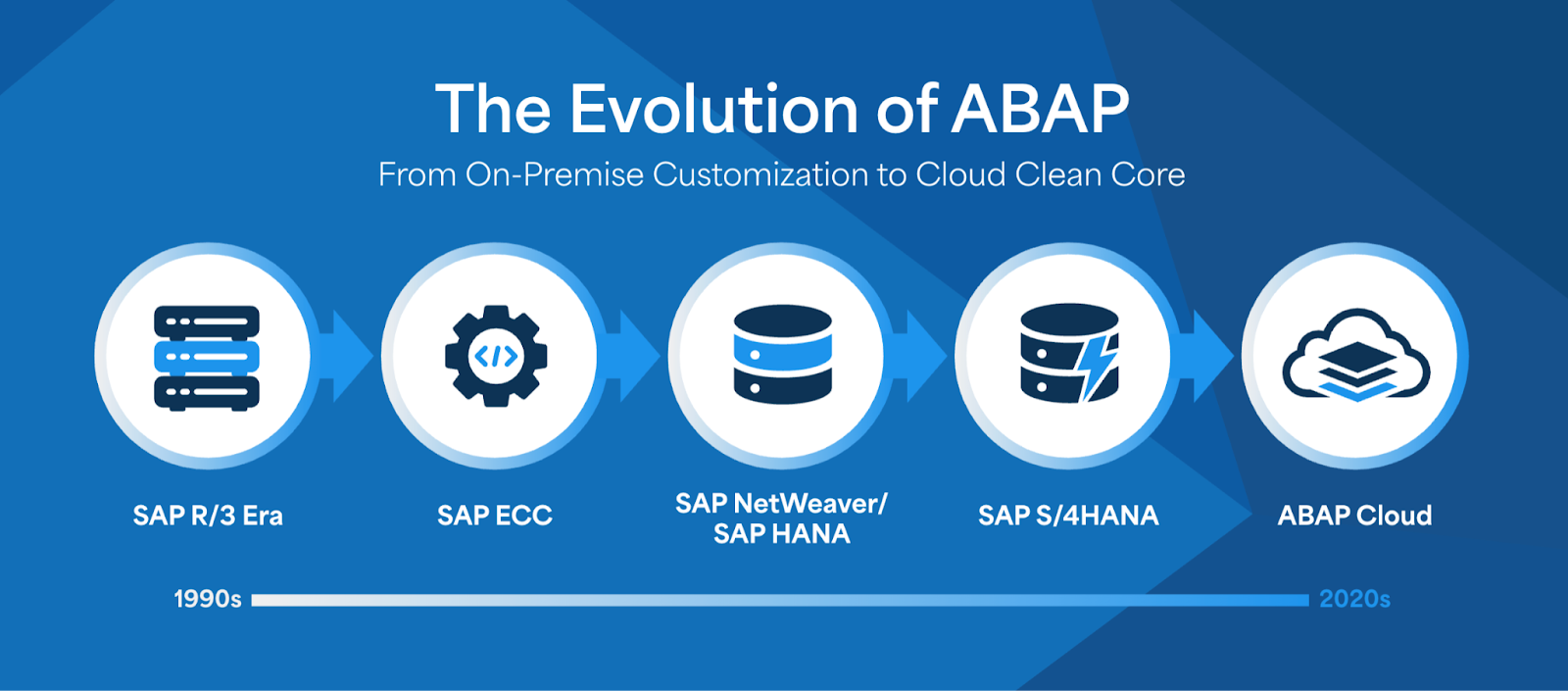
Enterprises often enter S/4HANA programs with decades of SAP legacy ABAP embedded across large custom code repositories. Recent ASUG and smartShift research found that 93% of fully or partially migrated organizations carried custom code forward into S/4HANA, confirming that remediation remains a practical requirement for most enterprises.
Developer-driven custom code remediation in SAP becomes increasingly difficult to scale as repositories grow, adding timeline, testing, and resource pressure. Usage analysis may also identify custom code that is no longer active and could be considered for controlled decommissioning.
Automated code remediation, including automated ABAP code correction, helps address repetitive technical changes at scale. smartShift Code Transformation extends automation across compatibility, performance, security, stability, modernization, and maintainability, creating a stronger foundation for ongoing SAP modernization.
What You’ll Learn
- The most common SAP custom code challenges that delay S/4HANA conversion, including legacy ABAP incompatibilities and obsolete objects
- Why developer-led, manual remediation approaches struggle to scale across large, complex codebases
- The limitations of tools like ATC and simplification item checks in fully resolving SAP custom code issues
- How automation enables consistent, ABAP code transformation with reduced regression risk
- How technical remediation, smartShift Code Transformation, and ongoing SAP modernization serve different roles
- How smartShift Intelligent Automation® supports predictable timelines, reduced manual effort, and measurable business outcomes
What SAP Custom Code Challenges Complicate S/4HANA Transformation?
SAP custom code remediation is a critical challenge in any S/4HANA transformation, driven by the scale and complexity of legacy ABAP environments.
Why Does SAP Legacy ABAP Require Adaptation for S/4HANA?
Many custom programs rely on outdated data models and syntax that are no longer supported, requiring extensive adaptation for S/4HANA compatibility.
How Can Legacy SAP Custom Code Create Security Risk?
Legacy custom code often contains embedded security gaps that must be identified and remediated to meet modern compliance standards.
How Do Obsolete or Deprecated SAP Objects Increase Remediation Scope?
smartShift frequently finds substantial volumes of unused custom ABAP code in complex SAP environments. Usage and dependency analysis can identify custom objects that may be candidates for retirement, provide a controlled path to decommission them, and preserve the option to reactivate code if business needs change. Custom code may also depend on deprecated or simplified SAP objects that require adaptation for S/4HANA. Limited visibility and tightly coupled dependencies can expand conversion scope and leave latent issues that surface during testing or after go-live.
Together, these factors significantly increase transformation risk, effort, and timeline, making SAP custom code remediation one of the most challenging aspects of S/4HANA programs.
What Risks Come With Developer-Driven SAP Custom Code Remediation?
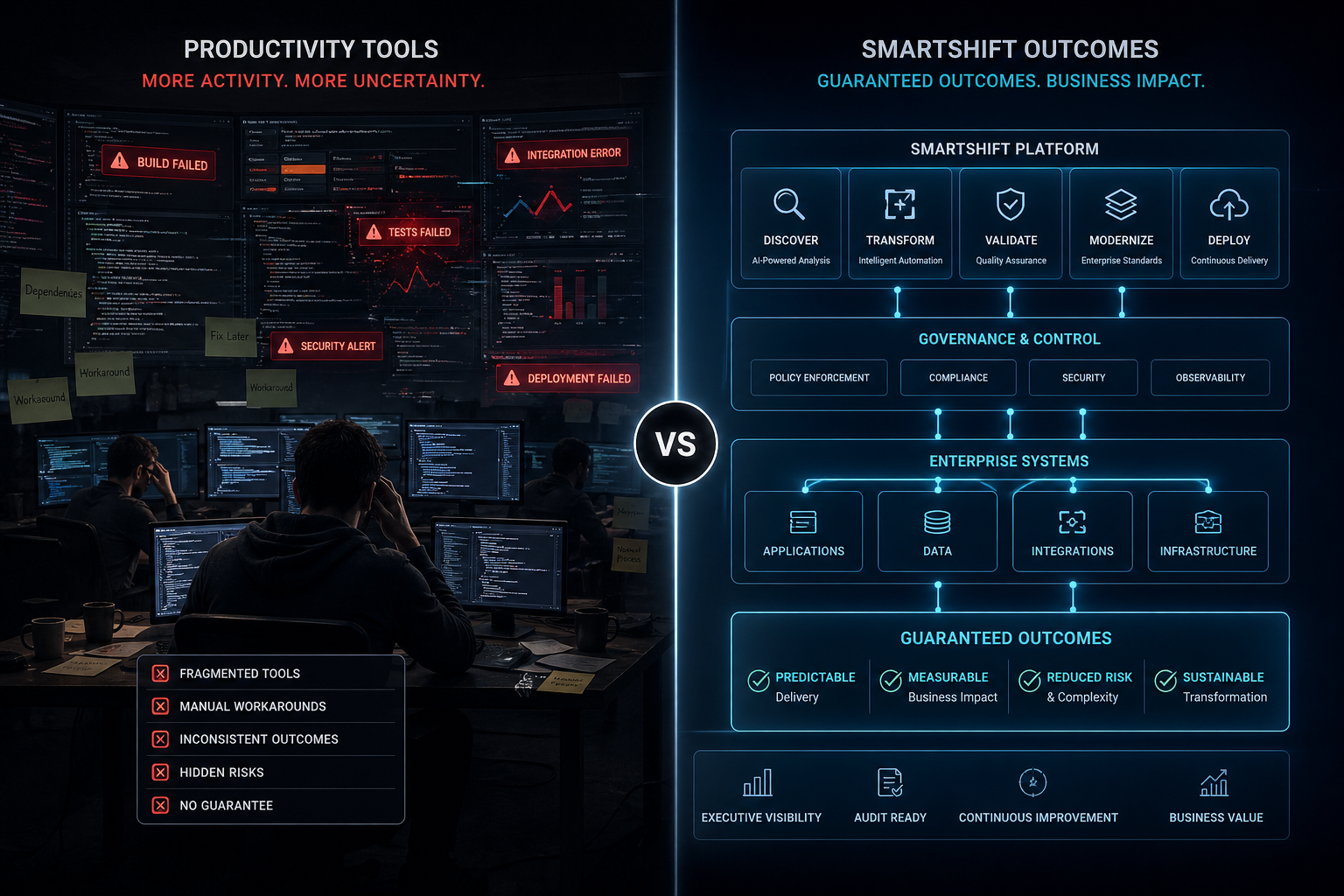
In many S/4HANA conversion programs, SAP custom code remediation remains developer-led, supported by analysis and automation tools. Teams review impacted objects and implement object-level code changes, often followed by substantial manual validation.
Development work may use environments such as ADT or SE80, while SPAU/SPDD supports SAP modification adjustments, and relevant SAP Notes may address specific conversion requirements. ABAP Test Cockpit (ATC) and simplification checks provide important visibility into technical impacts.
ATC and simplification checks are valuable identification tools, but they do not deliver repository-wide remediation on their own. Developers still need to interpret many findings, implement or validate changes, and manage consistency across the codebase. The resulting dependence on individual expertise can extend timelines and leave latent issues unresolved.
As a result, remediation can vary across teams, increasing the risk of inconsistencies, missed issues, and incomplete coverage.
This developer-driven model creates several operational challenges, including the following:
- Extended timelines: Large, complex SAP landscapes can require months or longer to remediate through developer-driven approaches
- High defect risk: Manual changes increase the likelihood of regressions and incomplete fixes
- Resource dependency: Heavy reliance on experienced ABAP developers, who are often limited and costly
- Limited scalability: Difficult to apply consistent remediation across thousands of custom objects
- Increased cost and disruption: Prolonged timelines and rework drive up project costs and impact business operations
Ultimately, developer-driven SAP custom code remediation struggles to deliver the speed, consistency, and full-codebase coverage modern S/4HANA transformation programs require.
Why Is Remediation Alone Not Enough for SAP Modernization?
Minimal, developer-led remediation focuses primarily on making custom code function correctly in the target S/4HANA environment. That narrower scope may leave performance, security, stability, maintainability, and technical debt issues unaddressed.
Modernization addresses different decisions about how customizations should evolve. Depending on business value and architecture, organizations may redesign, replatform, retain and adapt, or retire customizations as part of an ongoing clean core journey.
smartShift Code Transformation bridges technical remediation and longer-term modernization. Automation addresses compatibility, performance, security, stability, modernization, and maintainability across the in-scope codebase while reducing developer-dependent variability. Usage and dependency insights also support decommissioning and lifecycle decisions before, during, and after conversion.
The approach improves delivery predictability during S/4HANA conversion and establishes a stronger foundation for ongoing modernization.
How Does smartShift Intelligent Automation® Transform SAP Custom Code?
smartShift Intelligent Automation® is purpose-built for enterprise SAP custom code transformation. Backed by more than 20 years of SAP transformation experience and patented automation technology, smartShift applies deterministic, rule-based automation where precision and repeatability are critical.
How Does Intelligent Automation Analyze Custom Code at Scale?
smartShift analyzes the full custom code landscape, evaluating dependencies, usage, and S/4HANA compatibility across thousands of objects. smartShift applies the automation method best suited to each use case. Deterministic automation supports transformations where accuracy and repeatability are critical, while AI can support semantic analysis and other modernization use cases within governed workflows.
What SAP Custom Code Remediation and Optimization Capabilities Does smartShift Provide?
smartShift enables automated code remediation and transformation to prepare systems for SAP S/4HANA. Core capabilities include:
- S/4HANA compatibility remediation
- Performance, security, and stability optimization
- Modernization and maintainability improvements
- Usage and decommissioning insights for controlled retirement decisions
- Clean core and ABAP Cloud readiness where included in scope
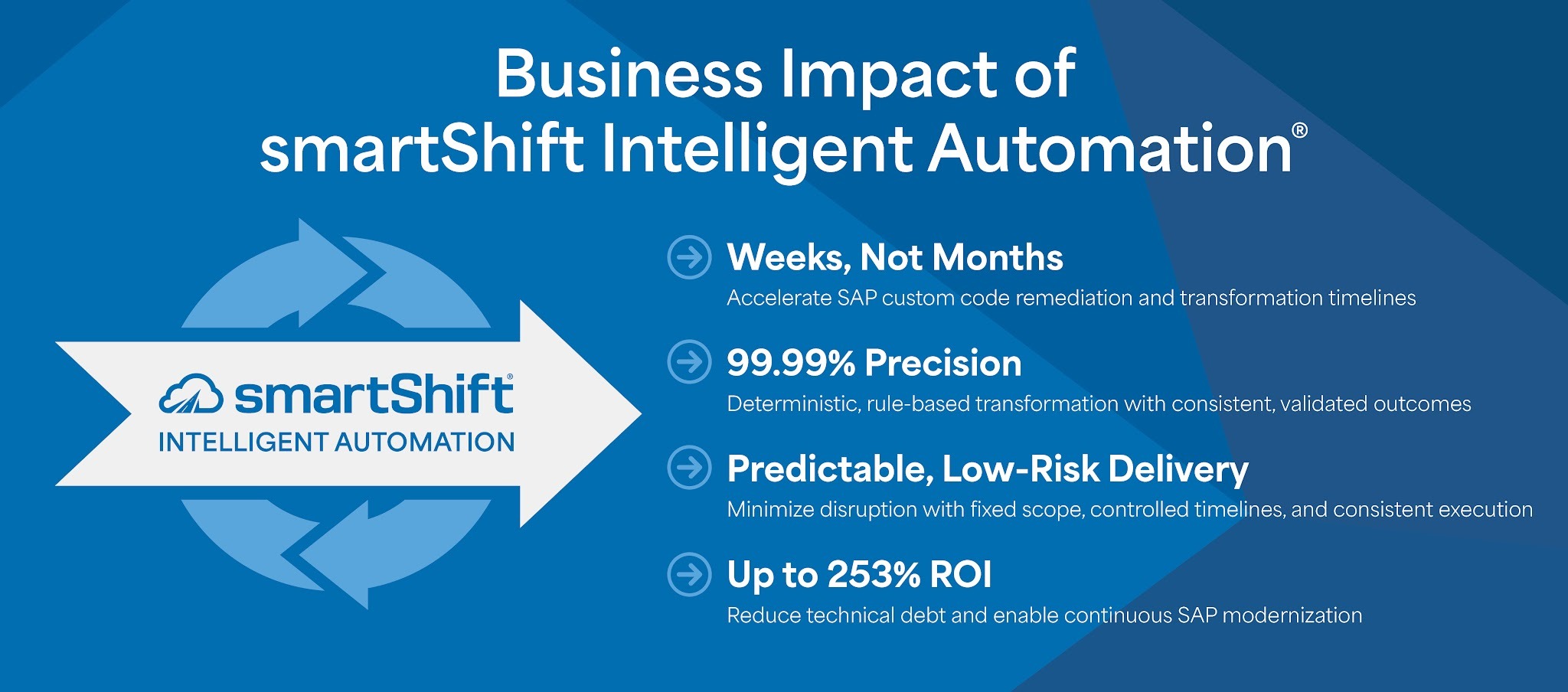
By combining precision automation with proven transformation logic, smartShift enables organizations to reduce developer-dependent remediation effort, reduce risk, and accelerate SAP transformation with predictable, enterprise-scale outcomes.
How Does smartShift Manage SAP Custom Code Across the Lifecycle?
smartShift brings more than 20 years of SAP custom code experience across thousands of transformed systems and billions of lines of code. Its approach combines analysis, automated transformation, lifecycle decisions, validation, and ongoing synchronization rather than treating custom code as a one-time project.
Analyze and Scope
Analyze the complete in-scope custom ABAP repository to identify dependencies, usage, compatibility issues, performance concerns, security risks, stability issues, and modernization requirements.
Transform and Optimize
Apply automated remediation and optimization across compatibility, performance, security, stability, modernization, and maintainability requirements with consistent, traceable execution.
Rationalize and Govern
Use usage, dependency, and clean core insights to inform modernization decisions across the custom landscape. Depending on the business and technical requirements, customizations may be redesigned, replatformed, retained and adapted, or retired. These lifecycle decisions can occur before, during, and after conversion.
Synchronize and Manage
Validate transformed code and use Automated Dual Maintenance™ to keep active and project landscapes aligned, reducing the need for restrictive code freezes while supporting ongoing business development.
Together, these capabilities reduce scope uncertainty, developer-dependent variability, and transformation risk while providing a foundation for continuous custom code lifecycle management.
How Has smartShift Delivered SAP Custom Code Transformation at Enterprise Scale?
Organizations across industries are using smartShift’s Intelligent Automation® to accelerate SAP transformation while reducing risk, cost, and operational disruption.
Potters Industries worked with smartShift on a custom code repository containing 629,351 lines of code across 4,783 custom objects. smartShift completed the transformation in four weeks, with only two objects requiring minor adjustment during testing. The project finished under budget and production continued without impact.
Dis-Chem used smartShift to address 79,000+ coding issues across 1.35 million lines of custom code and decommission 34% of its codebase. The project reached its S/4HANA go-live on time, with only three defects identified during testing and minimal business disruption.
UGL, an Australian engineering and construction company, used smartShift to address 149,000+ coding issues across 2.1 million lines of code and more than 27,000 custom objects. Development-system remediation was completed in four weeks, and the S/4HANA and RISE with SAP program went live in six months with seven custom-code defects identified during testing and minimal business impact.
How Does smartShift Bridge SAP Custom Code Remediation and Sustainable Modernization?
Effective SAP custom code remediation establishes compatibility and helps preserve business functionality during S/4HANA conversion. smartShift Code Transformation extends that work across compatibility, performance, security, stability, modernization, maintainability, and decommissioning insights through enterprise-scale automation.
The approach improves delivery predictability and creates a stronger foundation for ongoing modernization and clean core readiness. Custom code continues to change after go-live, so enterprises also need continuous visibility, transformation, synchronization, and governance across the lifecycle.
Frequently Asked Questions
What is automated code remediation in SAP?
Automated code remediation is the use of software-driven, rule-based automation to analyze and correct SAP custom code for S/4HANA compatibility. Instead of manually reviewing each object, automation applies proven transformation logic across the full codebase, accelerating SAP custom code remediation, reducing errors, and improving consistency in SAP code correction and S/4HANA conversion projects.
How does smartShift use AI and automation for SAP custom code transformation?
smartShift uses a combination of deterministic automation and AI based on the requirements of each use case. Deterministic, rule-based automation supports transformations where precision, repeatability, and trusted outcomes are critical. AI can support semantic analysis and modernization scenarios where contextual judgment adds value. The governed combination allows smartShift to apply the appropriate technology without depending on generative AI for deterministic remediation.
How does smartShift handle the full scope of SAP legacy ABAP code challenges?
smartShift analyzes custom code across dependencies, usage, compatibility, performance, security, stability, modernization, and maintainability. Automation remediates and optimizes code at scale, while usage and dependency insights identify objects that may be candidates for controlled decommissioning. Dual Maintenance and ongoing lifecycle capabilities help organizations continue managing custom code as SAP systems and business requirements change.
How does smartShift improve reliability in automated SAP custom code transformation?
smartShift applies validated automation consistently across enterprise-scale code repositories and combines that execution with fixed-price, fixed-timeline commitments and structured validation. smartShift has transformed more than 3,300 SAP systems and more than 4 billion lines of code, with 99.99% automation accuracy reported in current company materials.
How does smartShift support clean core readiness in SAP S/4HANA transformations?
smartShift supports the clean core journey by providing visibility into custom code, dependencies, usage, and modernization opportunities. Automated remediation and optimization reduce immediate technical risk, while analysis helps teams decide what to redesign, replatform, retain and adapt, or retire. Those lifecycle decisions can continue before, during, and after conversion as organizations modernize their SAP environments over time.
What results can organizations expect from smartShift’s SAP custom code transformation approach?
Organizations using smartShift’s automated code transformation approach typically achieve faster remediation cycles, significant reductions in manual effort, and lower regression risk during testing. By automating remediation at scale, smartShift accelerates S/4HANA upgrade timelines, can reduce carried-forward scope through controlled decommissioning, and brings predictability to costs and delivery. As a result, SAP teams can focus on higher-value innovation while executing transformation with greater speed, control, and confidence.
How does smartShift ensure quality and validation in automated SAP custom code transformation?
Quality is embedded throughout the smartShift transformation process through deterministic, rule-based automation and proven transformation logic refined across billions of lines of SAP code. Transformation rules are applied consistently and traceably across the in-scope codebase, ensuring alignment with SAP standards. Built-in validation and structured testing confirm S/4HANA compatibility, performance, and stability, significantly reducing regression risk and delivering predictable, high-quality outcomes at enterprise scale.