ABAP Code Remediation vs Application Modernization: What to Do First on the Road to S/4HANA
July 28th, 2026
9 min read
By Steve Copans

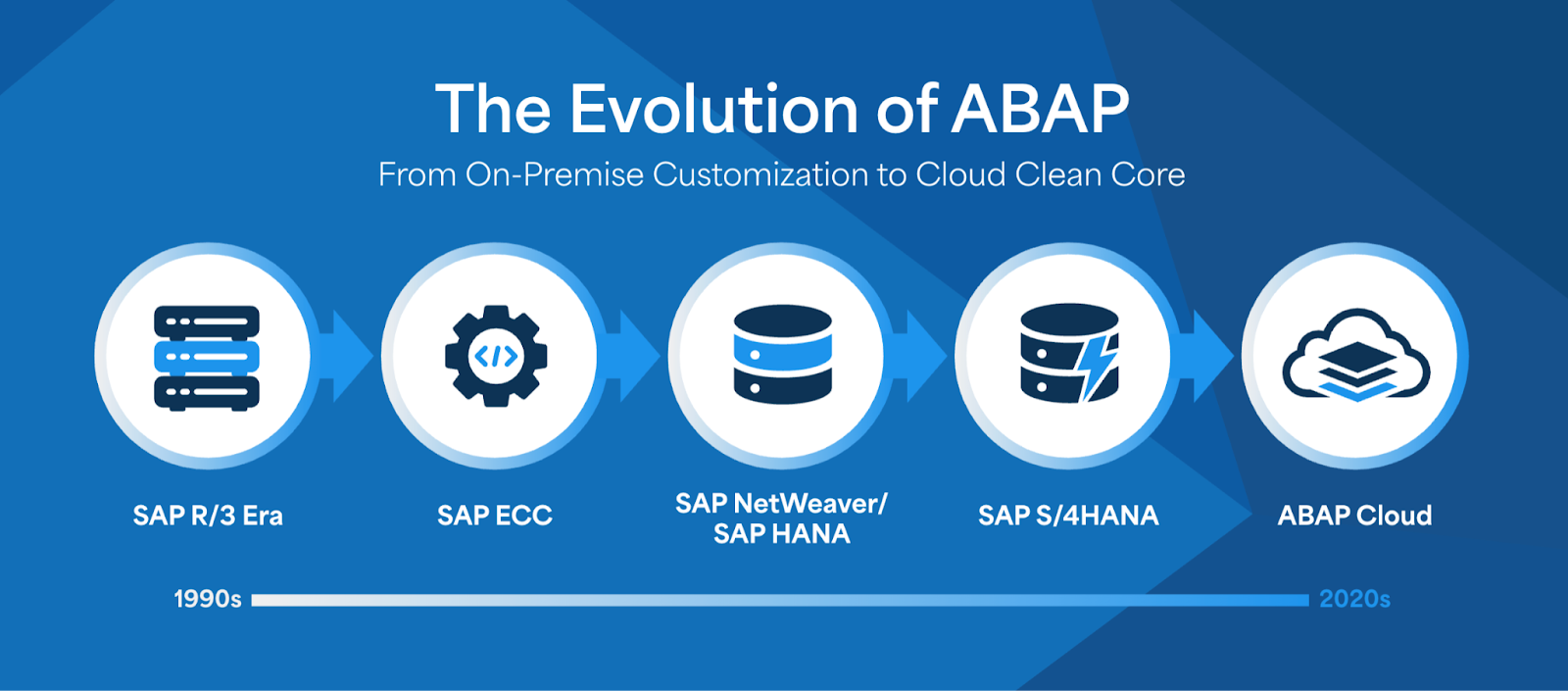
Moving from SAP ECC to SAP S/4HANA forces a practical question: Do we remediate our legacy ABAP code, or do we focus on modernizing our customization to fit into new “clean core” paradigms? What do you do now, and what can wait?
Here’s the reality most enterprise teams encounter: you can’t jump straight from legacy ECC customization to a completely “clean core” S/4HANA implementation without introducing major risk, cost, and timeline pressure. In fact, for customers with a lot of existing custom ABAP development, pure “clean core” deployment is impossible because there is no guarantee that SAP has provided clean core pathways that substitute for every customization you’ve made. Before you can modernize strategically, you need to ensure your custom code works reliably in the target environment and your business can operate on day one.
So if you need to retain any of your existing customization, the decision is never “either/or.” It’s a progression:
- Step 1: ABAP code remediation to ensure compatibility and business continuity at go-live
- Step 2: ABAP code modernization selectively once you’re stable on S/4HANA and can modernize with governance, ROI focus, and lower disruption
This article explains the difference between ABAP code remediation and ABAP code modernization, when each approach makes sense, and how to plan a roadmap that balances speed, stability, and long-term clean core goals.
Terminology note: In this post, we’ll refer to the move from ECC to S/4HANA as “conversion,” and reserve the term “migration” for infrastructure or database moves (e.g., Oracle to HANA) to keep the language consistent.
What Is ABAP Code Remediation?
ABAP code remediation is the process of updating existing ECC custom ABAP so it runs correctly after an SAP S/4HANA conversion
The purpose is straightforward: Focus on technical changes to ensure uninterrupted operations post-go-live. The goal is not redesign or re-architecture. It’s ensuring legacy custom programs function correctly in the new S/4HANA environment.
Typical ABAP code remediation work includes:
- Fixing syntax errors that arise during S/4HANA conversion
- Updating obsolete or changed table references
- Adjusting database queries for the new data model
- Replacing deprecated function modules
- Resolving issues tied to SAP S/4HANA simplification items
Importantly, remediation preserves existing functionality and user experience to the fullest extent possible. Inputs and outputs remain the same, and end users typically see no changes other than the system operating reliably in S/4HANA, unless SAP mandates a change due to functional deprecation.
ABAP code remediation is often business-critical for hitting conversion timelines and protecting stability. However, remediation alone does not materially reduce technical debt or meaningfully advance clean core alignment. Rather, it carries forward many legacy design decisions that may need to be addressed later through a modernization roadmap.
What Is ABAP Code Modernization?
ABAP code modernization improves, redesigns, or re-implements custom ABAP code to align with modern SAP standards, evolving business needs, and clean core principles. Unlike remediation, which focuses on compatibility, SAP code modernization is about long-term agility; reducing technical debt, improving performance, and aligning with SAP’s extensibility approach.
Modernization typically answers higher-order questions, such as:
- Should this custom object be retained, redesigned, or replaced with a clean core alternative?
- Can we simplify by reverting to standard S/4HANA capabilities?
- What changes will improve user experience (UX), extensibility, or cloud readiness?
A practical caveat: Many organizations discover that attempting broad modernization during the S/4HANA conversion can lead to “analysis paralysis,” scope creep, and increased risk. That’s why modernization is most successful when it’s selective, staged, and built on a stable S/4HANA foundation.
Common SAP custom code modernization decisions are best understood through four strategic paths:
Retire
Decommission unused or inactive custom code that no longer supports business processes. In most SAP environments, a significant portion of custom objects are never executed in production. Safely retiring this “dead code” reduces migration scope, lowers risk, and simplifies testing.
Re-platform
Move selected custom logic out of the S/4HANA core into extension environments such as SAP BTP or other cloud platforms. This process supports clean core principles, reduces long-term maintenance effort, and improves flexibility for future innovation.
Redesign
Re-architect custom code that relies on obsolete technologies or no longer aligns with current business or technical requirements. This step often involves rethinking how functionality should be delivered in an S/4HANA-native or cloud-first model.
Retain and Adapt
Preserve complex or business-critical custom code that must remain within the S/4HANA core because no suitable released APIs, standard functionality, or clean core extension path currently exists. These entry points are adapted to support S/4HANA compatibility, improve stability and performance where possible, and reduce future maintenance risk while preserving required business functionality.
Together, these four pathways help organizations make consistent, portfolio-level decisions across the custom codebase rather than relying on ad hoc rebuilding or refactoring.
ABAP Code Remediation vs. Transformation vs. Modernization: The Core Differences
| Criteria | ABAP Code Remediation | smartShift Code Transformation | ABAP Code Modernization |
| Primary Goal | Achieve minimal S/4HANA compatibility based on subjective issue prioritization | Deliver full-codebase transformation with defined scope and timeline | Enable long-term business and technical innovation |
| Timeline | Short-term, project-based | Fixed timeline with predictable delivery | Ongoing, iterative process |
| Technical Debt | Carried forward and preserved | Significantly reduced through automated remediation and decommissioning | Reduced over time through redesign and architecture changes |
| Performance Impact | Not a primary objective | Improvement through targeted HANA and S/4HANA performance optimization rules | May improve depending on redesign approach (not guaranteed) |
| Clean core Alignment | Limited | Actively enabled through decommissioning, re-platforming, and alignment to modern extensibility models | High, if clean core principles are followed |
| Cloud Readiness | Basic compatibility | Supports cloud-ready standards where applicable (e.g., ABAP Cloud, released APIs, extensibility models), based on target architecture and feasibility | Strong, depending on architecture decisions |
| Scope and Scale | Selective, issue-by-issue | Mass transformation across the entire custom codebase | Selective, driven by business priorities |
| Delivery Model | Manual, developer-dependent | Automated, outcome-based with SLAs and guarantees | Programmatic varies by organization |
Why Remediation Alone Is Not Enough in the S/4HANA Era
Remediation is essential for a successful S/4HANA conversion, but it’s not the end of the journey. To fully support clean core and ongoing innovation, many organizations ultimately evaluate selective modernization after remediation.
That’s because SAP S/4HANA is more than a database upgrade. It reflects SAP’s broader shift toward clean core architecture, cloud readiness, and modern ABAP development paradigms. The goal is to keep the ERP system as close to standard as possible while managing extensions through approved frameworks such as SAP BTP, released APIs, CDS views, and in-app extensibility options.
Remediation gets you stable on S/4HANA. But if you stop there, you typically carry forward legacy design decisions that make future upgrades, cloud adoption, and innovation harder than they need to be. Long-term agility comes from pairing remediation with a modernization roadmap that steadily reduces legacy customization and aligns extensions to SAP’s standards.
When remediation is treated as the final step rather than the first phase of a broader transformation strategy, several limitations remain:
It Retains Technical Debt
Traditional remediation focuses on fixing compatibility issues but does not fundamentally address the underlying codebase. Legacy design decisions, obsolete logic, and inefficient structures are often carried forward into S/4HANA.
smartShift Code Transformation goes further. It includes code decommissioning to identify and safely retire unused or inactive custom objects. This reduces code volume, removes unnecessary complexity, and limits the technical debt carried into the new environment.
It Does Not Systematically Improve Performance
Traditional remediation ensures that custom code runs in S/4HANA, but performance optimization is not the objective. The focus is on compatibility, not applying targeted HANA and S/4HANA performance optimization rules across the codebase.
smartShift Code Transformation includes performance optimization within its scope. It applies specific HANA and S/4HANA performance optimization rules to improve code quality, stability, and efficiency where optimization opportunities are identified.
It Does Not Advance Alignment With SAP’s Extensibility Model
S/4HANA is built around released APIs, clean core principles, and modern extensibility patterns. Remediation makes existing code compatible, but does not align custom programs with these newer standards or architectures.
Over time, this gap becomes more pronounced as organizations adopt cloud platforms, expand integrations, and evolve business processes. As a result, many organizations that begin with remediation ultimately need to pursue modernization to support scalability, extensibility, and long-term innovation.
Modernization Comes After Stabilization
Not every custom object needs to be modernized during an S/4HANA conversion. For many organizations, the immediate priority is brownfield conversion, with the goal of remediating existing custom code, protecting business continuity, and reaching go-live with lower risk.
Once the system is stable on S/4HANA, modernization becomes a more strategic, selective discipline. Organizations can then evaluate where modernization will create the greatest value, such as:
- Improving user experience through Fiori
- Moving appropriate extensions to SAP BTP
- Supporting mobile enablement
- Reducing technical debt
- Improving upgrade readiness
This keeps modernization focused on business value rather than forcing a broad redesign into an already complex conversion timeline.
Some changes, such as aligning to S/4HANA data models like Business Partner, are mandatory for conversion, not modernization.
Choosing Between Remediation and Modernization
The decision between remediation and modernization should be driven by a clear understanding of the overall custom code landscape—not isolated, object-by-object decisions.
Organizations first need visibility into their full codebase, including usage, business value, technical complexity, and risk. This transparency enables a structured, portfolio-level strategy that determines what should be retired, remediated, or modernized.
In general, remediation is appropriate when the priority is to make existing custom code compatible with S/4HANA, preserve business continuity, and reduce conversion risk before making broader modernization decisions.
Modernization may be appropriate when:
- You have developed a mature governance model for how SAP customization will be handled once you’re running on S/4HANA
- A viable clean core path exists through standard SAP functionality, released APIs, SAP BTP, or another approved extension model
- The custom functionality can be redesigned or re-platformed without disrupting required business processes
- There is clear long-term value in changing the architecture, user experience, or extensibility model
Some highly differentiating customizations may not have a practical modernization path today. In those cases, remediation remains critical to preserve required functionality, support S/4HANA compatibility, and maintain business continuity.
Evaluation Criteria for Informed Decisions
Before making modernization decisions, organizations need a clear view of the custom code landscape.
Typical evaluation criteria include:
- Business value: Does the code support revenue, compliance, or critical operations?
- Technical complexity: How difficult and risky would transformation be?
- Usage: Is it used frequently or rarely accessed?
- ROI potential: Will changes deliver measurable usability, maintainability, or architectural value?
- Future readiness: Is there a viable path to align with clean core, cloud, or extensibility standards?
Identifying unused or redundant objects can reduce scope, while understanding business value and technical feasibility helps determine where modernization is practical after S/4HANA stability is achieved.
The Hybrid Approach: Remediate First, Modernize Selectively Later
Many organizations begin with a brownfield, remediation-first approach to minimize risk, control cost, and meet S/4HANA conversion timelines. Once stable, they can evaluate where selective modernization makes sense.
Over time, this may lead to a phased model:
- Remediate required custom code to ensure S/4HANA compatibility
- Retire unused or redundant objects
- Modernize only where a viable path exists and the long-term value justifies the effort
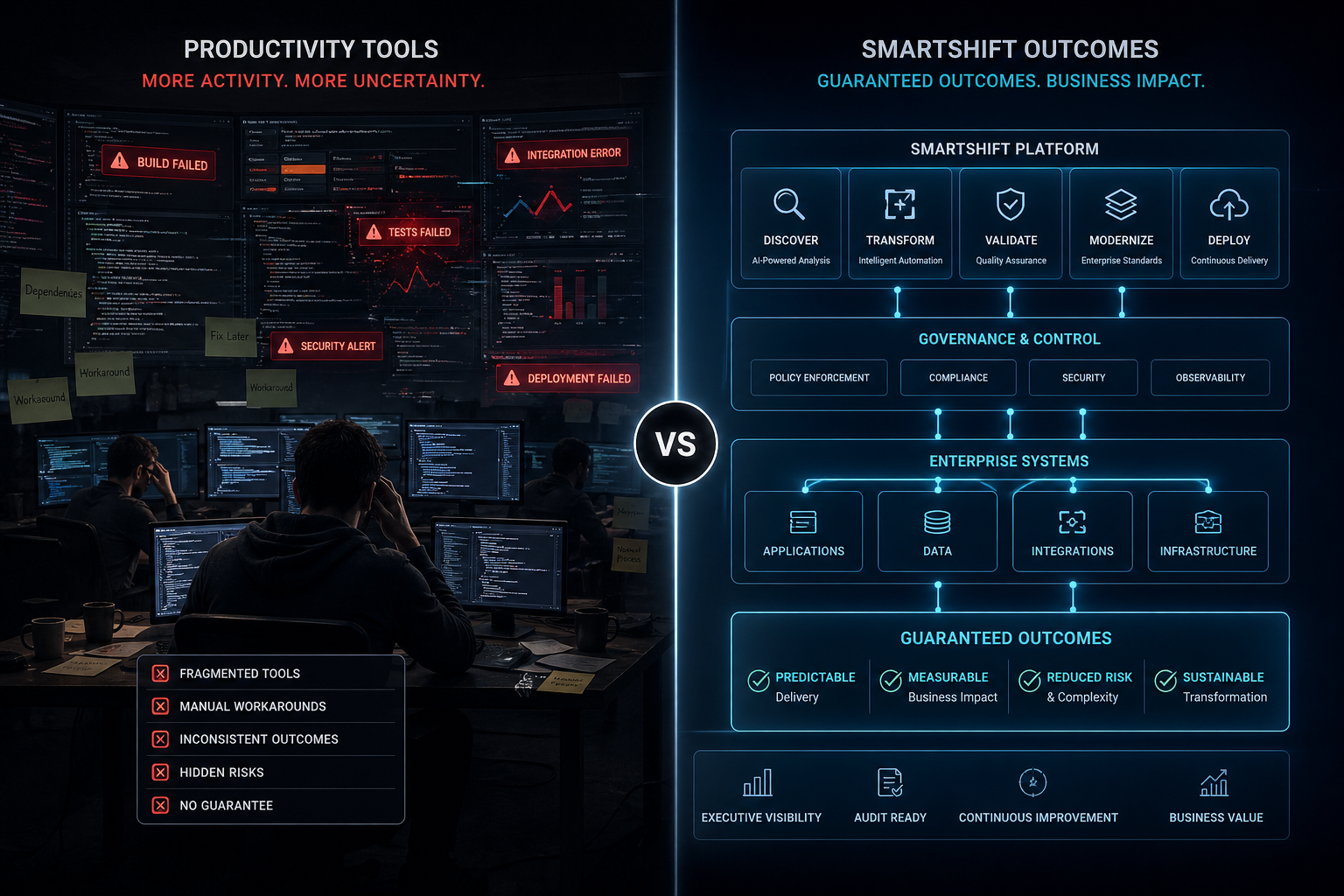
smartShift: Transforming SAP Custom Code with Automation and Guaranteed Outcomes
smartShift delivers automation-driven SAP custom code transformation, enabling enterprises to modernize, optimize, and future-proof their codebase with speed, precision, and predictability.
Unlike manual, object-by-object approaches, smartShift applies patented Intelligent Automation® across the entire custom codebase, addressing compatibility, performance, security, and technical debt at scale. The result is a consistent, high-quality transformation significantly faster than human-led approaches, with predictable outcomes.
smartShift capabilities include:
- Identifying and decommissioning unused or redundant custom code to reduce footprint and complexity
- Remediating code for S/4HANA compatibility across the full codebase
- Aligning custom code with clean core and modern SAP development standards
- Enabling ongoing transformation through automated dual maintenance and lifecycle support
Traditional approaches rely heavily on manual effort, leading to inconsistent outcomes, extended timelines, and increased risk. smartShift replaces this with an automation-first model that delivers predictable, audit-ready results across even the most complex SAP environments.
The impact is reduced risk, improved code quality, accelerated transformation timelines, and faster realization of S/4HANA value.
Download the IBM case study to see how millions of lines of custom code were transformed in months, with no disruption to business operations.
Final Thoughts
Remediation establishes a stable S/4HANA foundation. Modernization builds on that foundation to support long-term agility. The most effective approach treats them as sequential, not competing priorities.
Frequently Asked Questions
Q. Does modernization reduce technical debt?
A. Yes, modernization can reduce technical debt by simplifying logic, redesigning outdated functionality, re-platforming appropriate extensions, and aligning custom programs with modern SAP standards.
However, technical debt reduction is not limited to modernization. smartShift Code Transformation can also reduce technical debt during remediation by decommissioning unused or inactive custom code, improving performance, and applying automated code quality improvements.
SAP’s clean core strategy reinforces the broader goal of minimizing customization within the ERP core and using approved extensibility models wherever possible.
Q. Is modernization required for all custom code?
A. No. Not every ABAP program needs full modernization. Many custom programs should be remediated first to ensure S/4HANA compatibility and business continuity. Some unused or inactive programs may be retired through code decommissioning.
Modernization is considered later when there is a viable path to redesign, re-platform, or replace custom functionality in a way that supports long-term architecture goals, clean core alignment, or meaningful business value.
Q. Is modernization more expensive than remediation?
A. Generally, modernization has a higher upfront cost per program because it involves more extensive changes, such as redesign, re-platforming, or UX improvements. However, it often delivers higher long-term value by improving maintainability, scalability, and alignment with modern SAP standards.
Remediation is typically less expensive in the short term because it focuses on compatibility. However, when done manually, it can carry forward large amounts of technical debt, create quality and stability issues after go-live, and require additional effort in future upgrades or transformations.
Q. Can I modernize only a few critical custom programs and remediate the rest?
A. In many cases, the safer path is to remediate first and defer modernization until after the S/4HANA conversion is stable. With SAP’s 2027 mainstream support deadline approaching, adding modernization goals to an already complex conversion can increase scope, risk, and pressure on the timeline.
After go-live, organizations can evaluate selective modernization opportunities based on business value, technical feasibility, and available clean core pathways. This staged approach protects business continuity first, then supports longer-term modernization with more control.
Q. Is ABAP modernization required before moving to cloud-based S/4HANA?
A. It depends on the target S/4HANA deployment model and extensibility strategy. SAP S/4HANA Cloud, public edition; SAP S/4HANA Cloud, private edition; and SAP S/4HANA on-premise each have different custom code requirements, development options, and extensibility constraints.
RISE with SAP may shape the commercial path to S/4HANA, but it is not a separate technical deployment model. For many brownfield conversions, remediation comes first to protect business continuity and achieve S/4HANA compatibility. Modernization can then be evaluated later based on target architecture, available released APIs, clean core goals, and practical paths for redesign, re-platforming, or replacement.
Q. Does remediated code need to be modernized later?
A. Often, yes, remediated code needs to be modernized later. If you only remediate code now, you will likely still face decisions about that code later on as business needs evolve or when migrating to newer SAP releases/cloud. Remediation buys time by preserving functionality, but it does not eliminate technical debt. Planning future modernization is wise, either as a second phase of your project or as ongoing maintenance, to ensure your custom code remains relevant and efficient.
Over more than nine years at smartShift, Steve has designed, implemented, and supported truly transformative code modernization initiatives for some of the world's largest SAP customers. As Director of Solutions and Partner Enablement, Steve approaches SAP modernization from multiple perspectives, serving as a trusted advisor to clients, prospective clients, and partners alike. He brings over 25 years of broad-ranging experience in the technology space to find innovative solutions for complex problems.
Topics: