SAP Custom Code Transformation: The Key to Future-Proofing S/4HANA Upgrades
March 30th, 2026
12 min read

For many enterprises, the SAP S/4HANA upgrade has shifted from a one-time milestone to a recurring operational reality. SAP’s release cadence, evolving compliance requirements, and end-of-maintenance deadlines mean organizations must be prepared for continuous S/4HANA version upgrades, not isolated events.
Each new release promises innovation, performance improvements, and stronger security. Yet in heavily customized environments, upgrades often lead to extended timelines, budget pressure, and avoidable risk.
One significant source of recurring upgrade complexity is the accumulation of SAP custom code carried forward from release to release. As SAP introduces new extensibility models, modern coding standards, and stricter compliance controls, legacy developments can become misaligned with these changes. Code that functioned in a prior SAP S/4HANA upgrade may require remediation in the next, creating a cycle of reactive fixes rather than strategic modernization.
This pattern drives inefficiency. Teams repeatedly address compatibility issues, meet the deadline, and move on, only to face greater complexity in the next S/4HANA upgrade cycle.
Breaking that cycle requires a shift in approach.
This article explores why minimal remediation approach strategies fall short, outlines SAP upgrade best practices, and explains why proactive SAP custom code transformation is the foundation for sustainable SAP custom code modernization and future-ready S/4HANA operations.
Why SAP S/4HANA Upgrades Are Becoming More Complex Over Time
A modern SAP S/4HANA upgrade is no longer a routine technical exercise. With every release, SAP advances its data model, security framework, extensibility standards, and compliance controls. These changes directly affect existing SAP custom code, especially in highly customized landscapes.
What makes today’s S/4HANA version upgrades more challenging is not the core platform. It is the interaction between evolving SAP standards and legacy developments built under older assumptions.
In many cases, incompatibilities are not immediately visible. They surface during integration testing, regression cycles, or, worse, after go-live. The result is predictable:
- Expanded remediation scope
- Extended testing timelines
- Increased cross-team coordination
- Heightened business risk
What was once viewed as an incremental SAP S/4HANA upgrade is increasingly requiring substantial rework of custom objects. Without a structured SAP custom code transformation strategy, each upgrade compounds complexity.
Over time, reactive remediation becomes the norm, and every subsequent S/4HANA upgrade demands more effort than the last.
Breaking that trajectory requires treating custom code modernization as a strategic initiative, not an upgrade afterthought.
What Changes with Every New S/4HANA Release
Every SAP S/4HANA upgrade introduces technical shifts that directly impact how SAP custom code must be designed, secured, and maintained.
With each release, SAP advances:
- Coding standards and language restrictions
- Security and compliance validation requirements
- Supported extensibility frameworks
- Upgrade-safe development models
Custom logic built on legacy patterns, such as direct table access, implicit enhancements, tightly coupled integrations, or outdated APIs, can fall out of alignment with these updates.
The challenge is rarely obvious at the start of an S/4HANA version upgrade. Not all incompatibilities are detected in early analysis. Many surface during integration testing or late-stage validation, where remediation becomes more disruptive and expensive.
Without a proactive SAP custom code transformation strategy, organizations risk discovering upgrade blockers when timelines are already compressed.
Each new release raises the bar. The question is whether your SAP custom code modernization efforts are keeping pace or compounding risk with every upgrade cycle.
Why the Next S/4HANA Upgrade Is Harder
When SAP custom code is remediated only to “pass” a specific SAP S/4HANA upgrade, the underlying complexity remains.
Obsolete objects are left in place. Unused developments are carried forward. Legacy patterns that narrowly meet current requirements persist in the system. Technical debt is not reduced; rather, it is deferred.
The next S/4HANA version upgrade begins with a larger codebase, more interdependencies, and a greater volume of issues to assess. What should be an incremental S/4HANA upgrade becomes a broader remediation effort, demanding expanded testing cycles and additional functional validation.
Instead of upgrades becoming easier over time, they become progressively harder.
This is the cost of reactive remediation.
Without a structured SAP custom code transformation and modernization strategy, each release compounds complexity. Sustainable SAP custom code modernization changes that trajectory, reducing the volume of future remediation and turning upgrades from recurring disruption into predictable, manageable events.
The Risk of Minimal Custom Code Remediation During S/4HANA Upgrades
Under pressure to meet deadlines, many organizations define an SAP S/4HANA upgrade with a narrow objective: achieve technical compatibility and go live.
That approach creates what can be described as minimal remediation projects. These are initiatives focused on clearing the immediate hurdle without addressing structural weaknesses in the SAP custom code landscape.
At first glance, this seems efficient. In practice, it defers risk to the next S/4HANA version upgrade.
Minimal remediation S/4HANA upgrade programs typically result in:
- Resolving visible incompatibilities while deeper architectural issues remain
- Carrying obsolete and unused SAP custom code forward
- Accumulating technical debt release after release
- Relying on manual remediation that introduces inconsistency and error
- Expanding regression and integration testing cycles
- Leaving security, compliance, and performance gaps unresolved
- Increasing business disruption with each successive SAP S/4HANA upgrade
Most critically, a “do minimum” strategy does not make future upgrades easier.
When remediation focuses solely on passing ATC checks or resolving high-priority findings, the underlying codebase remains unchanged. Legacy patterns persist. Redundant objects accumulate. Interdependencies grow more complex.
The next SAP S/4HANA upgrade then begins from a weaker position, such as a larger scope, greater testing effort, and higher uncertainty.
This inflection point is where SAP custom code transformation fundamentally differs from incremental fixes.
Rather than reacting to compatibility findings one release at a time, transformation addresses the structural drivers of upgrade risk:
- Eliminating unused and redundant developments
- Refactoring code to align with modern, upgrade-safe standards
- Strengthening performance and security posture
- Enforcing consistent development patterns across the landscape
In short, minimal remediation approach projects optimize for deadline compliance, while SAP custom code modernization optimizes for long-term upgrade stability.
Why Custom Code Transformation Is Essential for S/4HANA Upgrades
An SAP S/4HANA upgrade changes your system version. SAP custom code transformation changes the resilience of your codebase.
That distinction matters.
An S/4HANA upgrade ensures compatibility for the current release. It fixes what must be addressed before go-live.
SAP custom code modernization addresses what will create risk in the next release and the one after that.
In highly customized environments, SAP custom code reflects years of layered development, shifting business requirements, and inconsistent architectural standards. Without a structured transformation strategy, each S/4HANA version upgrade repeats the same pattern: assess, remediate, test, repeat.
SAP custom code transformation breaks that cycle by addressing root causes, not just surface-level findings:
- Reducing the active code footprint by eliminating unused and redundant objects
- Refactoring developments to align with modern, upgrade-safe standards
- Strengthening performance, security, and compliance posture
- Establishing consistent governance across the SAP landscape
When executed proactively, SAP custom code transformation reduces the volume of future upgrade findings, shortens regression cycles, and improves predictability across every SAP S/4HANA upgrade.
Organizations that embed transformation into their SAP upgrade best practices do more than clear the next milestone. They create a codebase designed for continuous S/4HANA upgrades that is stable, compliant, and scalable.
Why Manual Custom Code Remediation Doesn’t Scale
Manual SAP custom code remediation may appear viable in limited environments. However, at enterprise scale, it breaks down.
Large SAP landscapes contain thousands of custom objects, complex interdependencies, modification adjustments, and edge cases. Analyzing and correcting these manually during an SAP S/4HANA upgrade introduces variability at every step.
Human-led remediation is:
- Time-intensive and resource-dependent
- Price unpredictability leading to customer budget overruns
- Inconsistent across teams and releases
- Difficult to validate at scale
- Hard to repeat reliably in the next S/4HANA version upgrade
Even when supported by tools like ATC, manual approaches focus on identifying issues rather than structural correction. Developers address findings individually, often under compressed timelines, increasing the risk of regression defects and performance degradation.
As the codebase grows, the effort required for each SAP S/4HANA upgrade expands proportionally. Manual remediation does not reduce future scope. It preserves it.
At the enterprise level, scalability requires automation-driven SAP custom code transformation, not developer-by-developer fixes.
How Transformation Changes the Economics of Upgrades
When SAP custom code is transformed rather than patched, the economics of an SAP S/4HANA upgrade fundamentally change.
Projects focused only on minimum compatibility fixes treat each release as a new cost center. The same categories of findings reappear. The same remediation effort is repeated. Testing scope remains high.
SAP custom code transformation alters that trajectory.
By eliminating unused objects, aligning development with modern standards, and reducing architectural complexity, organizations reduce the volume of future upgrade findings. The results include:
- Smaller remediation scope in each S/4HANA version upgrade
- Shorter regression and integration testing cycles
- Lower functional validation effort
- Reduced reliance on scarce ABAP expertise
- Greater predictability in timeline and cost
Instead of costs compounding with every SAP S/4HANA upgrade, effort stabilizes and, in many cases, declines over time.
This benefit represents the critical difference between recurring disruption and managed continuity.
Transformation converts the SAP upgrade process from reactive expenditure into a controlled, repeatable operating model aligned with SAP upgrade best practices.
Why Upgrading and Modernizing Don’t Have to Be Separate Projects
A common misconception is that organizations must choose between completing an SAP S/4HANA upgrade now and pursuing SAP custom code modernization later.
In practice, the path is sequential, not optional.
You do not jump directly from legacy custom code to full modernization. You move in stages.
A successful SAP S/4HANA upgrade first requires structural remediation of custom code to ensure compatibility, stability, and business continuity. That is the immediate priority. Attempting a large-scale redesign during conversion introduces unnecessary risk.
However, stopping at basic remediation creates a different problem: it carries forward legacy complexity, making future modernization harder.
This point is where the SAP custom code transformation serves as the bridge.
Transformation goes beyond manual fixes, but it does not attempt a full redesign. It stabilizes, optimizes, and structurally improves the codebase during the S/4HANA version upgrade, enabling modernization to occur in a controlled, planful manner afterward.
In other words:
- Remediation gets you to S/4HANA.
- Transformation strengthens the foundation.
- Modernization becomes achievable without disruption.
When organizations embed transformation into their SAP upgrade best practices, they avoid the false choice between “upgrade now” and “modernize later.” They create a disciplined progression from compatibility to resilience to long-term evolution.
The SAP S/4HANA upgrade is not the moment for a big-bang modernization. It is the moment to establish the structural integrity that makes modernization a realistic prospect.
Why Transformation Must Happen During the Upgrade
An SAP S/4HANA upgrade concentrates executive attention, funding, and cross-functional alignment around the system. That alignment is temporary.
After go-live, budgets close. Stabilization becomes the priority. Business stakeholders shift their focus to new initiatives. What was labeled as a “next phase” improvement often becomes deferred technical debt.
The SAP S/4HANA upgrade is the most strategic opportunity to execute transformation.
The objective is not to modernize full-scale SAP custom code during conversion. The objective is structural improvement while the system is already under analysis and governance control.
During the SAP S/4HANA upgrade window:
- Custom code is already being assessed
- Testing cycles are already planned
- Risk mitigation is already funded
- Change governance is already active
Executing the transformation in this phase avoids reopening the system later for a second wave of disruption. It strengthens the codebase before it becomes the foundation for future innovation.
How Dual Maintenance Reduces Business Disruption
One concern during an SAP S/4HANA upgrade is the potential for an operational freeze.
Extended code freezes delay innovation, create backlog pressure, and increase business frustration. A structured dual maintenance approach reduces that risk.
By maintaining SAP custom code in both the current and target systems during the upgrade, organizations can:
- Limit freeze periods
- Continue controlled development activity
- Prevent backlog accumulation
- Ensure new enhancements align with upgrade-safe standards
Dual maintenance supports business continuity while SAP custom code transformation occurs in parallel. It allows the organization to stabilize and improve the technical foundation without halting operational progress.
The result is a smoother SAP S/4HANA upgrade, reduced business disruption, and a target system that is structurally prepared for continuous S/4HANA version upgrades from day one.
Why Automation Is Essential for Scalable and Predictable S/4HANA Upgrades
Large, complex environments contain tens of thousands of custom objects and millions of lines of SAP custom code. Addressing compatibility findings manually during each S/4HANA version upgrade is slow, inconsistent, and inherently risky. It limits scope, increases the risk of human error, and creates unpredictable timelines.
Automation is the critical solution. An automation-first approach enables comprehensive SAP custom code transformation across the entire codebase, not selective fixes designed to meet the next deadline.
With automation-led transformation:
- All relevant SAP custom code is remediated, not just high-priority findings
- Obsolete and unused objects are eliminated, reducing technical debt
- Coding, security, compliance, and extensibility standards are applied consistently
- Clean Core principles are enforced during execution, not deferred as a future initiative
- Upgrade timelines become predictable, minimizing business disruption
- The landscape is positioned for future S/4HANA upgrades and extensibility
Instead of fixing what breaks and repeating the cycle, automation transforms the structural integrity of the codebase. It prepares it for controlled modernization, creating a cleaner foundation that makes every subsequent SAP S/4HANA upgrade faster, lower-risk, and more predictable.
For organizations defining their SAP upgrade best practices, automation is a scalable path to sustainable, future-ready S/4HANA operations.
Business Outcomes of Custom Code Transformation
Embedding SAP custom code transformation into your SAP S/4HANA upgrade strategy delivers measurable, enterprise-level impact, not just technical compatibility.
Reduced Risk, Timelines, and Rework
A structured, automation-led SAP custom code transformation reduces structural complexity during the S/4HANA version upgrade.
Instead of resolving the same categories of findings in every SAP S/4HANA upgrade, transformation addresses root causes. Unused objects are eliminated. Interdependencies are reduced. Performance inefficiencies are corrected.
The result:
- Lower upgrade risk
- Compressed remediation scope
- Shorter testing cycles
- Greater execution predictability
Remediation ensures compatibility, while transformation improves the integrity of the codebase itself.
Improved Stability, Performance, and Security
Transformed SAP custom code aligns with current architectural, security, and compliance standards.
By enforcing consistent development patterns and eliminating structural fragility, organizations reduce regression risk and improve operational stability. Performance improves not through redesign, but through structural optimization.
This process strengthens governance posture and reduces exposure during audits or future platform changes.
Faster and Simpler Future S/4HANA Upgrades
The most strategic outcome of SAP custom code transformation is upgrade stability over time.
When transformation is embedded into SAP upgrade best practices, each SAP S/4HANA upgrade begins from a cleaner, more controlled baseline. Complexity is reduced rather than compounded.
Findings decrease. Testing cycles shorten. Predictability improves.
Modernization can then be achieved deliberately and in phases, built on a strengthened foundation rather than layered atop legacy instability.
Companies That Need to Pay Attention
SAP custom code transformation is most urgent for organizations approaching critical SAP S/4HANA upgrade milestones while carrying forward complex legacy development.
This criticality is particularly relevant for:
- Companies running SAP S/4HANA 1709, 1809, or 1909, where extended maintenance ends on December 31, 2025
- Organizations on SAP S/4HANA 2020, where regular maintenance also ends on December 31, 2025
- Enterprises planning a near-term SAP S/4HANA version upgrade under compressed timelines
- Teams that are struggling with manual remediation cycles and developer-heavy upgrade models
- Landscapes that are heavily dependent on legacy SAP custom code built under outdated architectural assumptions
- Organizations carrying forward obsolete or unused objects, compounding technical debt
- SAP environments where each S/4HANA upgrade has resulted in longer regression cycles and greater business disruption
For these organizations, the risk is not simply meeting the next deadline. It is entering another upgrade cycle with the same structural complexity that created friction in the last one.
As maintenance windows close and release cadences accelerate, minimal remediation approaches become increasingly unsustainable. Without structured SAP custom code transformation embedded into SAP upgrade best practices, each SAP S/4HANA upgrade demands more effort, more testing, and more risk mitigation than the previous one.
The organizations that need to pay attention are those that recognize a pattern: rising upgrade effort, growing custom code volume, and diminishing predictability.
Transformation is the inflection point that changes the trajectory.
The Urgency of Acting Now
SAP S/4HANA upgrade deadlines are fixed. Maintenance timelines do not adjust to internal indecision.
As end-of-maintenance milestones approach, the margin for strategic execution narrows. Waiting until the final window often forces organizations into compressed, remediation-only projects focused on technical compatibility rather than structural improvement.
That approach may achieve go-live, but it does not improve the foundation.
When SAP custom code transformation is deferred during an S/4HANA version upgrade, legacy complexity is carried forward into the new release. The consequence is predictable:
- Expanded remediation scope
- Longer regression and validation cycles
- Increased dependence on scarce ABAP expertise
- Greater business disruption with each successive SAP S/4HANA upgrade
What is not structurally addressed during the upgrade window does not disappear. It compounds.
Acting now does not mean attempting full-scale SAP custom code modernization during conversion. It means executing disciplined transformation while governance, funding, and executive focus are already aligned.
What You Get with smartShift
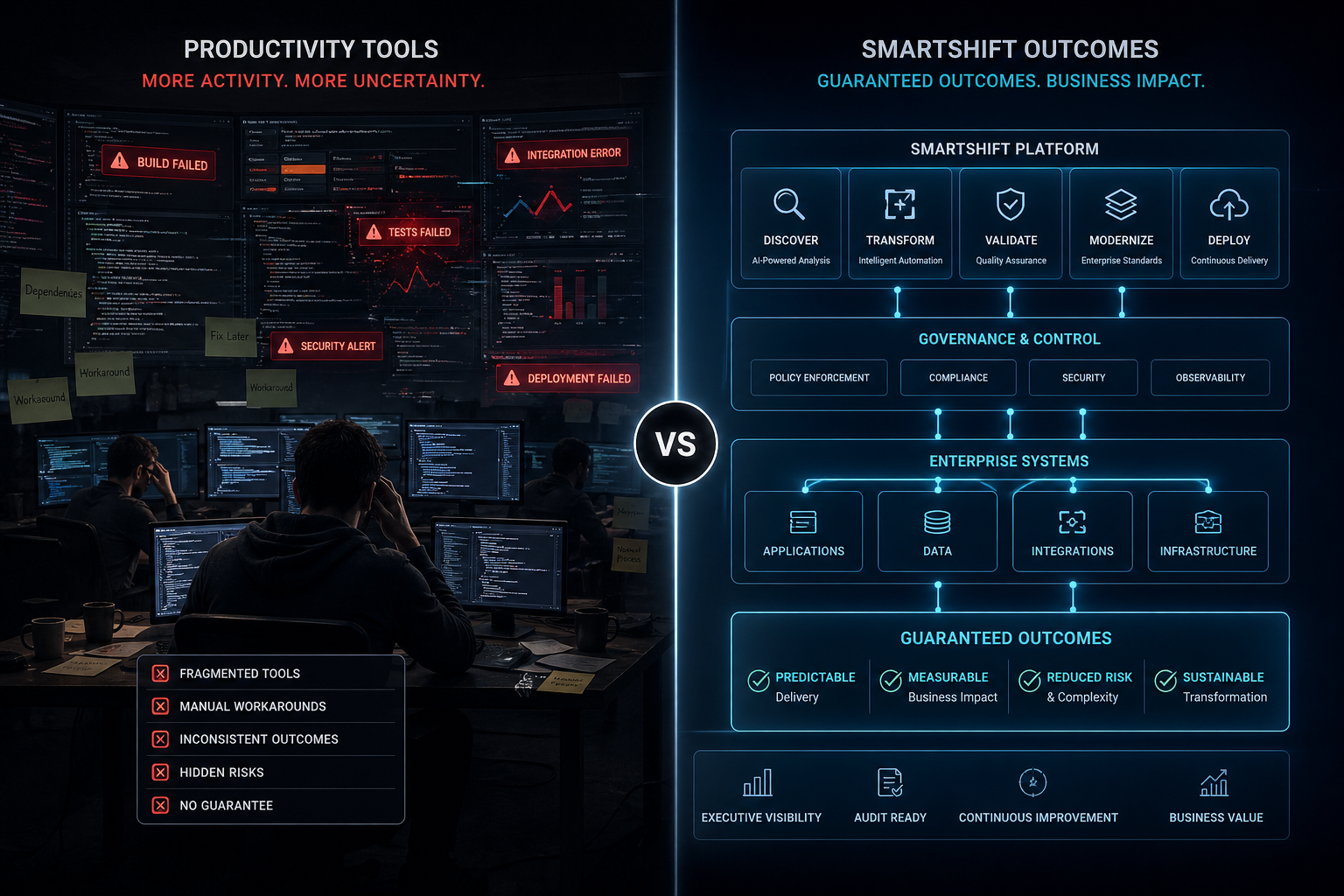
smartShift enables automation-driven SAP custom code transformation during your SAP S/4HANA upgrade without introducing big-bang disruption.
smartShift applies structured, rule-based automation across the entire codebase. The result is not just compatibility, but structural improvement.
With smartShift, organizations achieve:
- Comprehensive SAP custom code remediation at scale
- Elimination of obsolete and unused objects
- Performance and security optimization aligned with modern standards
- Reduced regression scope and shorter testing cycles
- Greater predictability in timeline and execution
smartShift ensures your codebase is technically sound, structurally strengthened, and ready for controlled modernization afterward.
Remediation gets you to SAP S/4HANA. smartShift transformation ensures you arrive on a stable foundation.
That foundation is what makes future S/4HANA upgrades faster, lower-risk, and economically sustainable.
Accelerate Seamless SAP S/4HANA Version Upgrades
Automation-driven SAP custom code transformation reduces structural friction during every SAP S/4HANA upgrade.
By eliminating unnecessary complexity and comprehensively addressing compatibility, organizations shorten timelines, reduce rework, and minimize business disruption.
Upgrades become controlled and predictable rather than reactive.
Automated Code Remediation
Manual remediation does not scale across complex SAP landscapes.
smartShift applies rule-based automation across the entire codebase, eliminating variability, reducing errors, and ensuring consistent, high-quality results at scale.
Compatibility is achieved systematically, not selectively.
Proactively Improve Performance, Stability, and Security
Structural transformation strengthens system integrity during the SAP S/4HANA upgrade.
By optimizing performance, eliminating obsolete objects, and aligning with modern standards, organizations improve stability and reduce risk from day one.
Reduce Freeze Windows and Enable Continual Innovation
Extended freeze periods disrupt business momentum.
Through dual maintenance, smartShift maintains SAP custom code in both source and target systems, reducing freeze duration and allowing innovation to continue during the upgrade.
Lay the Foundation for Clean Core and SAP BTP Adoption
Transformation during the SAP S/4HANA upgrade establishes the structural foundation for future alignment with Clean Core and SAP BTP adoption.
Modernization can be achieved in a controlled, phased manner and is built on a strengthened codebase.
Why Choose smartShift
smartShift delivers automation-driven SAP custom code transformation at speed, with precision and execution certainty for your SAP S/4HANA upgrade.
- Enterprise-Grade Accuracy and Speed: Transform millions of lines of code in weeks with 99.99% automation accuracy, powered by patented Intelligent Automation®.
- Predictable, Controlled Delivery: Fixed price and timeline commitments reduce budget uncertainty and execution risk.
- Built for Clean Core and SAP BTP: Establish the structural foundation required for disciplined Clean Core alignment and future SAP BTP adoption.
- Proven at Enterprise Scale: Leading global SAP customers rely on smartShift to reduce upgrade complexity and strengthen long-term platform stability.
Frequently Asked Questions
How does custom code affect SAP S/4HANA upgrade complexity?
SAP custom code often reflects legacy coding patterns, outdated extensibility models, and years of incremental development. Each SAP S/4HANA upgrade introduces stricter technical and architectural standards, increasing the likelihood of compatibility findings.
Without structured transformation, organizations face expanded remediation scope, longer testing cycles, and greater execution risk in every S/4HANA version upgrade.
Why is automation critical for SAP custom code transformation?
Manual remediation is resource-intensive, inconsistent, and difficult to scale across complex SAP landscapes.
Automation enables comprehensive, rule-based SAP custom code transformation across the entire codebase, not selective fixes. smartShift’s Intelligent Automation delivers 99.99% accuracy and aligns code with modern ABAP, extensibility, and Clean Core standards during the upgrade process.
Can custom code transformation be done during the S/4HANA upgrade project?
Yes, and the SAP S/4HANA upgrade window is typically the most strategic time to execute transformation.
The objective is not full-scale modernization during conversion. It is a structural improvement while governance, funding, and technical assessment are already in place. Delaying transformation often results in legacy complexity being carried into the next release cycle.
What is dual maintenance, and how does it help during S/4HANA upgrades?
Dual maintenance keeps SAP custom code changes synchronized between the source and target systems during the upgrade.
smartShift automates the comparison and merge process, reducing extended code freezes and allowing controlled innovation to continue throughout the SAP S/4HANA upgrade.
What are the business benefits of transforming custom code with smartShift?
Organizations achieve reduced upgrade complexity, shorter testing cycles, improved stability and performance, and greater predictability in future SAP S/4HANA upgrades.
Enterprise customers such as Beiersdorf, CONA, John Deere, and Kimberly-Clark have executed large-scale SAP custom code transformations in weeks — not months — with controlled risk and measurable efficiency gains.
As the Chief Technology Officer at smartShift, he brings over 25 years of experience in product strategy, SAP applications, and enterprise AI. Previously, he served as SAP's field CTO, where he worked with ISVs and channel partners to align complex technologies with market needs. He has earned multiple accolades, including the SAP Innovation Award (2005). His leadership roles across startups and large enterprises, along with recognition such as the Zinnov Start-up Beacon Award (2014), uniquely position him to drive innovation and growth at smartShift.
Topics: