Transitioning to SAP S/4HANA should not mean gambling your budget on manual code refactoring. smartShift’s intelligent automation analyses, decommissions, and transforms millions of lines of custom ABAP code with extreme precision. This enterprise-scale approach guarantees outcomes, eliminates business disruption, and delivers a proven return on investment.
The Hidden Costs of Manual Code Remediation
Many organisations mistakenly believe that deploying large manual development teams is the only way to modernise a massive SAP repository. However, a purely manual approach to code adaptation is labour-intensive, expensive, and highly prone to human error.
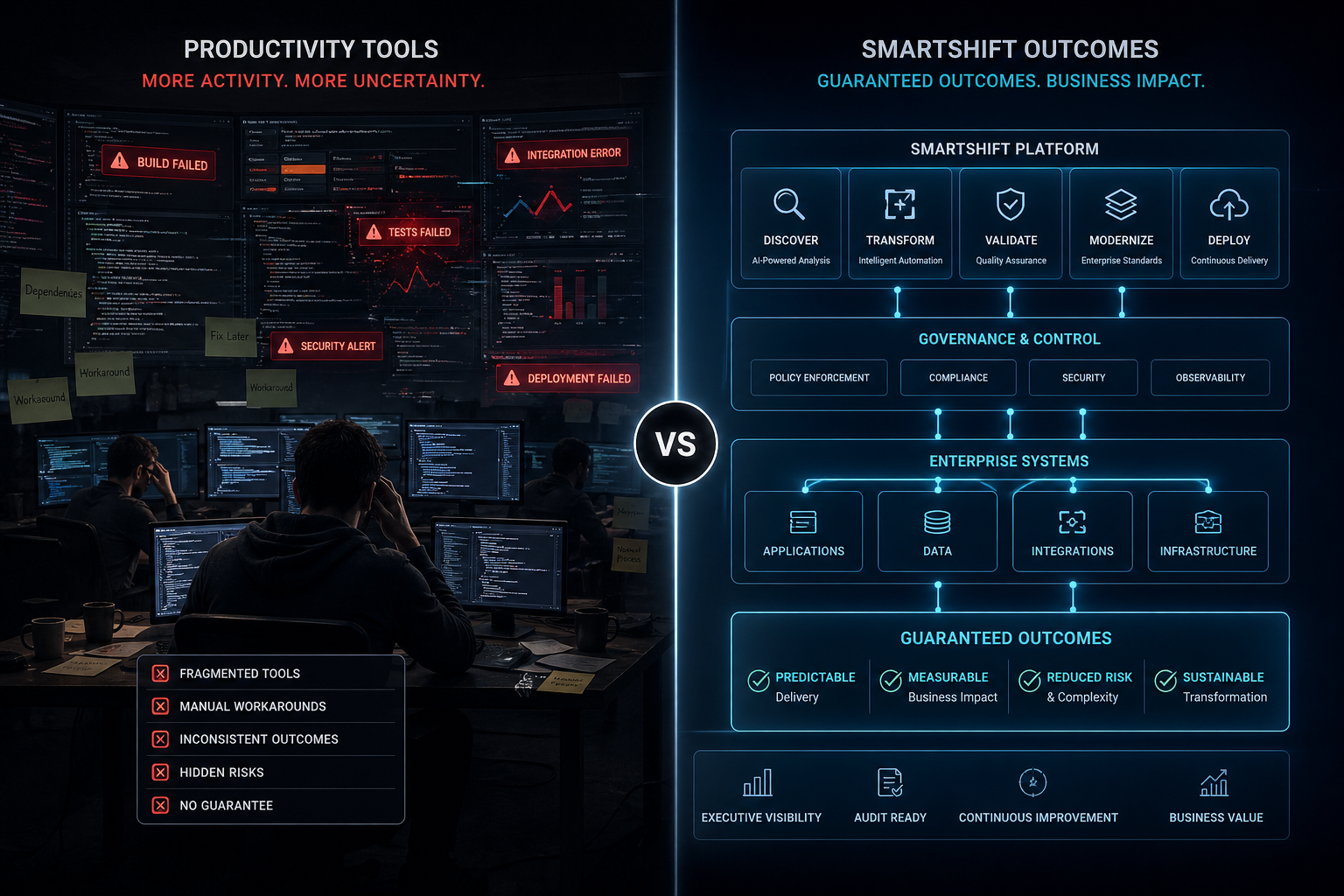
For instance, attempting to manually transform custom code often requires dozens of expensive ABAP developers working for up to nine or ten months. Because manual remediation is driven by speed and limited capacity, developers typically patch only the most critical Priority 1 and Priority 2 compiling issues. This approach leaves deeper security vulnerabilities, performance flaws, and Clean Core architectural issues unresolved.
Similarly, adopting basic AI developer assist tools only boosts individual productivity for one object at a time; it still requires manual validation and operates on a risky time-and-materials commercial model without guaranteed outcomes.
How smartShift Delivers Real Enterprise Value
To achieve a resilient S/4HANA environment and a true Clean Core, organisations need guaranteed automation at scale. Here is exactly how smartShift translates technological capabilities into hard business value:
1. Immediate ROI Through Code Decommissioning
Why migrate code that is no longer used? Industry benchmarks reveal that between 40% and 60% of customisations in an average SAP system are technically obsolete. By analysing production usage data, smartShift safely decommissions this "dead code," avoiding an estimated $0.25 to $0.63 per line in annual testing and maintenance costs.
2. Industrial-Scale Speed and Precision
smartShift’s Intelligent Automation Platform utilises hundreds of distinct rulesets to transform legacy ABAP. It analyses and remediates millions of lines of code up to 4x faster than manual approaches. Operating with a defect rate of less than 0.01%, the platform simultaneously addresses mandatory S/4HANA compatibility, HANA performance optimisations, and critical security vulnerabilities in one comprehensive pass.
3. Eliminating Business Disruption
A multi-year transformation programme cannot halt daily business operations. smartShift's Automated Dual Maintenance compares, merges, and transforms new ECC code into S/4HANA-compliant code on the fly. This eliminates the need for extended "code freezes." At organisations like Procter & Gamble, this capability seamlessly handled the synchronisation of 1,250 objects per month from their production environment to the S/4HANA project landscape, allowing hundreds of parallel projects to continue without interruption.
4. Guaranteed Timelines and Contractual Accountability
Unlike manual approaches that leave project leaders guessing until reviews are complete, smartShift delivers outcome-based automation. Because the platform builds a complete meta-model of the repository upfront, every single issue is identified before the project begins. This allows smartShift to offer strict Service Level Agreements (SLAs), fixed timelines, and fixed pricing. According to a Forrester Total Economic Impact study, an enterprise leveraging smartShift can realise massive financial benefits, with the model showing $17.87 million in benefits versus costs of $5.07 million over three years.
Real-World Success Metrics
The true test of any transformation strategy is its performance in real-world enterprise environments:
- Procter & Gamble: Automatically remediated 77,000 custom objects in eight weeks, fixing 1.3 million issues with a defect rate below 0.01%, saving an estimated 42,000 days of manual labour.
- CONA Services: Transformed 5.8 million lines of code and 45,000 custom objects in just three months, resolving over 262,000 issues with a flawless 19-hour go-live cutover.
- JBS Foods: Accelerated their S/4HANA journey by 50%, saving 30,000 hours of manual developer effort and safely decommissioning 2.7 million lines of unused legacy code.
- BMW Group: Successfully retired 9.5 million lines of unused custom code, immediately reducing their technical debt footprint and maintenance costs.
Conclusion: Stop Funding Open-Ended IT Programmes
Treating SAP custom code as a manual refactoring exercise drains your budget and distracts your most valuable IT talent from driving strategic growth. To truly unlock enterprise value, organisations must shift from merely assisting manual developers to fully automating enterprise outcomes.
Are you ready to see the exact financial and technical impact automation could have on your system?
Contact us today to request a Rapid Code Analysis and secure a fixed-price, fixed-timeline blueprint for your S/4HANA transformation.