Introduction
The transition to SAP S/4HANA is accelerating.
With mainstream maintenance for SAP Business Suite 7 core applications ending at the end of 2027, followed by optional extended maintenance through 2030, enterprises are under increasing pressure to move to S/4HANA. This move is not only about meeting a support deadline; it is also about positioning the business to take advantage of SAP’s latest innovations, improve operational performance, and keep pace with changing business requirements.
For many organizations, the modernization path runs into a barrier when it intersects with their custom code. SAP environments often contain thousands of custom objects and millions of lines of ABAP code supporting critical processes, integrations, reporting, compliance requirements, and industry-specific ways of working. As S/4HANA adoption rises, this legacy custom code can become a major source of conversion complexity by expanding testing scope, increasing risk, and slowing modernization efforts.
SAP custom code remediation helps organizations address that complexity by analyzing and transforming custom development as part of the S/4HANA conversion, while creating visibility for future decommissioning, governance, and lifecycle decisions.
In this article, we explain what custom code remediation in SAP entails, how it fits within SAP Custom Code Transformation, and how to approach it effectively.
What Is SAP Custom Code Remediation?
In SAP S/4HANA migration programs, custom code remediation refers to the work required to transform legacy ABAP code so it functions reliably in the S/4HANA environment. For smartShift, this is not a narrow “fix only what breaks” or “fix only what you have time to fix” exercise. It is part of a comprehensive code transformation approach that addresses S/4HANA compatibility, performance, stability, security, modernization, maintainability, and clean core readiness.
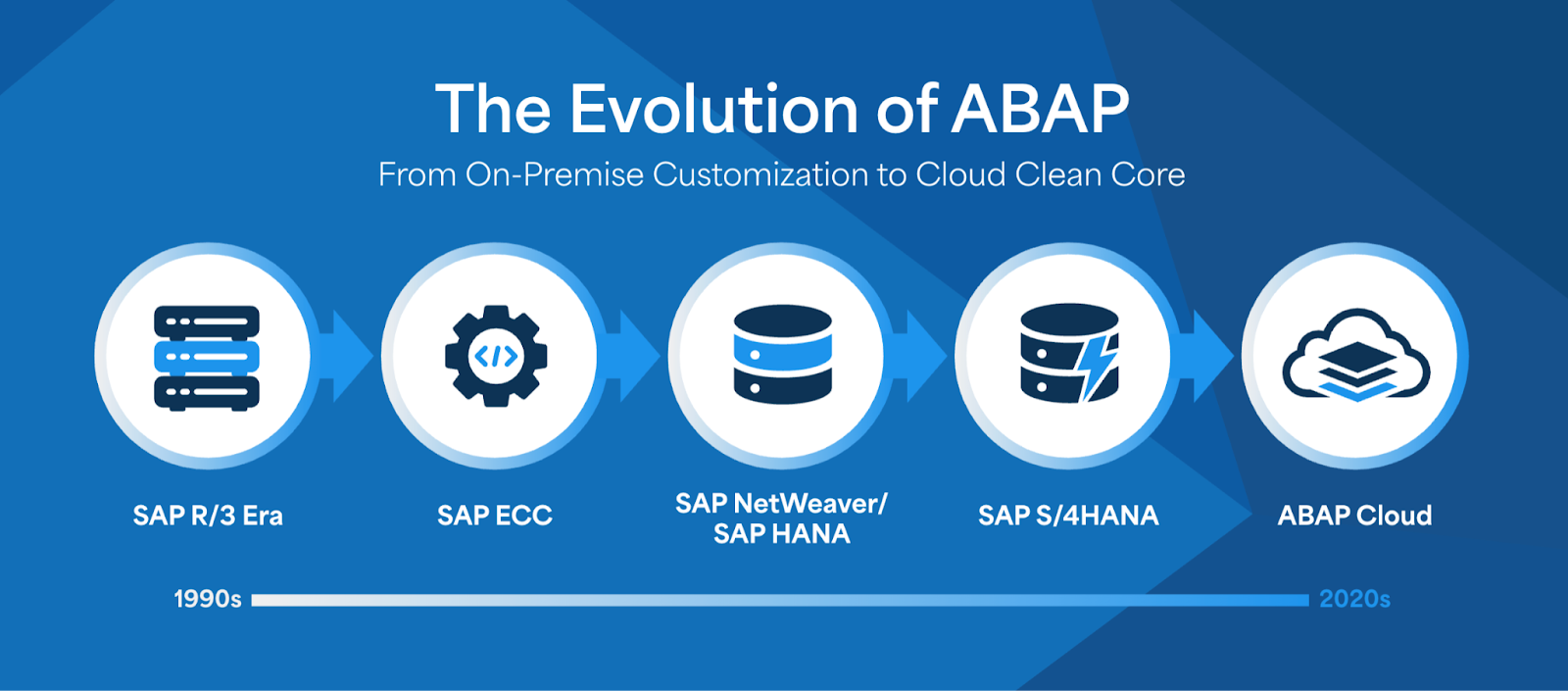
Over the years, organizations have built custom reports, interfaces, enhancements, forms, and programs to support specific business processes that standard SAP functionality did not originally address. These customizations often become deeply embedded in day-to-day operations. When companies convert from SAP ECC to S/4HANA, changes to the architecture and data model can create compatibility, runtime, and performance issues for older custom code.
Effective custom code remediation in SAP helps organizations transform the custom code required for S/4HANA while addressing compatibility, performance, security, stability, modernization, and maintainability requirements. It also creates visibility into usage and dependencies that can support decommissioning, governance, and lifecycle decisions before and after conversion.
At a high level, SAP Custom Code Transformation for S/4HANA may include:
- Compatibility remediation to ensure existing programs work correctly with the S/4HANA data model, HANA database, APIs, and technical architecture
- Performance optimization to improve how legacy ABAP code runs in the new environment
- Stability and security improvements to address outdated patterns, vulnerabilities, and operational risks
- Code modernization to align custom development with current ABAP standards and future clean core requirements
- Usage and decommissioning insights to identify custom objects that may be candidates for retirement, provide a framework to retire them, and preserve the ability to reactivate code if business needs change
Remediation is not purely a technical exercise.
Custom code is often tightly integrated with core business processes, such as order management, supply chain operations, financial reporting, and customer communications. Even a small piece of custom logic may support multiple downstream workflows, reports, or integrations.
For that reason, effective code remediation in SAP requires understanding both the code's technical structure and the business processes it supports. The goal is to ensure that custom code continues to support reliable business operations in the S/4HANA environment while improving performance, maintainability, and long-term standards where appropriate.
Understanding the Importance of SAP Custom Code Remediation
SAP custom code remediation is important because legacy ABAP code can affect the success, stability, cost, and timeline of an S/4HANA conversion. Custom programs built for ECC may rely on data structures, tables, or development patterns that have changed in S/4HANA. Without remediation, these issues can create errors, broken integrations, or process disruptions.
Remediation also gives organizations an opportunity to address broader optimization needs. Older ABAP programs may not be aligned with SAP HANA’s in-memory architecture, modern ABAP performance standards, security requirements, stability expectations, or efficiencies introduced with S/4HANA. Left unaddressed, these issues can limit system responsiveness, increase operational risk, or create unnecessary processing load.
Finally, remediation helps simplify the SAP landscape. Many organizations carry unused or redundant custom objects that increase testing scope and long-term maintenance effort. By transforming the custom codebase and creating visibility into usage, dependencies, and technical risk, organizations can reduce conversion uncertainty and establish a stronger foundation for post-conversion lifecycle management and simplification.
In short, effective SAP custom code remediation improves compatibility, performance, security, stability, and simplification while reducing conversion risk.
Key Considerations for S/4HANA Conversion
An organization’s S/4HANA approach shapes how custom code is analyzed and transformed. Most programs follow one of three broad paths: new implementation, system conversion, or selective data transition, commonly referred to as Bluefield®, a registered trademark of SNP.
In a new implementation, often called Greenfield, teams can redesign processes rather than convert the existing ECC system as-is. However, Greenfield does not eliminate legacy customization decisions. Fit-gap analysis may uncover business-critical requirements that standard SAP does not fully address, requiring teams to decide whether functionality should be brought forward, redesigned, rebuilt, or replaced with standard SAP where appropriate.
In a system conversion, often called Brownfield, the existing ECC system is converted to S/4HANA. Because configuration, data, and custom development are largely preserved, custom code remediation becomes a major workstream. Teams must assess S/4HANA impact, remediate the custom codebase, and use usage and dependency insights to inform decommissioning and lifecycle decisions after remediation.
In a selective data transition, organizations selectively move data into S/4HANA to reduce data volume, shorten cutover downtime, and limit the cost of keeping stale historical data online. This does not necessarily mean selective custom code transformation. Custom code does not create the same database volume or cutover constraints as historical transaction data, so the code workstream may still follow a system conversion-style approach. Some companies do try to implement a “selective code” approach, depending on how much they want to invest in the complex fit-gap and fit-to-standard activities required to properly identify what code can be left behind, and what needs to be retained.
Regardless of approach, organizations need clear visibility into custom code inventory, usage, dependencies, and remediation requirements as part of S/4HANA planning.
Challenges of SAP Custom Code Remediation During S/4HANA Conversion
Custom code remediation is a critical step in S/4HANA conversions, but it is rarely simple. Organizations typically encounter several common challenges during SAP custom code remediation.
Compatibility Issues
S/4HANA introduces a simplified data model, updated tables, and new application interfaces. Many legacy programs rely on structures or database access patterns that have changed in the S/4HANA environment.
Custom reports, interfaces, and enhancements may reference tables that have been replaced or redesigned, requiring updates to ensure the code functions correctly after conversion. Without remediation, these incompatibilities can lead to runtime errors or broken business processes.
Code Quality and Performance
Legacy ABAP code may reflect years of changing development standards, ownership models, and business requirements. During custom code transformation, organizations should distinguish between compatibility issues, performance issues, and broader code quality improvements such as maintainability, stability, security, and readability.
Time and Resource Constraints
Large SAP systems frequently contain millions of lines of custom ABAP code across thousands of custom objects. Analyzing and updating this volume of code can be a significant effort.
Organizations often underestimate the time required to assess impacted objects, determine which programs remain essential, and remediate code for S/4HANA compatibility.
Business Continuity
Conversion projects must be executed while the existing SAP system continues to support daily operations. Development teams often need to balance remediation work with ongoing enhancements and production support.
Without clear standards, changes introduced during the remediation process can create inconsistencies between legacy environments and the future S/4HANA system.
Limited Visibility Into Custom Code Usage
Many SAP environments contain large amounts of custom code that is no longer actively used. However, without reliable usage analysis, organizations are often reluctant to remove these objects.
Without usage visibility, organizations may carry unnecessary custom code complexity forward without a clear plan for governance, decommissioning, or lifecycle management after conversion.
All of these challenges underscore why organizations benefit from adopting a structured methodology for SAP code remediation. Structured analysis and automation help organizations remediate consistently at scale while creating the visibility needed for testing, governance, and post-conversion simplification.
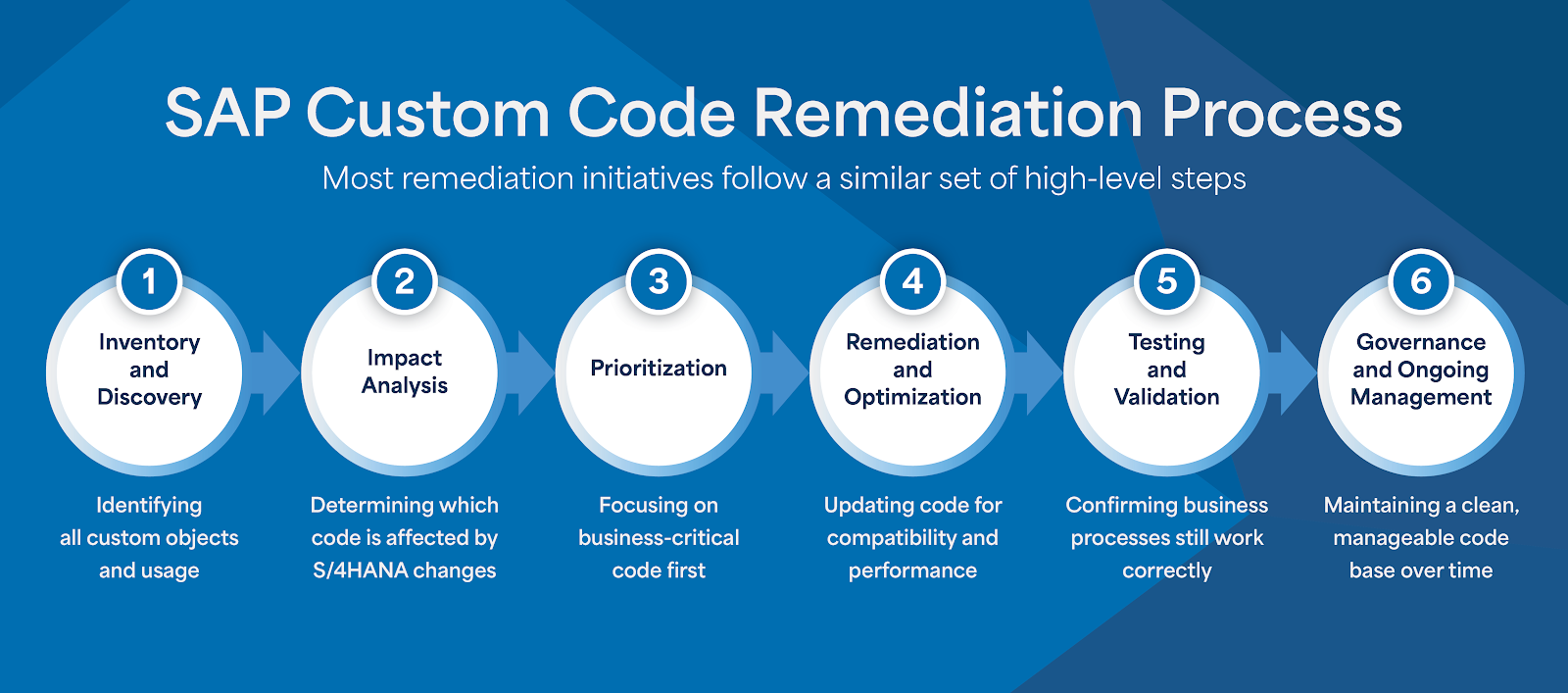
SAP Custom Code Remediation Process
Successful SAP custom code remediation requires a structured, automation-led process that identifies impacted custom code, applies consistent transformation rules, and validates that business functionality continues to operate reliably in S/4HANA. The focus should be on remediating the custom code required for conversion at scale, not relying on manual inventory-building or selective triage.
- Automated Code Analysis. Analyze the custom codebase to identify S/4HANA compatibility issues, SAP HANA performance requirements, security findings, stability risks, and modernization opportunities.
- Impact Assessment. Determine where custom programs are affected by S/4HANA changes, including updates to tables, data structures, APIs, syntax, and development standards.
- Remediation and Optimization. Transform impacted code for S/4HANA compatibility while addressing related performance, stability, security, maintainability, and modernization requirements.
- Testing and Validation. Confirm that transformed code functions correctly and that critical business processes continue to operate as expected.
- Usage and Lifecycle Insights. Use usage, dependency, and technical insights to support decommissioning, governance, and custom code lifecycle decisions before, during, and after conversion.
By following an automation-led remediation process, organizations can reduce conversion risk, improve consistency, and preserve the custom capabilities that continue to support business operations.
Clean Core and Its Role After Custom Code Remediation
Clean core is an important long-term SAP strategy. Clean core modernization should be approached as a journey, not a destination. For organizations facing S/4HANA deadlines, the immediate priority is to remediate the custom code required for conversion so business functionality continues to operate reliably in the new environment.
Once the conversion path is under control, organizations can take a more refined approach to clean core, repository simplification, and custom code lifecycle management. That may include evaluating which custom code should be retired, re-platformed, redesigned, or retained and adapted over time.
In this context, SAP custom code remediation helps reduce immediate conversion risk while creating a stronger foundation for longer-term modernization.
Manual vs. Automated Custom Code Remediation
|
Aspect |
Manual, Developer-Led Remediation |
Automation-Enabled Code Transformation |
Business Impact |
|---|---|---|---|
|
Time Required |
Developers review and update objects individually, making large code bases slow to remediate. |
Automation analyzes and remediates large volumes of code faster. |
Shorter remediation cycles help keep S/4HANA conversion timelines on track. |
|
Accuracy and Consistency |
Results depend on individual developer expertise and can vary across teams. |
Standardized remediation patterns improve consistency across the code base. |
More predictable outcomes and fewer remediation-related defects during testing. |
|
Scalability |
Manual remediation becomes increasingly difficult as the volume of custom objects increases. |
Automation can support thousands of objects across large SAP landscapes. |
Organizations can manage remediation at enterprise scale. |
|
Cost and Resources |
Manual work requires significant developer time and extended project effort. |
Automation reduces manual effort across analysis and remediation. |
Teams can control cost and reduce pressure on internal developers. |
|
Risk Management |
Manual analysis and remediation can miss dependencies or introduce inconsistencies. |
Automated analysis and remediation improve visibility into dependencies and impact areas. |
Lower technical risk supports a smoother system conversion. |
Tips and Techniques for SAP Custom Code Remediation
To manage SAP custom code remediation more effectively, organizations should:
- Define the remediation workstream clearly as part of the S/4HANA conversion plan, including impacted custom code, dependencies, and technical requirements.
- Use automation to analyze and remediate compatibility issues, performance requirements, security findings, quality issues, and other remediation needs at scale.
- Apply consistent transformation rules across the custom codebase rather than relying on manual, object-by-object fixes that can vary across developers or project teams.
- Use usage analysis to inform decommissioning, governance, and lifecycle decisions without prematurely narrowing the remediation scope.
- Separate baseline remediation from longer-term modernization so clean core and repository simplification efforts do not unnecessarily expand the immediate conversion scope.
- Establish governance for ongoing custom code management to prevent new complexity from accumulating after conversion.
smartShift SAP Custom Code Transformation
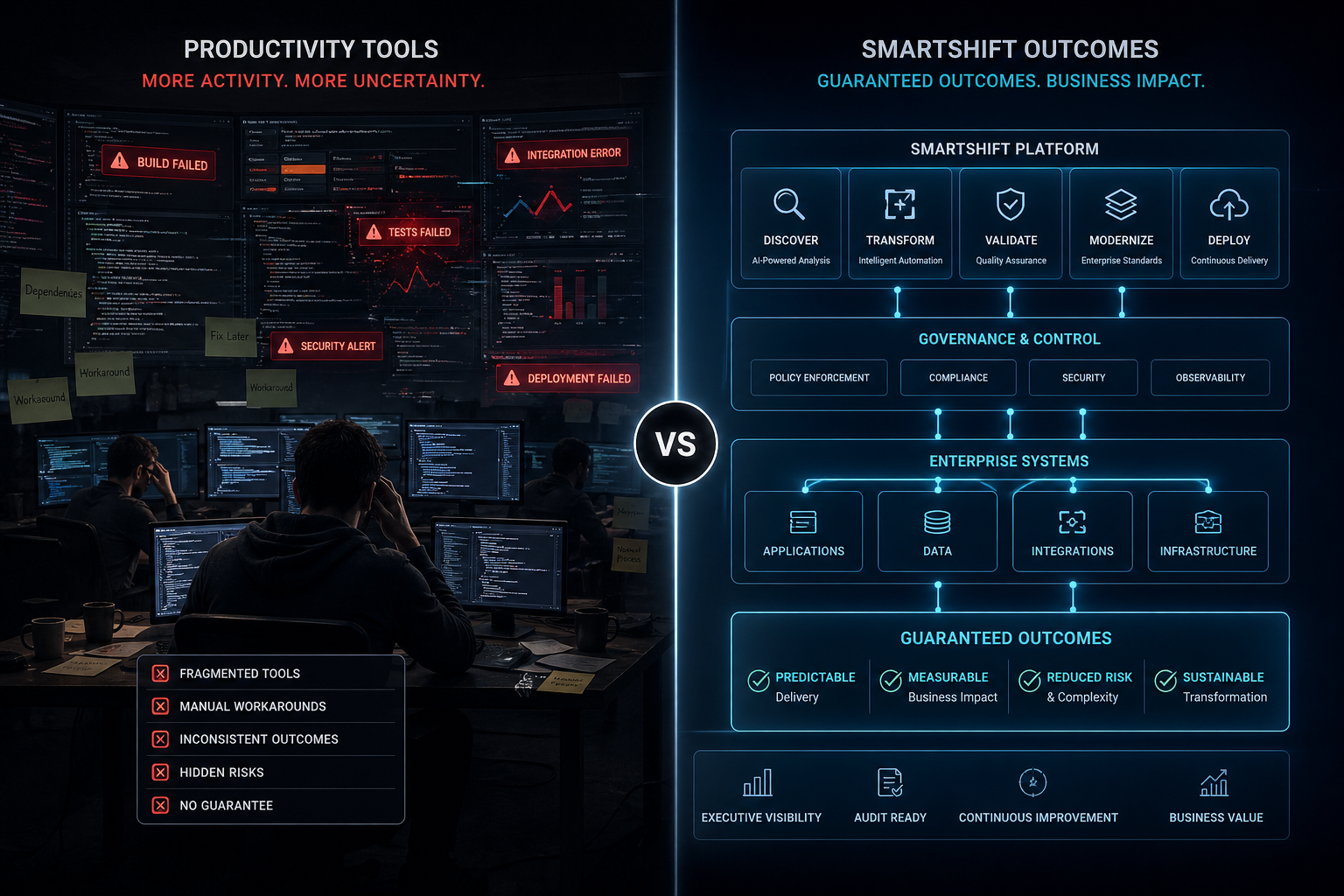
smartShift helps organizations address SAP custom code remediation at enterprise scale through SAP Custom Code Transformation. Rather than relying on manual, object-by-object review, smartShift analyzes the entire custom codebase, identifies S/4HANA compatibility issues, SAP HANA and S/4HANA performance requirements, security findings, stability risks, modernization opportunities, and usage insights that can inform future decommissioning decisions, and then applies proven transformation rules to prepare legacy ABAP code for S/4HANA.
This automation-led approach reduces manual effort, improves consistency, and gives SAP teams a more predictable path to conversion. It helps organizations remediate the custom codebase for S/4HANA while creating a stronger foundation for ongoing custom code lifecycle management after go-live.
Get in touch with smartShift to learn how SAP Custom Code Transformation can accelerate and de-risk your S/4HANA conversion.
Conclusion
As organizations accelerate their transition to S/4HANA, addressing legacy custom development becomes a critical part of the modernization journey. SAP custom code remediation helps ensure that existing business functionality continues to operate reliably while aligning custom code with S/4HANA architecture, performance, stability, security, and maintainability requirements. By approaching remediation in a structured, scalable way and leveraging automation, organizations can reduce conversion risk, improve consistency, and create a stronger foundation for future modernization.
Frequently Asked Questions
How do you handle legacy code issues during S/4HANA conversion?
Legacy code issues should be handled through automation-led analysis, remediation, optimization, validation, and lifecycle planning. smartShift SAP Custom Code Transformation remediates the custom codebase for S/4HANA compatibility, performance, security, stability, and maintainability, while creating usage visibility to support decommissioning and lifecycle decisions after remediation.
Do we need to remediate all custom code before moving to S/4HANA?
With smartShift, the preferred approach is to remediate the entire custom codebase before finalizing decommissioning decisions. Because smartShift applies automation at scale, organizations do not have to rely on manual triage to decide upfront which code is worth remediating. This eliminates as many latent issues as possible to preserve your ability to operate without unnecessary risk. Even code that appears unused can be remediated first, so it can be reactivated later if the business needs it. Decommissioning can still reduce long-term complexity, but remediation first preserves the ability to restore deactivated code in edge cases and lowers risk during the S/4HANA conversion.
How do I find which custom code is still being used in my ECC system?
Organizations use standard SAP usage reports (SCMON aggregated by SUSG being the latest and greatest) to understand which custom objects are active, inactive, or potentially obsolete. For smartShift, this insight need not limit the scope of custom code transformations. Because smartShift can remediate custom code at scale, usage reporting is better used to support decommissioning, governance, and lifecycle management decisions before and after the S/4HANA conversion.
What happens if we skip custom code remediation?
You can’t skip remediation because some customization will simply not work in S/4HANA. Partially addressing remediation will leave compatibility, performance, security, and stability risks unresolved. These issues may appear during testing, delay conversion timelines, or – worst of all – create disruption after go-live.
How long does SAP custom code remediation typically take?
Timing depends on the size and complexity of the SAP custom code landscape, as well as whether the work is handled manually or through automation. Manual remediation can take months or longer in large enterprise environments. With smartShift SAP Custom Code Transformation, organizations can remediate their custom codebase on a predictable 4–8-week timeline, using automation to analyze, transform, and validate large volumes of code consistently and efficiently.
Does every migration approach require remediation?
Yes. Every S/4HANA approach requires custom code analysis and remediation decisions, but the level of analysis can vary. System conversions typically require broad remediation of the existing custom codebase. New implementations may still require rebuilding or reintroduction of legacy custom functionality when fit-gap analysis identifies business requirements that standard SAP does not fully cover. If an organization takes a selective approach to custom code, the analysis becomes even deeper because teams must understand dependencies, business process impact, integrations, and whether code may need to be reactivated later.
What tools does SAP provide for custom code analysis?
SAP provides tools such as the Custom Code Migration app, ABAP Test Cockpit, and the Simplification Item Catalog to help identify S/4HANA compatibility issues. These tools support analysis and scoping for developer-led remediation.
smartShift SAP Custom Code Transformation goes deeper and broader by using automation to detect and remediate issues across more categories, including S/4HANA compatibility, SAP HANA, and S/4HANA performance, security, stability, maintainability, modernization, and decommissioning insights. This helps organizations move beyond manual issue identification and apply consistent remediation at enterprise scale.
Topics: