SAP Custom Code Transformation at Scale: Why Automation is the Only Path to S/4HANA
May 8th, 2026
8 min read
By Gerren Mayne

TL;DR
SAP custom code transformation at scale is becoming urgent as mainstream maintenance for SAP Business Suite 7 ends in 2027, with optional extended maintenance through 2030. Manual custom code remediation is difficult to scale across large enterprise repositories within constrained transformation timelines. AI developer assist tools accelerate object-level work but still depend on human judgment and validation. smartShift applies deterministic automation across complete ABAP repositories with 99.99% precision and fixed-price, fixed-timeline delivery. The company has modernized more than 3,300 SAP systems.
Introduction
The transition to SAP S/4HANA now carries a defined maintenance timeline. SAP will provide mainstream maintenance for core SAP Business Suite 7 applications through the end of 2027, followed by optional extended maintenance through the end of 2030. For large enterprises, SAP custom code transformation at scale is one of the most consequential and frequently underestimated workstreams. Decades of enhancements can leave teams responsible for large ABAP repositories that support essential business processes.
Manual custom code remediation in SAP requires developers to assess, correct, and validate objects individually. As the scope expands, a manual approach increases timeline uncertainty, cost, testing effort, and dependence on scarce expertise. An automation-first platform gives enterprises the capacity to analyze and transform complete codebases consistently, with AI applied within a governed and deterministic delivery model.
In more than 25 years working with global SAP customers, I have seen custom code become a critical source of scope and delivery risk. Recent SAP customer research identified too many customizations as the leading S/4HANA migration challenge. Organizations that establish the full scope early and automate remediation across the repository gain greater speed, consistency, and confidence. Automation provides the scale required to keep complex transformation programs moving while business-as-usual development continues.
The Reality of Enterprise SAP Transformation
Custom code is a business-critical layer in many enterprise SAP environments. Years of enhancements, integrations, workarounds, and business-specific logic can produce repositories containing millions of lines of ABAP. The size and complexity of these environments make manual code remediation in SAP ABAP increasingly difficult to plan, execute, test, and govern. Deterministic automation provides enterprises with a consistent way to transform SAP custom code at scale while reducing delivery uncertainty.
Research from ASUG and smartShift found that 95% of surveyed organizations build and run custom code. For many organizations, custom code supports up to half of their essential business processes.
Challenges with Manual Custom Code Transformation for Enterprises
Manual, sample-based transformation approaches can leave critical questions unresolved until developers begin working through the repository object by object. Hidden dependencies, incomplete documentation, and ongoing development can expand the scope throughout the program, creating several enterprise risks:
- Unpredictable scoping. Teams often discover more custom code and remediation work than initial assessments identified.
- Resource drain. Manual code remediation diverts experienced internal developers from business priorities, architectural decisions, and innovation.
- Extended development restrictions. Long S/4HANA programs may require organizations to limit business-as-usual changes when production and project landscapes cannot be synchronized efficiently.
Inside an Enterprise SAP Custom Code Environment
Enterprise SAP custom code environments often contain millions of lines of ABAP distributed across tens of thousands of custom objects. The repository may span multiple development, quality assurance, production, regional, and project systems. Years of acquisitions, local deployments, regulatory requirements, integrations, process changes, and business-led enhancements add further layers of complexity.
Large repositories also contain more than standalone programs. Custom fields, reports, interfaces, forms, workflows, enhancements, ABAP Dictionary objects, and business rules can depend on one another across applications and systems. Incomplete documentation and changes introduced by different development teams make it more difficult to scope enterprise SAP custom code transformations. A correction to one object may affect several downstream processes that also require analysis and testing.
At this scale, code remediation in SAP ABAP becomes an operational capacity challenge. Manual teams must review objects, interpret findings, implement corrections, document changes, and validate results across the transformation landscape. Each additional system, dependency, and parallel development stream increases coordination and testing requirements. Large global rollouts can involve several business units and go-live waves, making object-by-object remediation difficult to standardize and govern.
Transformation timelines add further pressure. Teams must continue supporting daily operations while resolving S/4HANA compatibility issues, improving HANA performance, addressing security risks, and preparing retained custom code for future modernization. Changes made in the active production environment may also need to be synchronized with the S/4HANA project system over the course of a multi-year program.
Enterprise SAP custom code transformation at scale requires an approach that can address the repository comprehensively and apply consistent rules across high volumes of code. smartShift’s Automation Engine analyzes and transforms complete ABAP repositories across the issue categories included in the agreed scope, including S/4HANA compatibility, HANA performance, security, and stability. Separate modernization scopes can address retained code that requires architectural redesign, clean core transformation, or ABAP Cloud enablement. Automated Dual Maintenance keeps ongoing development aligned with the project landscape, helping large enterprises maintain business velocity as they progress toward S/4HANA and establish a stronger foundation for later clean core and ABAP Cloud initiatives.
The smartShift Platform: Beyond Simple Code Suggestions
smartShift was built for enterprises that cannot afford trial-and-error transformation. Three connected capabilities support this transformation use case. They include comprehensive analysis, automated code transformation, and continuous synchronization between active and project landscapes.
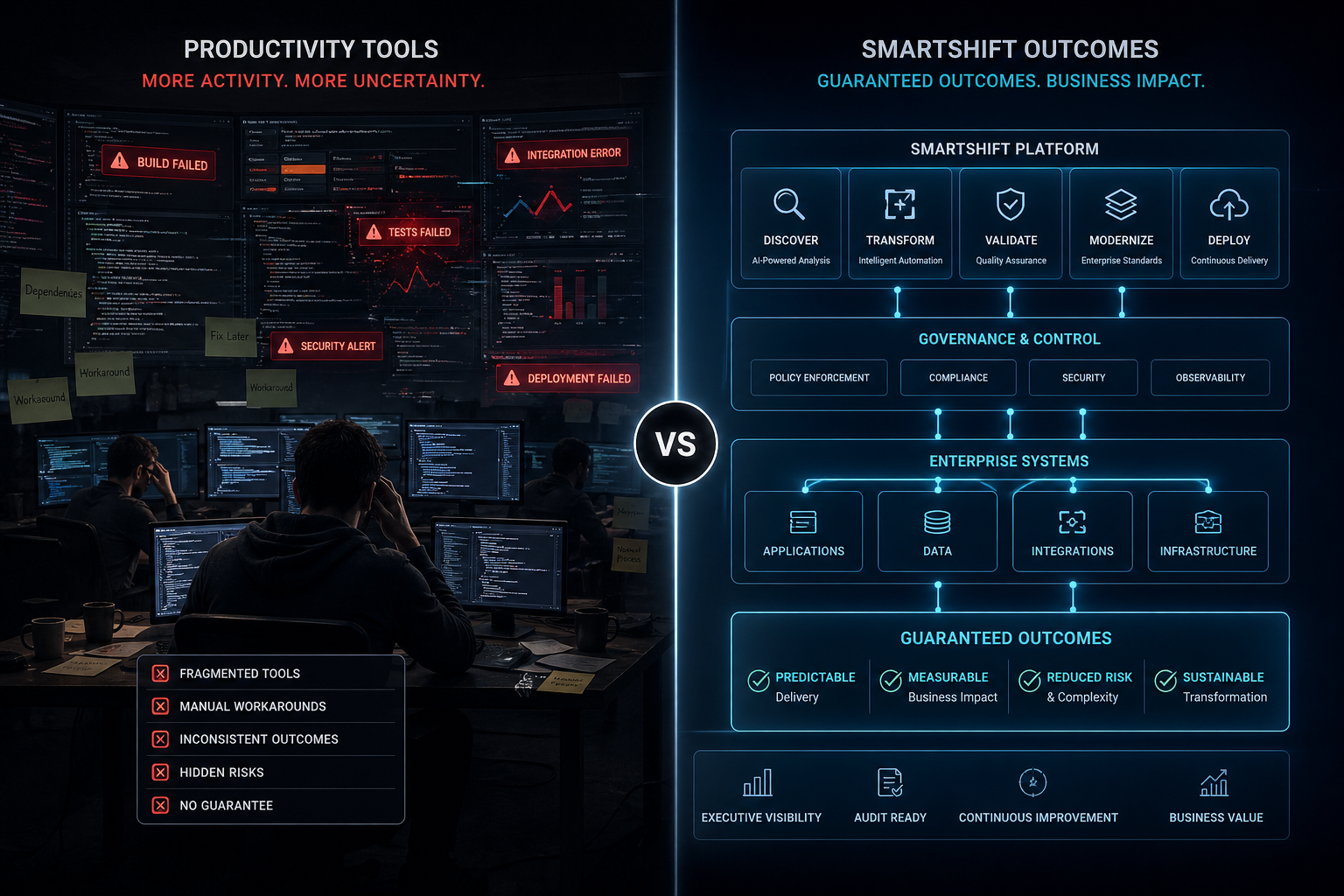
Traditional consulting-led remediation models often rely heavily on developer-led execution. smartShift provides an enterprise transformation platform. smartShift identifies issues across the complete repository and executes SAP custom code transformation at scale with 99.99% precision. Large enterprises achieve predictable outcomes through fixed-price, fixed-timeline delivery.
Strategic Scoping and Visibility
Before transformation begins, smartShift Code Analysis provides full-spectrum visibility into the ABAP repository. The analysis identifies the volume of custom code, dependencies, usage, compatibility issues, security risks, performance concerns, and modernization requirements.
Comprehensive visibility strengthens enterprise SAP custom code transformation scoping by showing teams:
- Which code requires remediation for S/4HANA
- Which objects appear unused and may be candidates for retirement, based on available usage data
- Which issues affect performance, security, stability, or maintainability
- Where further modernization or architectural decisions are required
The resulting analysis gives transformation leaders a factual basis for defining scope, cost, resources, and delivery timelines.
Automated Remediation at Scale
smartShift Code Transformation analyzes and remediates millions of lines of ABAP across complete enterprise repositories. The platform applies validated transformation rules consistently across S/4HANA compatibility, HANA performance, security, stability, and code modernization requirements.
Developer-assist tools generate suggestions that still require developers to interpret, apply, and validate each change. smartShift’s deterministic automation analyzes the complete in-scope repository and automates applicable remediation across the agreed issue categories, producing consistent and auditable results. The approach gives large enterprises a scalable alternative to object-by-object remediation during complex SAP S/4HANA migrations and global rollouts.
Continuous Dual-Landscape Synchronization
Multi-year transformation programs must account for ongoing development in the active SAP environment. Changes made during the program also need to be available, remediated, and validated in the S/4HANA project landscape before go-live.
smartShift Dual Maintenance automatically compares, merges, and transforms ongoing ECC code changes for the S/4HANA environment. Continuous synchronization helps organizations reduce or eliminate extended code freezes, prevent landscape drift, and maintain business velocity while SAP custom code transformation proceeds in parallel.
Enterprise SAP Custom Code Transformation Scoping
Large SAP transformations often begin accumulating delivery risk during scoping.
Enterprise SAP custom code transformation scoping often relies on manual sampling, partial analysis, prior project assumptions, and expert judgment. Those methods can produce an initial estimate while leaving the full volume of custom objects, dependencies, unused code, and remediation issues unclear.
Sampling becomes less reliable as repository size and landscape complexity increase. Enterprise codebases rarely contain a uniform mix of objects or issues. Older enhancements, regional variants, undocumented dependencies, and low-frequency business logic may sit outside the sample and surface later during remediation or testing. Late discovery expands effort, changes testing requirements, and puts committed budgets and timelines under pressure.
smartShift builds a repository-wide technical model (meta-model) of the custom code environment before transformation begins, identifying the custom code inventory and issues across S/4HANA compatibility, HANA performance, security, stability, and modernization. Upfront visibility helps teams establish a clearly defined scope and supports fixed-price, fixed-timeline delivery. A commissioned Forrester Total Economic Impact study modeled a 253% three-year ROI for a composite organization using smartShift, including nearly $9.3 million in avoided manual code transformation costs.
How smartShift Guarantees Outcomes at Enterprise Scale
Large-scale SAP programs are often plagued by T&M uncertainty. smartShift reduces commercial uncertainty by operating on a fixed-price, fixed-timeline model.
The guarantee begins before SAP custom code transformation starts. smartShift builds a complete meta-model of the custom code repository, identifying and categorizing compatibility, performance, security, and stability issues upfront. Repository-wide visibility establishes the scope before execution, enabling fixed pricing and predictable timelines.
smartShift then applies a deterministic automation engine that produces consistent, repeatable results across the codebase with 99.99% precision. SLA-backed delivery places the agreed scope, timeline, and quality commitments into the contract. Enterprise customers gain accountability for the completed outcome rather than paying for an open-ended remediation effort.
| Feature | smartShift Platform | Manual Remediation | Generative AI Developer-Assist Tools |
| Execution Model | Deterministic automation across the complete custom codebase | Developer-led, object-by-object remediation | Assistive suggestions initiated and applied by developers |
| Accountability | SLA-backed commitments for scope, timeline, and quality | Delivery risk depends on staffing, estimates, and manual execution | Developers remain responsible for implementation, review, and validation |
| Pricing | Fixed price based on upfront repository analysis | Time and materials, with costs tied to labor and project duration | Subscription or license costs plus internal developer labor |
| Quality and Validation |
99.99% precision with automated validation and governed quality controls |
Results vary with developer experience, interpretation, and quality controls | Probabilistic output requires manual review and testing |
| Coverage |
All in-scope objects analyzed; applicable issues remediated across agreed categories |
Coverage is shaped by available time, resources, and project priorities | Selective, user-driven coverage at the object or issue level |
| Developer Overhead |
Internal experts focus on business decisions, validation, and exceptions |
Developers perform analysis, remediation, documentation, and testing | Developers prompt, review, apply, correct, and test suggested changes |
Choosing an SAP Custom Code Transformation Vendor for Global Rollouts
Choosing the right SAP custom code transformation vendor is one of the most consequential decisions in a global S/4HANA program. The vendor must manage repository scale, regional complexity, ongoing development, and technical quality across multiple systems without introducing new uncertainty into the rollout.
Enterprise teams should evaluate SAP custom code transformation vendors for large global rollouts against five criteria:
- Proven execution across complete enterprise repositories
Look for documented results across millions of lines of ABAP, tens of thousands of custom objects, and multiple SAP landscapes. References should demonstrate production-scale transformation across complete repositories, multiple landscapes, and active go-live programs.
- Comprehensive scoping with contractual accountability
The vendor should analyze the complete repository and identify the transformation scope before delivery begins. The commercial model should provide accountability for the completed outcome and limit exposure to open-ended discovery costs.
- Experience with phased, multi-region rollouts
Global programs may include regional systems, separate go-live waves, local variations, and years of parallel development. Evaluate whether the vendor can apply consistent transformation rules across landscapes and synchronize ongoing production changes with each S/4HANA project environment.
- Technical coverage, governance, and auditability
Enterprise transformation requires coverage across S/4HANA compatibility, HANA performance, security, stability, maintainability, decommissioning, and modernization. Regulated organizations should also require traceable changes, reproducible results, and documentation that supports testing, validation, and audit requirements.
- Forward readiness for clean core and ABAP Cloud
The selected platform should help enterprises evaluate retained custom code against modern SAP development requirements, including released APIs, ABAP Cloud language rules, upgrade-stable extensibility, and the three-tier model. Clean core and ABAP Cloud work should be treated as defined modernization scopes, with clear pathways for code that must remain custom.
For enterprises comparing SAP custom code transformation vendors for large global rollouts, these criteria distinguish repository-wide transformation capability from tools and services designed for narrower remediation tasks.
Case Studies
See how global enterprises have used smartShift automation for S/4HANA transformation, code decommissioning, dual maintenance, and large-scale modernization programs.
Procter & Gamble
- 77,000 custom objects in the transformation scope
- 1.3 million issues remediated
- Eight-week transformation
smartShift automated remediation across P&G’s enterprise custom code environment with a reported defect rate below 0.01%. Automated Dual Maintenance also helped the company continue parallel business projects during its multi-year S/4HANA program.
Read the Procter & Gamble case study →
BMW Group
- 20,000+ custom objects in scope
- 62,000+ compatibility, performance, stability, architecture, maintainability, and security issues addressed
- 650,000+ lines of unused code safely decommissioned
- Four-week S/4HANA custom code remediation
BMW used smartShift automation to decommission unused custom code and support a broader global SAP S/4HANA modernization program. Repository simplification reduced the volume of legacy code requiring ongoing maintenance.
Read the BMW Group case study →
JBS Foods
- S/4HANA journey accelerated by 50%
- 30,000 hours of manual developer effort saved
- 2.7 million lines safely decommissioned
JBS replaced a labor-intensive remediation plan with enterprise-scale automation, reducing manual effort while safely removing unused legacy code from the transformation scope.
Read the JBS Foods case study →
CONA Services
- 45,000 custom objects analyzed
- 300,000+ ABAP impacts addressed
- Eight-week custom code transformation
- Successful 19-hour go-live cutover
smartShift completed the custom code transformation in eight weeks as part of CONA’s three-month S/4HANA conversion. smartShift Automated Dual Maintenance compares, merges, and transforms ongoing ECC code and relevant ABAP Dictionary changes for the S/4HANA project environment.
Read the CONA Services case study →
Visit the How We Compare page for a deeper comparison of smartShift, manual remediation, and AI developer-assist tools.
Future-Proof Your SAP Landscape
SAP custom code transformation continues beyond the initial S/4HANA conversion. Future upgrades, security requirements, code decommissioning, clean core initiatives, and ABAP Cloud enablement all require ongoing visibility, governance, and modernization.
smartShift has modernized more than 3,300 SAP systems and applies automation across the custom code lifecycle. Complete repository analysis, clearly defined transformation scope, and deterministic execution help enterprises keep custom code compatible, secure, optimized, and ready for future SAP change.
Regional Vice President with smartShift and SAP Thought Leader with over 25 years of experience working with clients driving value through innovation as they transform their businesses. Having built up an extensive network, I bring together the best of my organisation combined with an extended Partner community. I take an active participation with Industry Analysts as a seat holder, exchanging views and opinions of the evolving business challenges and how clients can drive value through their ERP and Cloud applications.