Can AI Be Trusted with SAP Custom Code? Governance, Risk, and Accountability Explained
5 min read

Key Takeaways
- AI can accelerate SAP custom code analysis, documentation, pattern detection, debugging, and remediation when guided by SAP-specific knowledge.
- SAP custom code often contains critical business rules across finance, supply chain, tax, compliance, reporting, approvals, and customer operations.
- Technically valid AI output can still create operational risk when the system lacks business context, dependency awareness, or documented intent.
- AI developer tools are built primarily for development and developer productivity. Transforming existing SAP custom code across an enterprise landscape requires broader capabilities for repository-wide analysis, automated remediation, validation, governance, and lifecycle management.
- Trust requires traceability from the original finding through remediation, validation, approval, deployment, and rollback planning.
- smartShift applies automation within a governed transformation process that supports enterprise control, accountable outcomes, and ongoing management of the SAP custom code lifecycle.
Introduction
AI now appears in nearly every SAP transformation conversation, from generative AI for ABAP and AI agents for code correction to automated SAP code remediation and developer assist tools.
Enterprise leaders still face a harder question: Can AI-assisted changes be trusted inside systems that run finance, supply chain, manufacturing, procurement, compliance, reporting, integrations, and customer operations? SAP custom code often contains years of business rules, process exceptions, approval logic, workflows, and technical dependencies. A flawed change can affect far more than syntax or developer productivity.
Responsible AI for SAP code transformation requires governance, traceability, validation, and clear accountability for the outcome. This article explains where AI adds value, where different AI approaches introduce risk, why developer tools address a different problem from enterprise-scale transformation, and what governed, accountable automation requires.
How Can Enterprises Trust AI Output in SAP Custom Code Transformation?
AI capability matters only when enterprises can trust the resulting change. SAP teams need a clear record of what changed, why the change was required, which objects and business processes were affected, how the output was validated, and who accepted responsibility before deployment.
Speed and automation alone cannot establish that confidence. AI-assisted output must remain traceable, explainable, testable, and governed throughout the transformation lifecycle. Without traceability and repeatable validation, AI recommendations can increase review effort and leave operational risk unresolved.
Trustworthy automation provides traceability, repeatable validation, auditable documentation, and enterprise control over production changes. These capabilities become increasingly important as SAP AI agents depend on business logic embedded in custom code.
What Can AI Do in SAP Custom Code Transformation, and Where Is Enterprise Judgment Required?
AI can support high-volume technical work across SAP custom code. It can scan repositories, detect recurring patterns, assist with debugging, suggest remediations, generate documentation, and reduce repetitive code review.
Generic AI has limits when business context is incomplete. A model may recognize how ABAP code works without knowing why a pricing rule, approval workflow, interface, or local process exists. Enterprise teams must retain decision rights for whether code should be retained and adapted, retired, replatformed, or redesigned.
AI for SAP ABAP becomes more useful when the technology matches the use case. Deterministic automation provides consistency and accuracy for repeatable transformation work, while generative AI can add value where contextual reasoning is required. SAP-specific knowledge, validation, traceability, and governance must support both.
|
Where AI Can Help |
Where Enterprise Control Is Still Needed |
|
Code scanning, pattern detection, debugging support, remediation suggestions, documentation, and repetitive review |
Business-process decisions, retain or retire choices, and interpretation of regulatory, regional, or contractual requirements |
|
SAP-specific automated remediation can apply repeatable transformation knowledge at scale |
Production approval, compliance sign-off, validation standards, and accountability for the final outcome |
What Happens When AI Changes SAP Business Logic Without Context?
SAP custom code often carries the business logic that keeps core operations running. Pricing rules, tax handling, approval paths, credit checks, inventory decisions, compliance controls, reporting calculations, and customer-specific workflows may all depend on custom ABAP.
A generative AI change made without sufficient business context can be technically valid and still alter the meaning of a business process. A simplified condition may remove an exception tied to a regional tax requirement. A revised workflow may bypass an approval created for compliance. A cleaner code path may change how a customer agreement is applied.
SAP custom code transformation therefore requires more than syntax validation. Teams need documentation, dependency context, testing, business review, and clear ownership before changes reach production. Business context, dependency analysis, testing, and validation help preserve the operational intent behind the code.
What Happens When AI Changes SAP Business Logic Without Context?
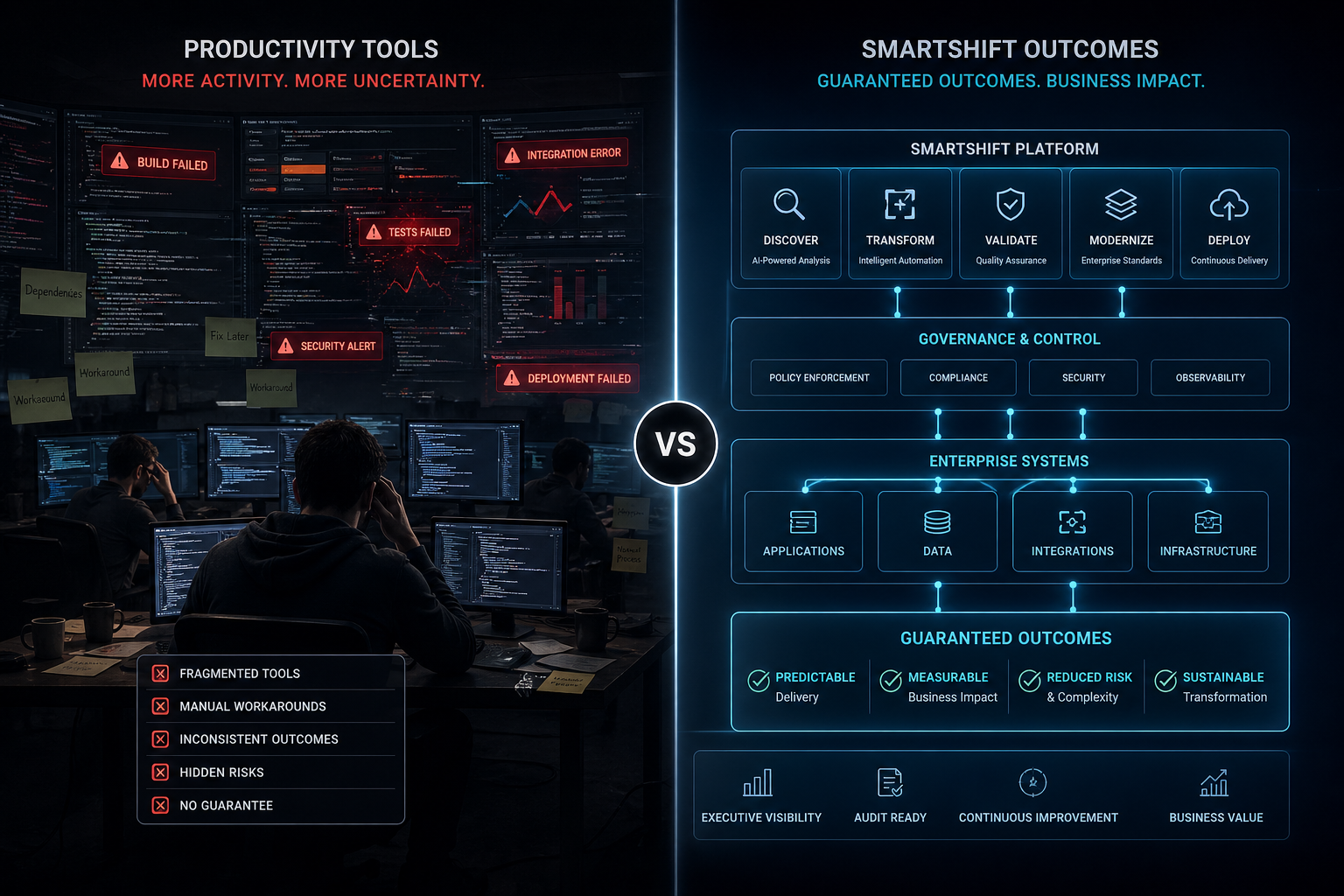
AI developer tools were built for development. Transforming existing SAP custom code is a different class of problem. Enterprise transformation requires consistent execution across an entire custom code landscape, including repository-wide analysis, automated remediation, validation, governance, and lifecycle control.
Teams need a complete inventory, usage analysis, repository-wide issue identification, dependency visibility, quality assurance, audit trails, testing support, and ongoing lifecycle management. They must also determine which customizations should be retained and adapted, retired, replatformed, or redesigned.
Developer tools primarily help developers create, understand, and modify code. Enterprise transformation of existing SAP custom code requires consistent coverage across the repository, repeatable execution, validation, governance, and accountability for the outcome. Effective transformation requires automation and controls that connect code-level changes to landscape-wide planning, validation, and governance.
Learn more about why AI developer assist tools are not enough for SAP custom code lifecycle management.
What Governance, Traceability, and Accountability does AI-Powered SAP Transformation Require?
AI-assisted SAP code changes need a controlled governance process from the initial finding through the approved output. Governance should preserve traceability from the original finding through the applied remediation and validation evidence, with review and approval gates defined at the appropriate project or release level.
Traceability gives SAP teams a defensible record of how a finding became a production-ready change. Review gates, audit trails, and rollback visibility help protect production systems, support compliance obligations, and preserve business continuity when custom code affects controlled processes.
TechTarget explains here how ERP systems enforce controls around risk, compliance, and accountability. AI can accelerate execution inside those systems. Accountable owners still retain responsibility for validation, approval, and business outcomes.
For SAP transformation, governance makes AI-assisted activity controlled, explainable, and auditable.
What AI Risks Should Enterprise SAP Leaders Watch?
Technical Risks
Generative AI used without sufficient SAP context, deterministic controls, and validation can introduce incorrect changes, inconsistent remediation, broken dependencies, or behavior that fails in the target SAP environment.
Security and Compliance Risks
Generative AI should not be relied on alone to resolve security and compliance issues that require deterministic, repeatable outcomes. Security remediation requires validated controls, complete coverage, and auditable results.
Business Process Risks
A technically valid change can alter pricing, tax calculations, approval paths, inventory logic, reporting, or customer-specific workflows when business context is incomplete.
Strategic and Lifecycle Risks
P1-only or time-boxed remediation can leave latent issues, technical debt, and recurring upgrade problems unresolved. Weak traceability and unclear ownership also increase future maintenance risk.
Enterprise leaders should evaluate AI based on coverage, validation, governance, auditability, and accountability across the full custom code lifecycle.
How Can Enterprises Use AI Responsibly in SAP Custom Code Transformation?
Responsible AI use begins with complete visibility into custom code. Enterprises need to identify what exists, what remains active, what is unused, and which objects support critical processes.
AI can then support analysis, pattern detection, documentation, and remediation within defined controls. Every AI-assisted change should be traceable from the original finding through remediation and validation. Governance should document:
- What changed and why
- How the change was validated
- Which review and approval controls applied before release
Enterprise teams must retain authority over business decisions and production release. AI output should remain explainable, reviewable, and reversible throughout the process.
smartShift applies AI-powered automation within a governed SAP custom code transformation process, combining repository-wide analysis, automated remediation, validation, traceability, and lifecycle management with predictable, accountable outcomes. Customers gain automation at scale with fixed timelines and guaranteed quality.
Conclusion
AI can be trusted with SAP custom code transformation when the technology matches the use case and is supported by SAP-specific context, deterministic controls, validation, traceability, and accountability.
SAP custom code often carries business rules, process logic, integrations, compliance controls, and operational decisions developed over many years. Enterprise teams therefore need more than fast code generation or isolated suggestions. AI developer tools can improve development productivity. Enterprise-scale transformation of existing SAP custom code requires repository-wide coverage, repeatable automation, validation, governance, and accountable delivery.
A responsible approach gives teams visibility into what changed, why it changed, how it was tested, and who approved it. AI creates real value when it operates within controlled, explainable, and auditable processes. Trust comes from combining deterministic accuracy, appropriate use of generative AI, SAP-specific context, validation, governance, and accountability for the outcome.
As the Chief Technology Officer at smartShift, he brings over 25 years of experience in product strategy, SAP applications, and enterprise AI. Previously, he served as SAP's field CTO, where he worked with ISVs and channel partners to align complex technologies with market needs. He has earned multiple accolades, including the SAP Innovation Award (2005). His leadership roles across startups and large enterprises, along with recognition such as the Zinnov Start-up Beacon Award (2014), uniquely position him to drive innovation and growth at smartShift.