Generative AI for SAP and ABAP Development - Risk vs. Reward
January 20th, 2026
3 min read
My Experimentation in a Completely Unrelated Topic - Stocks
Recently, I have been experimenting with one of the big AI Assistants for stock market and trading analysis. I would say that one of the strengths of this particular assistant is its ability to integrate real-time data vs. others that lack these kinds of capabilities. In fact, I asked this assistant to generate a detailed prompt based on one of our conversations that wouldn't even run in another assistant due to the lack of access to real-time data.
Given that stock trading analysis has the potential to impact personal finances, it is extremely important that the information being provided is technically correct. If the AI assistant cannot produce real-time stock quotes, understand order flows, and other key data points, how can one be confident in placing a trade?
I could write a whole different article on pros, cons, and my experience with this over the past couple of week however, I want to relate this back to the world of ABAP and use of Generative AI for ABAP customization.
Here are the key findings that I want to focus on:
- Regardless of how much access to data your assistant has, you still can't be 100% sure when your assistant crosses the line from real data vs. hallucinations
- Regardless of how well you structure your prompts or questions to tell the LLM to avoid hallucinations and source data, they don't always follow commands
- If the supporting data is not correct, trade analysis can never be correct
As someone who has not studied every market indicator, charting method, or concept, this assistant has accelerated my learning and decision-making. That said, the gaps exposed here have raised new questions in my mind regarding the feasibility of Generative AI-assisted ABAP development and its impact on future ABAP customization.
Relating this back to ABAP Development
I don't think it is controversial to say that AI Assistants are enabling productivity gains in the world of software development. In fact, our own product engineers at smartShift are seeing efficiency gains across the whole software development lifecycle.
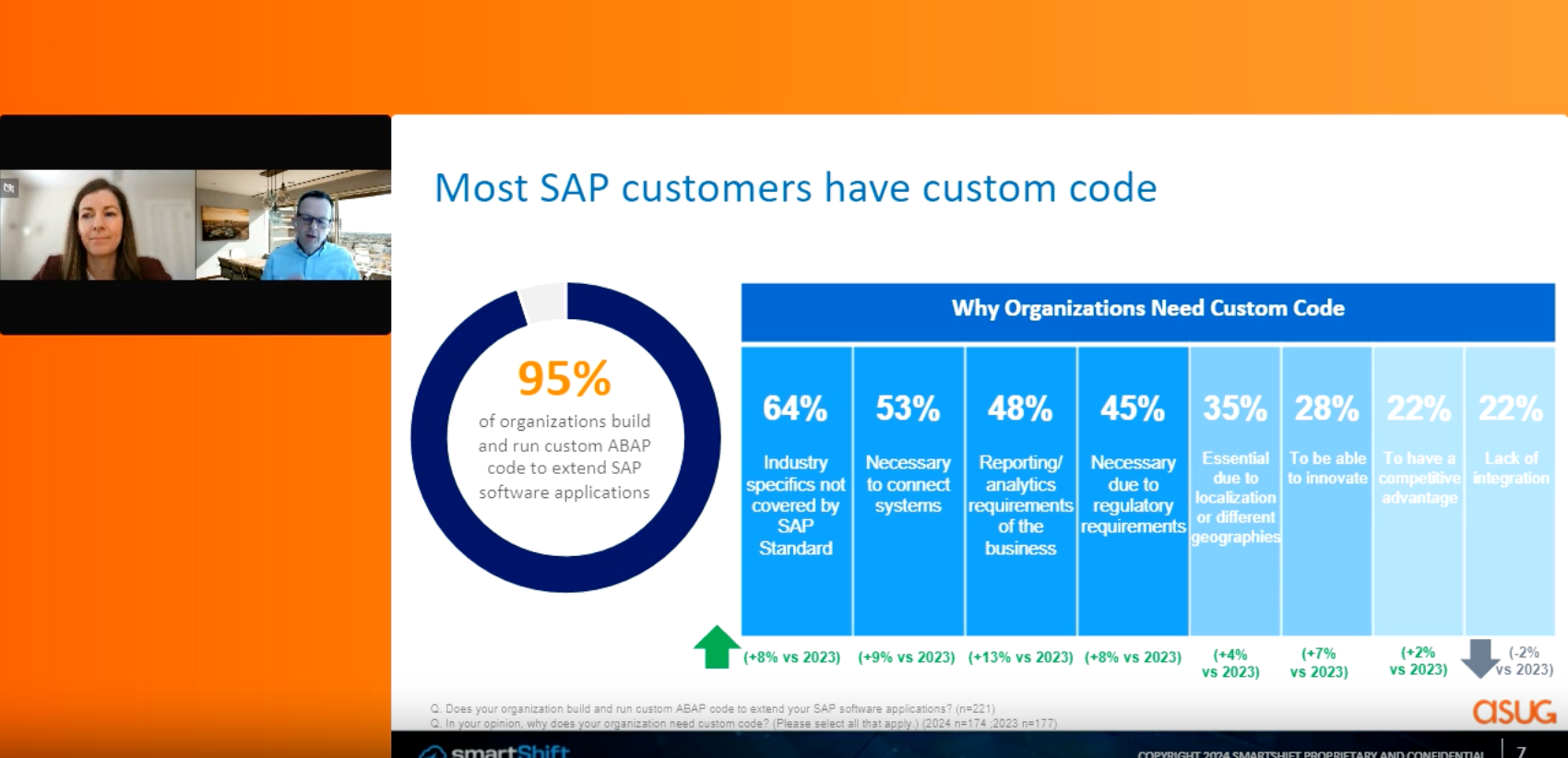
However, I believe customization of SAP with ABAP requires a different point of view. I have always held the opinion that an ABAP developer has the responsibility to actually minimize the amount of customization they are creating within an SAP environment. SAP was implemented for a reason - standard functionality, standard processes customized at the edges for automation, strategic, and localization reasons.
In addition, the introduction of the new S/4HANA Extensibility Frameworks and Clean Core standards should put a bigger burden on ABAP developers to ensure that we are not writing code with the same constructs we did back in the 90s, and we are leveraging Released APIs and new extensibility techniques when necessary.
If you are part of a SAP ABAP Development team that believes Clean Core standards make your upgrades easier in the future and believe it is important to minimize technical debt, then your AI Assistants need to function with those key principles in mind.
Consider the following points:
- Does the assistant have the ability to write or modify code, considering modern ABAP Language syntax standards, and leave the old ways behind?
- Is access to the proper list of recommended APIs available and accessible in your assistants or supporting agents?
- Can the assistant understand the use of the object you are working on, shared use across the repository, or other contextual repository information necessary to ensure the code that is being written does not have other impacts?
- Are you positive that your assistant or agents are accessing the correct data or whether something broke down in the process, and the assistant starts hallucinating?
- Do you have confidence that your team of ABAP developers is experienced enough operators to properly leverage the power of code assistants while still understanding enough about the latest guidelines and standards to ensure technical debt is minimized in the future?
Summary
As a technologist and someone who is passionate about automated software transformation, I love the opportunity that Generative AI and agentic systems have introduced into our world at smartShift. However, when you are dealing with large enterprise systems at the core of your processes, it is essential we take special care with the code being produced. At smartShift, we are focused on building Automated Transformation Systems where we leverage multiple approaches to deliver high rates of transformation, including:
- Deterministic algorithms
- Targeted model training
- A data repository with thousands of supporting data points
- A well-defined agentic approach
- A guided experience with clear, concise recommendations supported by Extensibility and Clean Core standards
As with any newer innovations, there is a lot of market noise with new entries, independent developments, and marketing hype. Make sure you have clear goals on what you want for the future of your ABAP repository before jumping head first in the hype around productivity gains and the next big thing.
Christopher Hanshew is Vice President of Product at smartShift and a recognized subject-matter expert in SAP ABAP custom code modernization and SAP Clean Core transformation. With decades of hands-on experience across SAP product strategy, solution architecture, and enterprise transformation, Chris leads the development of smartShift’s AI-powered automation-driven solutions that help organizations modernize, optimize, and future-proof their SAP ABAP custom code. His background spans product leadership, consulting, and large-scale SAP programs, giving him a practical, real-world perspective on what it takes to modernize complex SAP landscapes without disrupting the business. Chris regularly shares insights on ABAP modernization, Clean Core alignment, and upgrade readiness, helping SAP leaders make confident, data-driven decisions as they prepare for S/4HANA and beyond.