Years ago, SAP introduced S/4HANA, and since then, there has been an ongoing discussion about the right approach to transform existing systems. In the beginning, there was a strong push from SAP and the system integrators to go full Greenfield. But contrary to push, many customers took a Brownfield path of getting to S/4HANA as fast as possible and being ready for future innovation. In the end, neither Greenfield nor Brownfield’s approach sounds too promising for IT and Business: choosing between a multi-year reimplementation science project vs. keeping all the technical and business debt of the past 20 years (or more) sounds like the choice between a rock and a hard place.
Greenfield or Brownfield – The Answer is in the Middle
The answer to such complex problems is always somewhere in the middle and opens up the market for alternate ideas. New approaches like Selective Greenfield or smart Greenfield have been successful, as they combine the best of two worlds, leveraging existing investments while still leaving the legacy debt behind.
When it comes to custom processes or custom code, the focus needs to be on maintaining and modernizing strategic custom applications while getting rid of unused or redundant legacy code. Ideally, even going one step ahead to “SAP Clean Core” – a standard SAP S/4HANA system, running strategic custom extensions decoupled on Business Technology Platform (BTP) or even entirely outside of SAP. With this architecture, SAP customers will be able to consume innovations from SAP more frequently and release new business functionality faster.
But is this even feasible, with monolithic SAP systems often holding more than 25k custom objects and over 3.5 million lines of custom code?
smartShift’s 4-step Approach : SAP Modernization
We have a proven 4-step approach powered by smartShift’s Intelligent Automation Platform™:
- Analyze, De-Commission, Re-package: Start with deep analysis to understand your legacy custom applications. Map custom applications to business areas. Use usage analysis to identify unused custom applications which should be decommissioned (40-60% as an average). Applications where (new) functionality is available in the SAP core should also be decommissioned. Cross-Application dependencies and dependencies to the SAP core are identified through a deep dependency analysis. Strategic Custom applications that are still required get re-packaged in preparation for a later carve-out and further modernization. All this can be done with the support of automation!
- Modernize: Now, the modernization journey starts powered by our Intelligent Automation to accelerate the process. Legacy User Interfaces (WebDynpro, SAP GUI, etc.) get converted to modern Fiori Apps following SAP design principles and models. Classical ABAP is converted to Restful ABAP (RAP) artifacts or implemented as NODE/Java Microservices (CAP).
- Integrate: The new/converted applications need to be integrated. Connect your applications to the Enterprise data model and integrate SAP on-premise and Cloud applications using APIs. Integrate ABAP and NODE/Java applications.
- Run: Finally, run the modernized applications with an agile development model in a true DevOps style on the Cloud or on-premise. Recurring automated checks, fixes, and enhancements can be integrated easily and fast.
This approach has been recently used by a Global Automotive and Motorcycle Manufacturer, resulting in 70% less custom code in the SAP core and 95% fewer cross-application dependencies in the remaining code.
Automation is Key for the Brownfield Elements of your S/4HANA Journey
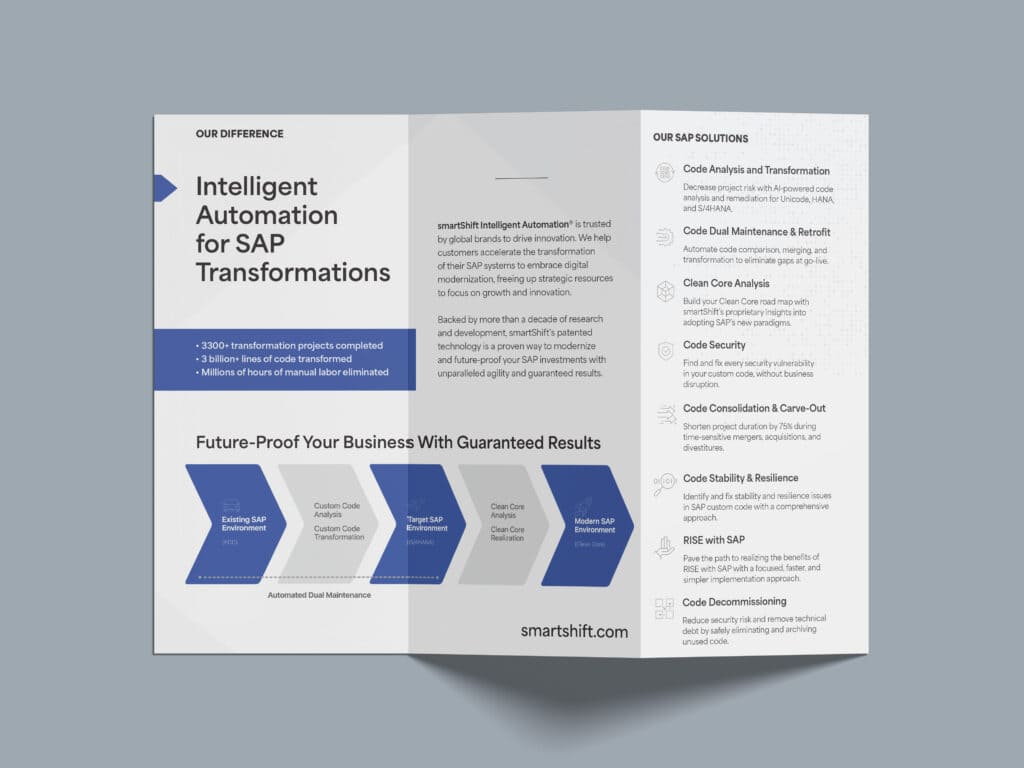
Note that the required transformation is only possible with automation. Manual reimplementation of all your strategic custom applications is not an alternative. The journey can even start today on your SAP ECC system, even before starting with S/4HANA. At smartShift, we have been helping customers for 20+ years to modernize their SAP systems using automation. Our approach allows customers to get to lean, modern, and secure custom extensions for SAP’s digital core. Our solutions are powered by our proprietary Intelligent Automation Platform™ and support scenarios like HANA & S/4HANA transformations, SAP system consolidations & carve-outs, and modernization & security initiatives for SAP systems. It is a high-quality, consistent, and secure approach for custom code modernization that speeds up transformation timelines, testing cycles, enables technical and business agility, and removes the need for unnecessary manual work for customers.
Arndt Hoffmann, Chief Strategist and Co-Founder of smartShift – with 25+ years of experience in the SAP transformation market serving as a Senior Advisor to the global CIO/CTOs looking for SAP business transformation in the coming years.
About smartShift
smartShift Intelligent Automation™ is trusted by global brands to drive innovation. We help customers accelerate the transformation of their SAP systems to next-generation cloud computing environments. Our solutions have delivered thousands of application modernization initiatives, analyzing and converting over 2.5 billion lines of code, eliminating risk, and freeing up strategic resources to focus on growth.
To learn more, please visit: www.smartShift.com
Frequently Asked Questions
How many types of implementation are there in SAP?
SAP implementations generally follow three main approaches, especially for S/4HANA transformations. A Greenfield implementation starts from scratch with a new system and redesigned processes. It’s ideal for organizations seeking significant transformation but typically requires more time and investment. A Brownfield implementation converts an existing SAP ECC system to S/4HANA while retaining core processes, configurations, and historical data - minimizing disruption and risk. The third approach, Selective Data Transition (often referred to as Bluefield), combines elements of both. It allows organizations to selectively migrate data and processes while modernizing specific areas of the system.
Choosing the right approach depends on the level of transformation required, system complexity, timelines, and risk tolerance.
What is a brownfield in SAP?
A brownfield implementation in SAP refers to upgrading an existing SAP system - typically SAP ECC - to SAP S/4HANA while keeping your current system, processes, and critical custom code largely intact. Instead of starting over, organizations modernize what they already have. This approach is popular with enterprises that want to reduce risk, control costs, and minimize business disruption, while still moving to S/4HANA. A brownfield approach focuses on technically converting the system, remediating and optimizing custom code, and ensuring compatibility with S/4HANA - allowing teams to modernize faster without forcing major process changes on the business.
What is the difference between greenfield and brownfield?
The difference between greenfield and brownfield comes down to how much you start over. A greenfield approach means implementing SAP S/4HANA from scratch. Existing processes and custom code are largely replaced, which allows for full redesign but often increases cost, time, and change management effort. A brownfield approach upgrades an existing SAP ECC system to S/4HANA while preserving proven processes and critical custom code. This makes it faster, lower risk, and less disruptive to the business. Most enterprises choose brownfield to modernize their SAP landscape without sacrificing stability or business continuity.
What is the greenfield in SAP?
A greenfield implementation in SAP means building a new SAP S/4HANA system from the ground up, without carrying forward the existing SAP ECC system or most legacy custom code. Organizations redesign business processes using standard SAP best practices and selectively rebuild only what is truly required. This approach offers the greatest opportunity for process transformation and simplification, but it also involves higher cost, longer timelines, and significant change management. Greenfield is typically chosen when companies want a fundamental reset of their SAP landscape or when existing systems are too complex or outdated to modernize efficiently.
What is the difference between bluefield and greenfield in SAP
A Greenfield approach starts completely fresh with a new SAP S/4HANA system, redesigning processes and leaving most legacy data and custom code behind. It enables maximum standardization but requires more time, cost, and change management. Bluefield (also called Selective Data Transition) takes a more balanced path - selectively moving relevant data, processes, and custom code into S/4HANA while cleaning up what no longer adds value. This allows organizations to modernize strategically without the disruption of a full restart.