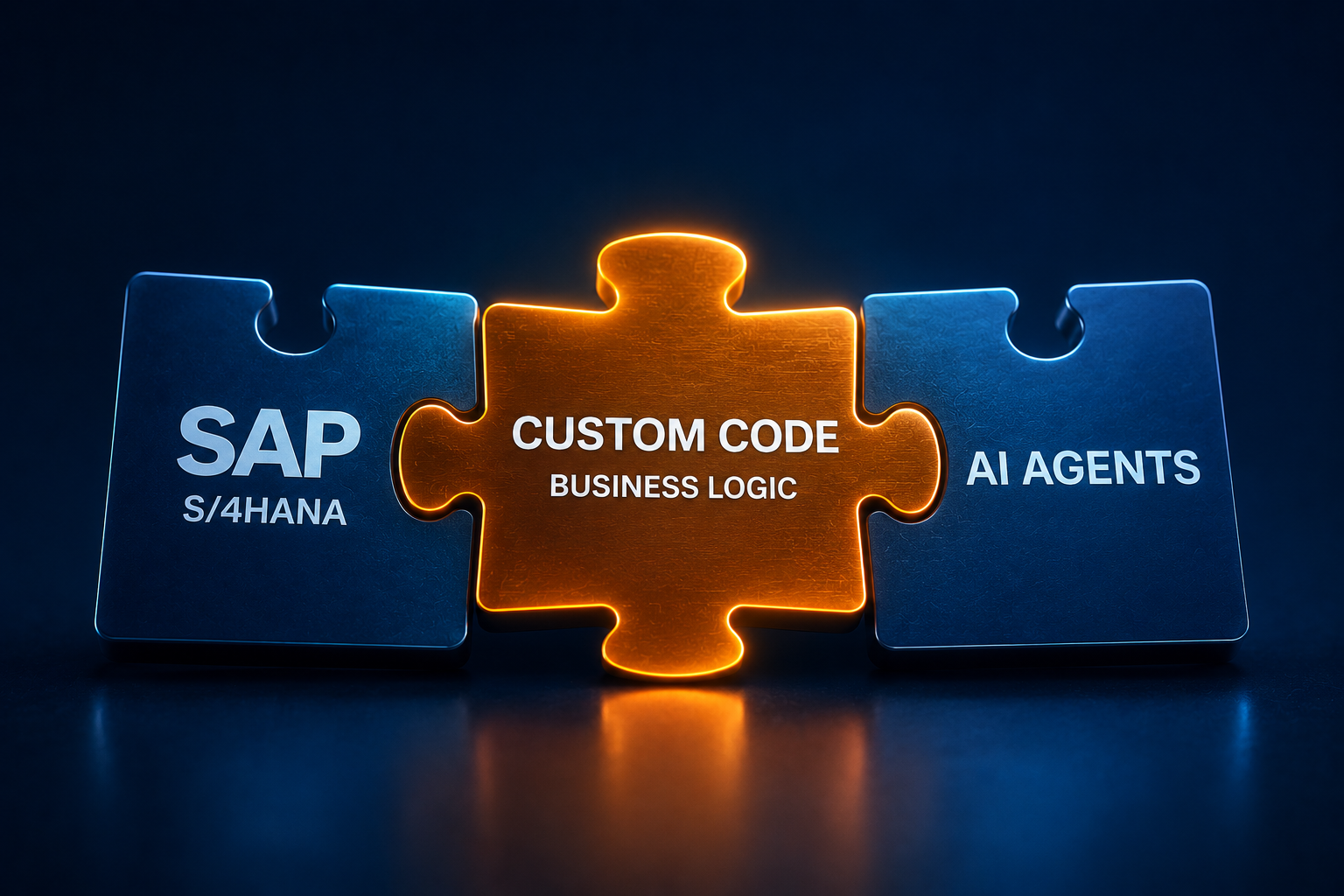
SAP’s AI Agents Signal the Future of S/4HANA Migration. Enterprises Still Need Proven Custom Code Transformation Today
June 29th, 2026
6 min read

SAP’s recent announcement of AI agents for technical migrations points to an important future for enterprise ERP transformation. Automation, AI, and trusted system intelligence will play an increasingly transformative role in helping organizations move faster, reduce risk, and make better use of SAP innovation. For CIOs and enterprise application leaders, the question is how to prepare for that future without underestimating the complexity of today’s SAP environments. Early-stage AI assistance may help teams accelerate specific tasks, but business-critical SAP custom code transformation requires proven automation, full codebase visibility, governed execution, and accountable outcomes.
SAP’s AI Announcement Validates the Need for Automation
For many SAP customers, the path from ECC to SAP S/4HANA is constrained by legacy custom code. Decades of customization have supported processes, integrations, workflows, reports, and industry-specific requirements that standard SAP functionality did not always address at the time.
Those customizations often became business-critical. They also created technical debt, undocumented dependencies, security risks, performance issues, and upgrade barriers.
SAP’s investment in AI agents reflects the growing need for more automation in technical migration work. Technical migration work needs more automation. Manual remediation is too slow and too variable for large enterprises with millions of lines of ABAP code. Teams need better ways to analyze systems, identify risk, prioritize change, and reduce the burden on developers.
That direction underscores the growing role AI-enabled automation will play in SAP technical migration and lifecycle management. The practical question is whether enterprises can rely on early-stage AI assistance alone for work that affects core business operations.
Gartner® states “Assume that SAP’s projected savings are optimistic at best. Evaluate the cost models behind these capabilities. Collaborate with SAP to determine the cost of AI unit consumption and how AI unit consumption impacts your cost-benefit ratio. Understand the technical prerequisites (e.g., the need for SAP Cloud ALM implementation) and their impacts on the supposed benefits” That caution does not reduce the importance of SAP’s AI direction. It reinforces the need to distinguish between emerging AI assistance and proven transformation automation for business-critical SAP environments.
Early-Stage AI Assistance and Proven Transformation Automation Are Different
AI assistance can be useful. Developer assistants can help write code, review code, suggest fixes, produce documentation, and improve productivity. Those capabilities can support individual developers and teams.
Enterprise SAP transformation requires a different level of control.
Custom code transformation is not limited to generating or reviewing code on a per-object basis. Large SAP environments need a full understanding of what exists, what is used, what can be retired, what should be retained and adapted, what needs to be replatformed, and what should be redesigned for the target architecture.
CIOs should evaluate AI migration tools against the full transformation need, including:
- Whether the solution analyzes the entire custom codebase
- Whether it identifies all relevant compatibility, performance, security, stability, and modernization issues
- Whether it accounts for dependencies across objects, applications, interfaces, and business processes
- Whether the output can be trusted without excessive manual validation
- Whether the vendor can commit to fixed timelines, fixed scope, and guaranteed quality
- Whether the approach supports the SAP custom code lifecycle after go-live
A tool that helps developers work faster can create value. A governed automation platform that delivers full-codebase transformation creates a different kind of enterprise value.
Why Custom Code Is Central to the AI-Enabled SAP Future
SAP’s AI future depends on trust. AI-powered insights and automation can only be as reliable as the data, code, and process context that support them.
Legacy custom code complicates that foundation. If customizations are outdated, insecure, poorly documented, tightly coupled to SAP code, or riddled with obsolete logic, enterprises may struggle to confidently take advantage of newer SAP capabilities.
That challenge becomes more important as SAP customers move toward:
- SAP S/4HANA
- Clean core initiatives
- ABAP Cloud readiness
- SAP BTP extensibility
- More frequent upgrade cycles
- AI-enabled business processes
- More automated SAP operating models
Proven custom code transformation gives SAP teams a stronger foundation for using AI-enabled capabilities with confidence.
Enterprises need clean, optimized, well-governed custom code so their SAP environments can keep pace with innovation. Without that foundation, teams may continue to face the same obstacles during every migration, upgrade, security initiative, or modernization program.
What CIOs Should Ask When Evaluating AI Agents for Custom Code
AI migration agents will continue to mature, and enterprises should welcome that progress. CIOs should also ask practical questions before applying early-stage AI assistance to business-critical custom code work.
Key questions include:
- What is the actual scope of analysis?
Does the solution inspect the entire ABAP codebase, or does it focus only on selected objects and high-priority issues? - How much manual validation remains?
If developers must review and validate every recommendation, the expected efficiency gains may shrink quickly. - Can the approach manage scale?
Enterprise SAP systems may contain tens of thousands of custom objects and millions of lines of code. Object-by-object assistance may not be enough. - Does the solution address more than S/4HANA syntax compatibility?
Custom code transformation should also account for performance, security, stability, maintainability, and modernization readiness. - Can the vendor guarantee the outcome?
CIOs need more than a productivity promise. They need confidence in the project timeline, cost, quality, auditability, and business continuity. - What happens after go-live?
Custom code does not stop changing after S/4HANA conversion. Enterprises need an ongoing lifecycle strategy that keeps custom code current, compliant, and ready for future upgrades.
These questions help separate AI interest from transformation confidence.
What Enterprise SAP Teams Should Do Now
Enterprise SAP teams do not need to wait for every AI migration capability to mature before reducing risk. They can start by building a reliable view of the custom code estate, identifying unused code, prioritizing the code that supports critical business processes, and determining which customizations should be retained and adapted, replatformed, redesigned, or retired.
This work gives CIOs a stronger foundation for S/4HANA conversion, clean core progress, ABAP Cloud readiness, and future AI-enabled innovation. It also helps internal teams and implementation partners make better decisions earlier, before project timelines tighten and validation work expands.
Where smartShift Fits
smartShift helps enterprises move from custom code uncertainty to proven transformation outcomes.
smartShift Intelligent Automation® has been developed through decades of SAP transformation experience. The platform is designed to analyze, transform, optimize, decommission, and continuously manage SAP custom code across complex enterprise environments.
smartShift uses AI-powered automation, patented transformation rules, governed execution, and expert validation to deliver predictable results at scale.
smartShift’s approach is built for:
- Full-codebase analysis
- Mass custom code transformation
- S/4HANA compatibility
- HANA performance optimization
- Security, stability, and syntax modernization
- Code decommissioning
- Automated dual maintenance
- ABAP Cloud and clean core readiness
- Ongoing custom code lifecycle management
With smartShift, organizations reduce transformation risk while freeing internal SAP teams to focus on higher-value work.
Proven Outcomes Matter When SAP Systems Run the Business
In large enterprises, SAP custom code often supports finance, manufacturing, supply chain, customer operations, field service, reporting, compliance, and other core processes. Custom code transformation directly affects business continuity because even small errors can disrupt the systems that employees, partners, and customers rely on every day.
That risk is why proof matters.
Kimberly-Clark used smartShift to analyze 5.8 million lines of ABAP custom code within hours and resolve more than 305,000 ABAP coding issues within six weeks, helping the company achieve S/4HANA compatibility and go live one month ahead of schedule.
During the transformation, smartShift Automated Dual Maintenance™ helped Kimberly-Clark continue making changes in its operational ECC system while smartShift compared, merged, and transformed new code across more than 20,000 custom objects to ensure go-live readiness.
These outcomes show why enterprise SAP teams need more than task-level acceleration. They need repeatable, governed transformation across the codebase.
Custom Code Transformation Is a Lifecycle Strategy
The shift toward AI agents also underscores that custom code management is no longer a one-time migration project.
ECC-to-S/4HANA conversion may be the immediate trigger, but the work continues. After conversion, SAP teams still need to manage S/4-to-S/4 upgrades, clean core progress, ABAP Cloud readiness, security requirements, business changes, mergers, carve-outs, and ongoing technical debt reduction.
Treating custom code as a lifecycle discipline helps enterprises avoid repeating the same painful remediation cycle during every major SAP initiative.
A lifecycle approach gives teams:
- Continuous visibility into custom code
- Ongoing modernization guidance
- Safer decommissioning decisions
- Better upgrade readiness
- Lower technical debt
- More predictable transformation planning
- A stronger foundation for AI-enabled SAP innovation
SAP’s AI direction makes this even more important. As SAP environments become more automated and intelligence-driven, the quality of the custom code foundation will become increasingly important.
Conclusion
SAP’s AI agents point toward an important future for S/4HANA migration and enterprise transformation. CIOs should pay attention to that direction and prepare for a more automated, AI-enabled SAP ecosystem. Preparation requires clear judgment about what early-stage assistance can handle today and what business-critical transformation still demands. For custom code, enterprises need proven automation, governed execution, full-codebase visibility, expert validation, and accountable outcomes. smartShift helps organizations build the trusted technical foundation required to move faster today and take advantage of SAP innovation tomorrow.
FAQs
How should enterprises evaluate SAP’s AI agents alongside transformation partners?
SAP’s AI agents may help accelerate parts of the technical migration process over time. Enterprises should evaluate them alongside partner-led transformation capabilities, considering maturity, scope, governance, validation, and accountability. For many customers, transformation partners will remain critical to reducing risk and delivering business-ready outcomes.
What is the difference between AI assistance and transformation automation?
AI assistance helps developers complete tasks faster. Transformation automation applies proven rules, governance, and repeatable execution across the custom codebase. The distinction matters because enterprise SAP programs need predictable outcomes, not only faster individual work.
Why does custom code matter for S/4HANA migration?
Custom ABAP code often supports business-critical processes, reports, workflows, and integrations. During S/4HANA migration, that code must be analyzed to determine what can be retired, what should be retained and adapted, and which customizations need to be replatformed or redesigned so the business can operate reliably after go-live.
How does custom code impact clean core progress?
Unmanaged custom code can create upgrade friction, security risks, performance issues, and tight coupling with SAP standard code. Clean core progress requires organizations to understand what custom code exists, retire what is unused, retain and adapt what still delivers business value, and identify which customizations should be replatformed or redesigned.
How can enterprises reduce risk when using AI for SAP migration?
Enterprises should start with full codebase visibility, assess how much manual validation is required, confirm whether timelines and quality are guaranteed, and use proven automation to remediate, optimize, and modernize custom code as part of an AI-enabled migration strategy.
As the Chief Technology Officer at smartShift, he brings over 25 years of experience in product strategy, SAP applications, and enterprise AI. Previously, he served as SAP's field CTO, where he worked with ISVs and channel partners to align complex technologies with market needs. He has earned multiple accolades, including the SAP Innovation Award (2005). His leadership roles across startups and large enterprises, along with recognition such as the Zinnov Start-up Beacon Award (2014), uniquely position him to drive innovation and growth at smartShift.
Topics: