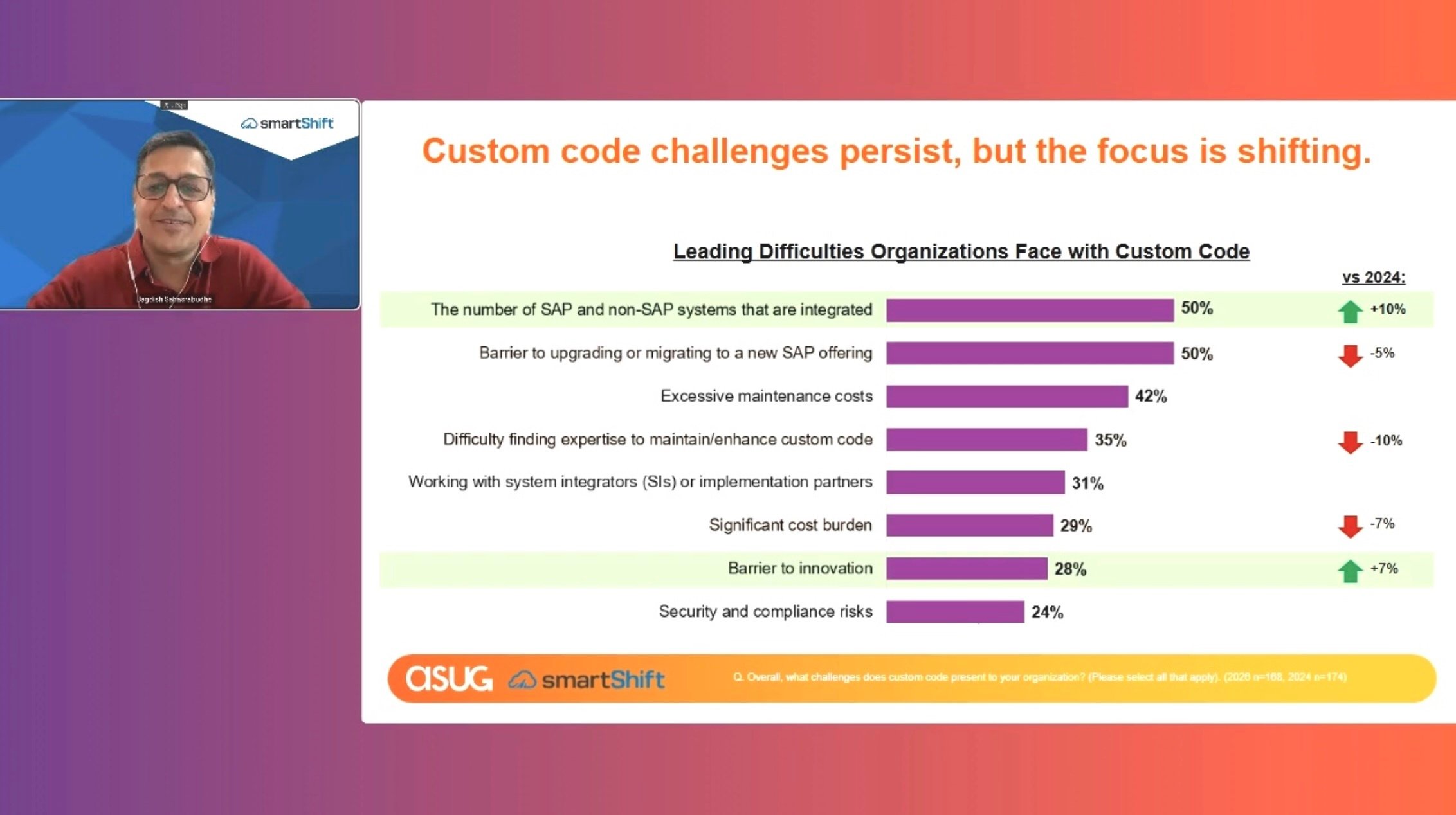
Custom code remains one of the most significant variables in SAP modernization. Organizations must determine what code still delivers value, what creates unnecessary cost and risk, and what should move forward into SAP S/4HANA.
In this on-demand webinar, ASUG Research and smartShift examine new findings on how SAP customers are managing custom code today. The discussion covers custom-code carryover trends, leading SAP S/4HANA migration challenges, Clean Core priorities, and where organizations see opportunities for AI and automation.
You’ll also hear practical perspectives on how SAP teams can reduce complexity without losing the business logic and customizations that support critical operations.
Chief Technology Officer, smartShift
Chief Sales Officer, smartShift
Research Director, ASUG
Learn how global enterprises are reducing custom code complexity, accelerating SAP S/4HANA transformation, and building more maintainable SAP environments.
smartShift helps enterprises analyze, transform, govern, and continuously manage SAP custom code across SAP S/4HANA transformations, Clean Core programs, and future upgrade cycles.
Combining AI-powered automation with deep SAP expertise, smartShift delivers predictable execution, fixed timelines, guaranteed quality, and secure, upgrade-ready custom code.
With more than 3,300 SAP systems modernized and over 4 billion lines of code transformed, smartShift helps organizations protect valuable business logic while reducing the complexity that slows modernization.

Frequently Asked Questions About SAP Custom Code, Clean Core and AI
Clean Core helps SAP AI agents and data services access the customer-specific business logic embedded in custom code. Standard agents may understand standard SAP processes, but they do not automatically have access to custom pricing rules and other proprietary logic. Released APIs and Clean Core-compatible architecture help create the connection these innovations need.
Not exactly. SAP’s agent is already trained, but it may lack the customer- and industry-specific context embedded in your customizations. The custom logic must first be transformed and made accessible so that context can be provided to the agent. This is less about retraining the agent and more about securely connecting it to your business-specific logic.
No. Clean Core does not automatically require moving every customization to SAP BTP. It can include on-stack approaches such as converting older customizations into SAP-approved key-user extensions. More complex developments may be candidates for SAP BTP, but organizations should evaluate each use case and move code selectively.
A high-level count of custom objects will not reveal specific security risks. Identifying those risks requires a detailed code-level assessment. smartShift’s Rapid Code Analysis scans custom code for security, performance, optimization, compliance, and business-related issues, helping organizations understand their exposure before beginning transformation work.
smartShift applies agentic AI to Clean Core use cases such as CDS view transformation. For example, the technology can analyze direct table access, identify an appropriate CDS view, present available options and tradeoffs, and recommend an approach. Similar capabilities can be applied to other Clean Core and custom logic modernization needs.
smartShift provides an ABAP extractor that the customer runs within its SAP environment. The extractor creates an XML representation of the custom code repository, which smartShift uses to perform the analysis and return the findings.
smartShift can provide guidance and recommendations based on its experience working with enterprise SAP custom code. However, it does not currently provide a real-time governance solution that controls code as it is being generated. Its primary focus is analyzing, cleaning, modernizing, and governing the existing custom code landscape.
Yes. Organizations should understand which custom code is active, how it supports business processes, and whether each object should be retired, replaced, remediated, replatformed, or retained. smartShift’s Clean Core Analysis performs this assessment object by object and provides modernization recommendations. It can be delivered as a point-in-time analysis or through an ongoing subscription approach.
No single technology is appropriate for every custom code use case. Generative AI is valuable for creating new code and developing business context, while repeatable automation is better suited to work requiring consistency, security, and predictable outcomes. The webinar recommends a hybrid approach that applies the right form of AI or automation to each use case.
Get the latest insights on S/4HANA, Clean Core, custom code, and AI delivered to your inbox.