
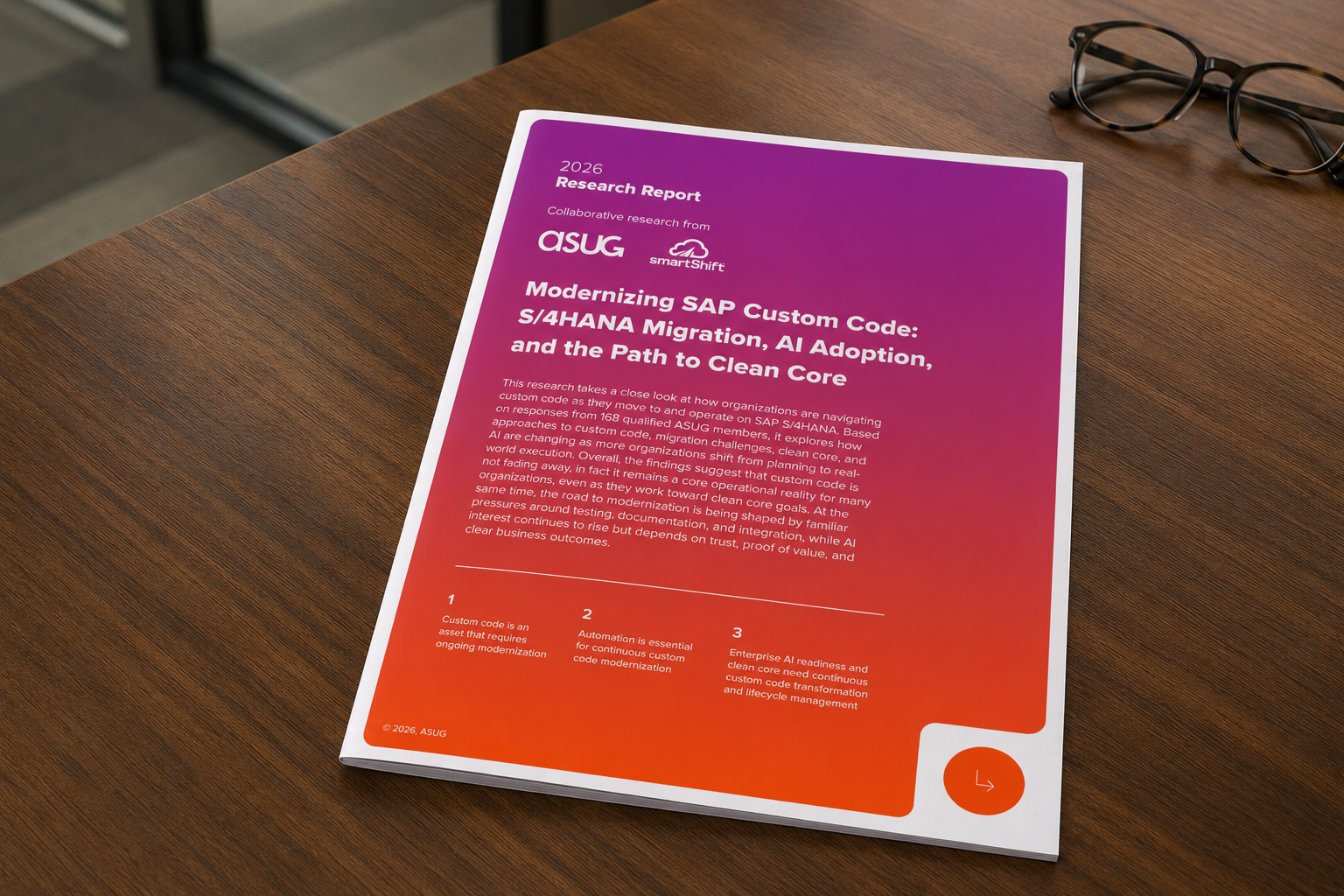
New research from 168 qualified ASUG members reveals how organizations are managing custom code as they migrate to and operate on SAP S/4HANA.
Custom code remains critical to SAP environments, even as organizations move to SAP S/4HANA. New research from ASUG and smartShift examines how SAP teams are managing custom code carryover, migration execution, Clean Core, and AI adoption—and reveals a growing need for continuous modernization and stronger governance after go-live.
See how much custom code organizations expect to carry into SAP S/4HANA—and how much they actually retain.
Understand how testing, poor documentation, integration errors, and underestimated scope affect SAP S/4HANA programs.
Learn why Clean Core remains aspirational for many organizations and what prevents teams from sustaining it after go-live.
See where SAP teams are using AI and automation today and what they require before expanding adoption.
Discover the actions organizations already live on SAP S/4HANA say should begin earlier.
Understand why custom code modernization must continue beyond the initial migration.
Nearly all respondents expect to carry some custom code into SAP S/4HANA. Sixty-four percent expect to retain more than 25% of their existing custom code landscape.
Testing is the most frequently identified custom code migration challenge, followed by poor documentation and integration errors.
Most organizations remain only partially optimized or have not consistently applied the practices required to maintain a Clean Core.
Interest in AI is growing, but adoption depends on trust, demonstrated accuracy, measurable cost reduction, and a clear business case.
Learn how global enterprises are reducing custom code complexity, accelerating SAP S/4HANA transformation, and building more maintainable SAP environments.
smartShift combines AI-powered automation with deep SAP expertise to analyze, transform, govern, and continuously manage custom code. Across more than 3,300 SAP systems and 4 billion lines of code, smartShift delivers predictable execution, fixed timelines, guaranteed quality, and secure, upgrade-ready custom code.
Frequently Asked Questions About SAP Custom Code, Clean Core and AI
The research shows that custom code remains a long-term operational reality. Ninety-two percent of respondents expect to carry custom code into SAP S/4HANA, and 64% expect to retain more than one-quarter of their existing custom code landscape. Organizations need a strategy for continuously modernizing what remains after go-live.
Extensive testing is the most frequently cited challenge, identified by 63% of respondents. Poor documentation follows at 55%, while 45% cite integration errors. Underestimating migration scope, performance issues, and poor code quality create additional pressure on timelines and resources.
Most organizations are not fully prepared. Only 17% report being significantly optimized toward a Clean Core. Another 40% are somewhat optimized, but their Clean Core practices are not consistently applied. The findings reinforce that Clean Core requires ongoing governance and rationalization after migration.
The leading barrier is the need to retain custom code that supports business requirements. Timeline and go-live pressure also force organizations to prioritize immediate migration needs over long-term optimization. Limited governance, executive alignment, and budget create additional barriers.
Organizations are initially applying AI and automation to practical use cases such as syntax corrections, SAP S/4HANA compliance, code decommissioning, legacy code transformation, security, and code synchronization. More advanced uses are expected to grow as organizations gain confidence in the technology.
The research points toward a hybrid approach. Generative AI can help interpret business context and support complex decisions, while deterministic automation provides the consistency, security, and predictability required for large-scale transformation. The right approach depends on the specific custom code use case.
Their leading recommendations are to reduce unnecessary custom code, return to standard SAP functionality where possible, review the existing landscape before migration, and begin planning early. They also emphasize the importance of skilled resources, automation, and thorough testing.
Migration does not eliminate custom code or the business requirements it supports. Code must continue to be governed, rationalized, secured, optimized, and prepared for future SAP releases. Lifecycle management prevents technical debt from rebuilding and helps organizations maintain Clean Core and upgrade readiness.
No single technology is appropriate for every custom code use case. Generative AI is valuable for creating new code and developing business context, while repeatable automation is better suited to work requiring consistency, security, and predictable outcomes. The webinar recommends a hybrid approach that applies the right form of AI or automation to each use case.
Get the latest insights on S/4HANA, Clean Core, custom code, and AI delivered to your inbox.