
Forrester Consulting interviewed five smartShift customers and modeled their results. The composite organization reached payback in under six months and completed its SAP S/4HANA transformation six months sooner.
SAP ECC mainstream support ends in 2027, and most SAP customers are carrying large volumes of custom code into SAP S/4HANA. Remediating that code manually can consume tens of thousands of developer hours, stretch timelines, and raise the risk of business disruption.
smartShift commissioned Forrester Consulting to measure what automation changes. Forrester built a composite organization with $60 billion in revenue, 150,000 custom ABAP objects, and 7 million lines of custom code, then modeled its costs, benefits, and risks over three years.
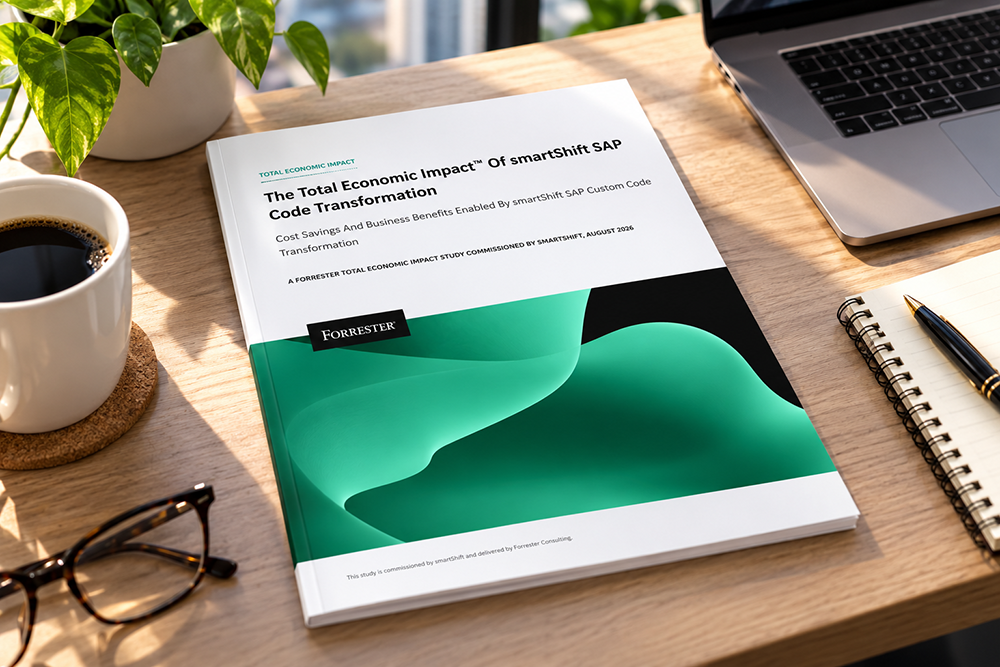
See how Forrester arrived at 254% ROI, $10.5M in net present value, and payback in under six months.
Understand how many developer hours manual custom code remediation would have required, and what avoiding them was worth.
Learn how the composite identified 25% of its custom code as unused or redundant and avoided $3.5M in ongoing maintenance.
See how Dual Maintenance reduced the developer effort required to keep ECC and S/4HANA in sync by 30%.
Find out how removing the custom code bottleneck accelerated the S/4HANA transformation by six months.
Hear how customers used code visibility, standardization, and decommissioning to move closer to a Clean Core.
The composite organization realized $14.6M in benefits against $4.1M in costs over three years.
Benefits outpaced the full investment within the first half of year one.
Automation replaced up to 99,840 developer hours of manual custom code remediation in year one alone.
Removing the custom code bottleneck pulled forward the transformation and $1.1M in legacy infrastructure savings.
Learn how global enterprises are reducing custom code complexity, accelerating SAP S/4HANA transformation, and building more maintainable SAP environments.
smartShift combines AI-powered automation with deep SAP expertise to analyze, transform, govern, and continuously manage custom code. Across more than 3,300 SAP systems and 4 billion lines of code, smartShift delivers predictable execution, fixed timelines, guaranteed quality, and secure, upgrade-ready custom code.
Frequently Asked Questions About the Forrester TEI Study
TEI is Forrester’s methodology for measuring the financial impact of a technology investment. It weighs benefits, costs, flexibility, and risk, then calculates ROI, net present value, and payback. This study was commissioned by smartShift and conducted by Forrester Consulting, which maintained editorial control over its findings.
Forrester interviewed five decision-makers at organizations in food and beverage, grocery, manufacturing, and retail. It combined their experiences into a composite organization with $60 billion in revenue, 150,000 custom ABAP objects, and 7 million lines of custom code. Benefits and costs were risk-adjusted and discounted at 10% over three years.
254% ROI over three years, with $14.6M in benefits, $4.1M in costs, $10.5M in net present value, and payback in under six months.
Avoided manual remediation was the biggest driver at $8.3M. Without smartShift, the composite would have needed more than 60 ABAP developers in year one dedicated largely to custom code remediation.
The composite identified 25% of its custom code as unused or redundant and decommissioned it, avoiding $3.5M in maintenance and support over three years. One interviewee found more than 31% of its custom code was unused.
During an ECC to S/4HANA transformation, both systems run in parallel and changes in ECC must carry into S/4HANA. Dual Maintenance reduced the developer effort for that work by 30% across a 12-month period, worth $974K. Teams kept delivering business enhancements during the transformation instead of pausing them.
Six months. Manual remediation was no longer the bottleneck for other transformation work, which pulled forward $1.1M in legacy on-premises infrastructure savings.
Every interviewee said the code visibility, standardization, and decommissioning from the work with smartShift moved them closer to a Clean Core. One grocery customer said that when SAP began the Clean Core conversation, they felt they had already started.
Get the latest insights on S/4HANA, Clean Core, custom code, and AI delivered to your inbox.